



Government plans ‘smart hospital system’ with AI managing entire patient journey
Sep 10, 2026, 09:23 am


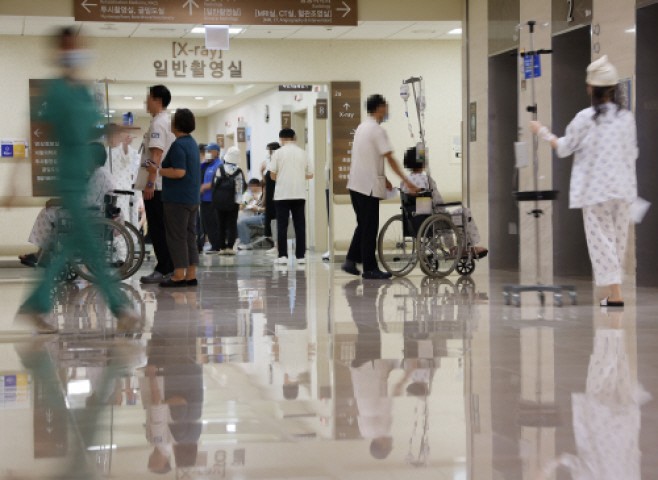 |
| Medical personnel and patients move through a university hospital. / Yonhap |
Amid the across-the-board proliferation of artificial intelligence (AI) technology, the government is accelerating the establishment of next-generation hospital systems. The initiative aims to drive an AI transition across the domestic healthcare sector by establishing AI services encompassing the entire patient journey from initial visit to discharge. Plans are also underway to devise countermeasures against potential risk factors that may arise during system construction and operation, such as data confusion and personal data privacy concerns.
According to the Ministry of Health and Welfare on the 9th, its affiliated Korea Health Industry Development Institute (KHIDI) is opening bids through the 18th for the "AI Native Hospital Information System (AI Native HIS) Planning" project. Earlier in July, the ministry announced its Basic Healthcare AI Strategy, under which it revealed plans to pursue the development of next-generation hospital information systems.
Targeting shared adoption across national university hospitals nationwide, the core of the system lies in redesigning overall in-hospital medical services—including consultations, nursing, surgery, and administration—on an AI foundation. Expanding the scope of AI utilization beyond traditional consultations and administrative tasks to the broader patient experience is expected to facilitate more efficient hospital operations and patient management. Furthermore, the project is viewed as a key initiative to bridge regional AI service disparities ahead of the Public Healthcare AI Highway the government seeks to construct.
Under this project, authorities will begin by defining the scope of AI support across every stage of the patient experience—from visits and clinical care to medication administration and discharge—while surveying and benchmarking comparable overseas models, including China's AI hospitals and the U.S. platforms Epic and Oracle Health.
In addition, the initiative will devise ways to apply specialized Agent AI to specific domains such as medical administration and medical imaging interpretation, followed by designing an integrated Agent AI conceptual architecture applicable hospital-wide. Through this process, planners intend to map out patient-specific optimized care pathway frameworks.
Establishing an operational framework to ensure smooth implementation across targeted national university hospitals nationwide serves as another core objective of the project. To this end, the project will derive modular concepts and technical standards intended for nationwide expansion, while evaluating data and communications standards to enable inter-hospital communication among Agent AIs.
The project will also project the expenses required to build a nationwide intelligent information system and identify associated challenges. Specifically, it plans to formulate an annual implementation roadmap from the second half of this year through 2030, estimate required budgets across phases 1 and 2, and further analyze risk factors and management measures arising from the initiative, such as data security and Medical Service Act regulatory issues.
An official from the KHIDI explained: "This planning study was designed to verify the investment feasibility of the AI Native Hospital Information System and achieve key objectives, including mapping out a phased implementation roadmap and designing shared-use strategies for an expandable deployment model."
Seo Byung-joo
Most Read
-
1
Celltrion’s Omlyclo gains ground in major European..

-
2
Trump demands rates fall below 1% as Fed hikes for..

-
3
Hyundai Motor Group breaks ground on integrated st..

-
4
U.S. strikes 3 Iranian oil tankers, Iran vows reta..

-
5
Trump makes $1 trillion bet ahead of midterm elect..

-
6
Iran resumes ballistic missile production, assembl..

-
7
Samsung Electronics, Mistral AI to jointly develop..

PEOPLE







-
Address : In-Young Bldg., 34, Uisadang-daero 1-gil, Yeongdeungpo-gu, Seoul
Copyright by ASIATODAY CO., LTD. All rights resereved