



Lee turns to domestic agenda after overseas trip as key week looms
Sep 10, 2026, 09:08 am


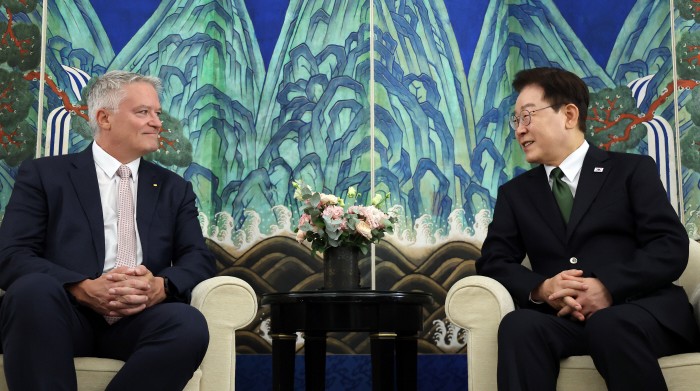 |
| President Lee Jae-myung meets with Mathias Cormann, Secretary-General of the Organisation for Economic Co-operation and Development (OECD), at a hotel in Paris, France, on the 9th (local time). / Yonhap News |
President Lee Jae-myung, returning home on the 10th after concluding his state visit to France, faces a backlog of major pending issues, including controversies over ministerial nominees, a requested re-recommendation for a Supreme Court justice, and South Korea's response to the Strait of Hormuz crisis. With personnel, judicial, and security issues converging at a time when he must translate the diplomatic achievements of the tour into domestic political momentum, he faces a fateful week immediately upon his return.
According to Cheong Wa Dae and political circles on the 9th, one of the most pressing tasks is naming a successor to former chief presidential secretary for policy Kim Yong-beom. The new policy chief will act as the control tower coordinating core economic issues, such as the three mega-projects, real estate policy, and trade with the U.S.
On the 14th, four days after his return, a full-fledged round of confirmation hearings will begin. Hearings will start with Supreme Court justice nominee Kim Sung-soo, followed on the 15th by Deputy Prime Minister and Minister of Economy and Finance nominee Lee Hyoung-il, Minister of Justice nominee Kim Seung-won, and Minister of SMEs and Startups nominee Lee So-young. On the 16th, hearings are scheduled for Minister of National Defense nominee Kang Shin-chul and Minister of Land, Infrastructure and Transport nominee Hong Ji-sun.
In particular, with controversies surrounding nominees Kim Seung-won and Yong Hye-in escalating during the presidential tour, keen attention is focused on President Lee's judgment following his return. Opposition forces, including the People Power Party, are stepping up their offensive, citing allegations that Kim improperly solicited approval for clinical drug trials. Although the Democratic Party of Korea is vigorously defending both nominees, Cheong Wa Dae's personnel plans could face unexpected complications if public indignation fails to subside.
Managing relations with the judiciary is another task requiring resolution. On the 28th of last month, Cheong Wa Dae refrained from submitting the appointment consent motion for Supreme Court justice nominee Sohn Bong-gi to the National Assembly, instead requesting a re-recommendation from Chief Justice Cho Hee-dae. Depending on whether and when a new recommendation is made, the prolonged vacancy on the bench could rekindle tensions between Cheong Wa Dae and the judiciary.
Determining the mode of contribution in the Strait of Hormuz is another security issue that demands a conclusion following his return. While President Lee and French President Emmanuel Macron affirmed plans to collaborate on freedom of navigation and supply chain stability, specific modes of contribution were left undecided. An on-site fact-finding team dispatched by the Ministry of National Defense to the United Arab Emirates (UAE) is scheduled to return as early as this week to report its findings to the National Security Council (NSC).
For President Lee, the situation calls for parlaying the trip's diplomatic gains into a turnaround in domestic politics. At a juncture requiring a rebound in approval ratings, how he navigates personnel disputes, judicial friction, and the Hormuz response will likely determine the momentum of state affairs in his second year in office.
Park Young-hoon
Most Read
-
1
Celltrion’s Omlyclo gains ground in major European..

-
2
Trump demands rates fall below 1% as Fed hikes for..

-
3
Hyundai Motor Group breaks ground on integrated st..

-
4
U.S. strikes 3 Iranian oil tankers, Iran vows reta..

-
5
Trump makes $1 trillion bet ahead of midterm elect..

-
6
Iran resumes ballistic missile production, assembl..

-
7
Samsung Electronics, Mistral AI to jointly develop..

PEOPLE






-
Address : In-Young Bldg., 34, Uisadang-daero 1-gil, Yeongdeungpo-gu, Seoul
Copyright by ASIATODAY CO., LTD. All rights resereved