



N. Korea and Russia open Tumen River road bridge, paving way for expanded trade and exchanges
Sep 09, 2026, 09:18 am


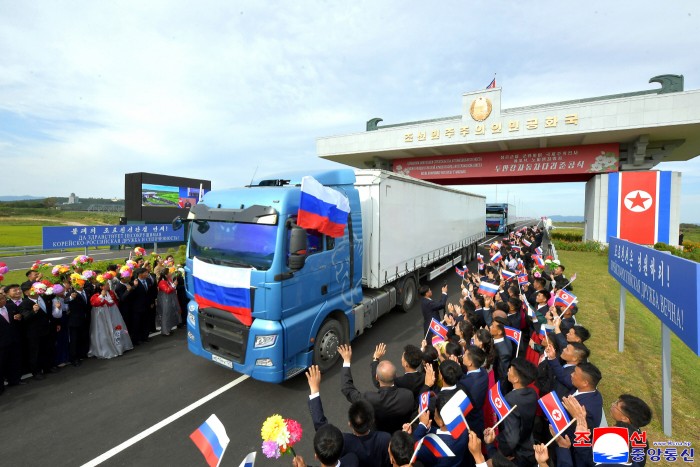 |
| The Korean Central News Agency reported on the 8th that a road bridge across the Tumen River connecting North Korea's border city of Rason and Khasan, Russia, has been successfully completed and inaugurated. / Yonhap News |
The opening of a new road bridge across the Tumen River connecting North Korea and Russia is expected to significantly boost the movement of goods and people between the two nations. The rapid completion of the bridge—which broke ground in April of last year following an agreement reached at a bilateral summit in June 2024 and opened in just about a year and four months—stands in sharp contrast to the New Yalu River Bridge between North Korea and China, which has remained unopened for over a decade.
North Korean media reported on the 8th that a completion ceremony was held following the finishing of the Tumen River road bridge linking the border cities of Rason in North Korea and Khasan in Russia. State media noted that the bridge will revitalize multifaceted bilateral cooperation, including personnel exchanges, tourism, and the distribution of commercial goods.
Meeting with reporters on the same day, a South Korean Ministry of Unification official stated, "This demonstrates the development of the comprehensive partnership between North Korea and Russia while providing the physical infrastructure to expand their exchanges of people and goods." The official added that the ministry will closely monitor related developments moving forward.
Experts project that complementing the existing bilateral rail connection with the new road bridge will generate tangible economic benefits by reducing logistics costs and transit times between the two countries.
While rail transport is constrained by rigid scheduling, turnaround logistics, and the need for cargo transshipment or wheel bogie exchanges due to different rail gauges between North Korea and Russia, roadways offer the operational advantage of on-demand cargo dispatch and direct point-to-point transit from the border to final destinations.
Joung Eunlee, head of the North Korea Research Division at the Korea Institute for National Unification (KINU), analyzed, "The construction of the new road bridge indicates a growing demand for the movement of goods and personnel in forms distinct from rail transit. It enables just-in-time delivery and flexible inventory management, which is particularly advantageous for expanding trade in time-sensitive items like fresh produce and component parts."
Furthermore, travel for tourism and civilian labor via buses and passenger vehicles is expected to become far more flexible than by rail. Analysts observe that this provides Pyongyang with a solid springboard to broaden the scope of its cooperation with Moscow across various sectors, including human exchanges, tourism, and cargo distribution.
From another angle, analysts point out that the opening of the cross-border road bridge complicates the trilateral dynamics among North Korea, China, and Russia while elevating Pyongyang's geopolitical leverage. As Beijing faces higher hurdles in securing direct maritime access to the East Sea through the lower reaches of the Tumen River, North Korea may stand to reap economic windfall benefits.
"In a structure where China cannot navigate the Tumen River directly and must rely on nearby ports such as North Korea's Rajin Port, North Korea's geographic location and its harbors hold intrinsic economic value," Joung noted. "North Korea has little incentive to grant China direct sea access at the expense of giving up the economic gains it derives from port usage and logistics handling."
Indeed, during their recent summit, the leaders of China and Russia agreed to continue consultations with North Korea regarding the passage of Chinese vessels through the lower Tumen River. This underscores that Beijing and Moscow cannot unilaterally resolve the sea-access issue on their own.
"The Tumen River road bridge illustrates that trilateral relations among North Korea, China, and Russia cannot be framed simply as straightforward cooperation or rivalry," Joung analyzed. "While the three countries share common strategic interests at a macro level, each pursues divergent national interests and priorities on individual projects, coordinating their differing stakes within manageable boundaries."
Joung added, "Recently, North Korea has signaled an openness to pursue international cooperation insofar as it aligns with its national security and concrete national interests. To formulate effective North Korea policies, it is necessary to view Pyongyang not merely as a political or ideological actor, but as a pragmatic player that cooperates selectively based on specific interests and material benefits."
Mok Yong-jae
Most Read
-
1
Celltrion’s Omlyclo gains ground in major European..

-
2
Trump demands rates fall below 1% as Fed hikes for..

-
3
Hyundai Motor Group breaks ground on integrated st..

-
4
U.S. strikes 3 Iranian oil tankers, Iran vows reta..

-
5
Trump makes $1 trillion bet ahead of midterm elect..

-
6
Iran resumes ballistic missile production, assembl..

-
7
Samsung Electronics, Mistral AI to jointly develop..

PEOPLE







-
Address : In-Young Bldg., 34, Uisadang-daero 1-gil, Yeongdeungpo-gu, Seoul
Copyright by ASIATODAY CO., LTD. All rights resereved