



August exports hit 98.25 billion U.S. dollars, ranking third-highest in history
Sep 01, 2026, 10:01 am


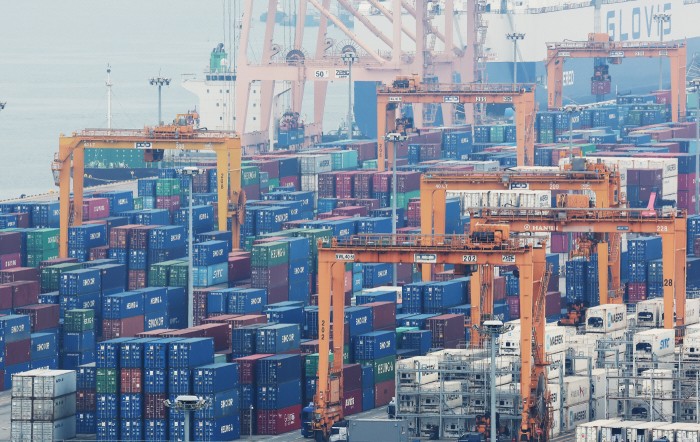 |
| Containers stacked at Pyeongtaek Port in Gyeonggi Province. / Yonhap |
South Korea's exports last month neared 98.3 billion U.S. dollars, buoyed by the semiconductor boom, recording the third-highest performance in history. Semiconductor exports hit an all-time monthly high of 46.7 billion U.S. dollars, accounting for nearly half of total exports.
The Ministry of Trade, Industry and Energy announced on the 1st that exports in August surged 68.7% year-on-year to 98.25 billion U.S. dollars.
In the all-time monthly export rankings, this marks the third-highest figure, following 102.0 billion U.S. dollars in June and 99.0 billion U.S. dollars in July. Factoring in working days, the daily average export volume reached 4.47 billion U.S. dollars, the second-highest level on record.
Imports rose 22.5% to 63.51 billion U.S. dollars, resulting in a trade surplus of 34.75 billion U.S. dollars and maintaining a surplus exceeding 30 billion U.S. dollars for the third consecutive month. The cumulative trade surplus from January to August reached 202.5 billion U.S. dollars, up 162.2 billion U.S. dollars compared to the same period last year.
At the center of this export momentum were semiconductors. Semiconductor exports surged 209% year-on-year to 46.65 billion U.S. dollars, breaking the all-time high record. They have surpassed 40 billion U.S. dollars for three straight months.
This was driven by sustained demand for chips, particularly High Bandwidth Memory (HBM), in line with expanded artificial intelligence (AI) infrastructure investments by global big tech companies such as Google and Amazon.
Exports of non-semiconductor items also grew 20% compared to the same month last year. Computer exports surged 419.5% to 6.24 billion U.S. dollars on the back of demand for enterprise SSDs and rising NAND flash prices, setting a new monthly record.
Petroleum products and petrochemical exports also increased by 65.3% and 12.2%, respectively. Rising oil prices caused by transit instability in the Strait of Hormuz drove up export unit prices. However, actual shipment volumes declined, suggesting that the increase was primarily driven by price effects.
Secondary battery exports grew 24%, continuing an upward trajectory for four consecutive months, fueled by the rebound in mineral prices including lithium, expanding orders for new electric vehicle products, and revitalized energy storage system (ESS) markets.
Conversely, automobile exports fell 29.8% to 3.85 billion U.S. dollars. This was impacted by base effects resulting from major automakers shifting their summer vacation period from late July last year to early August this year, alongside production disruptions due to partial strikes.
By region, exports to China and the U.S. showed sharp increases. Exports to China surged 119.3% to 24.1 billion U.S. dollars, while shipments to the U.S. rose 89.3% to 16.5 billion U.S. dollars. Exports to ASEAN countries increased 75.4% to 19.09 billion U.S. dollars, posting the highest-ever performance for the month of August. In contrast, exports to the Middle East and the CIS regions fell 15% and 25%, respectively.
Minister Kim Jung-kwan stated, "Uncertainties in the trade environment confronting our businesses are higher than ever, driven by the tightening of protectionism across major economies, such as U.S. tariff policies and the EU's tariff-rate quotas (TRQ)." He added, "The government will not become complacent with current export momentum and will closely monitor the impact that trade environment shifts have on our companies' exports."
Kim Jeong-gyu
Most Read
-
1
Celltrion nears additional contract with major U.S..

-
2
Putin proposes trilateral U.S.-China-Russia summit..

-
3
U.S. weighs dropping MOAB, world's most powerful n..

-
4
"Aren't those foreigners on welfare?": M..

-
5
Attention centers on APEC for possible Trump-Xi-Pu..

-
6
Saudi Arabia, Iran hold first diplomatic talks to..

-
7
China tightens grip on boosting domestic demand an..

PEOPLE







-
Address : In-Young Bldg., 34, Uisadang-daero 1-gil, Yeongdeungpo-gu, Seoul
Copyright by ASIATODAY CO., LTD. All rights resereved