



To Lam's operation for Vietnam's 10% growth
Sep 01, 2026, 10:24 am


 |
| Includes images created with generative AI. |
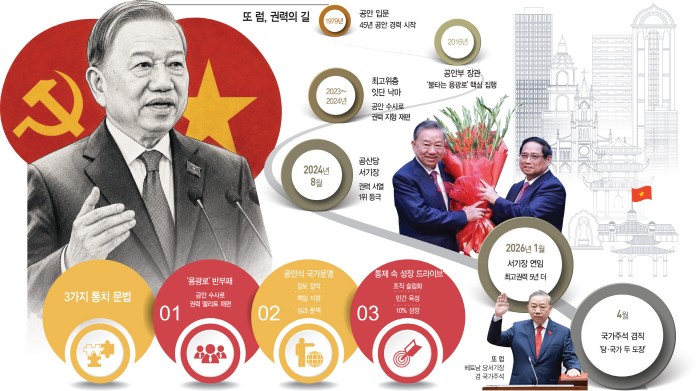
Having spent 45 years in public security, To Lam has ascended to the pinnacle of Vietnamese power. Following his rise to General Secretary of the Communist Party last year, he took on the state presidency once again this year, simultaneously seizing the supreme power of both the party and the state. He has transformed from a public security bureaucrat into the supreme leader reshaping Vietnam's power structure.
To Lam's governance is epitomized by strong control and swift execution. After ascending to General Secretary, he reorganized state structures from the ground up, reducing central government departments and massively consolidating local administrative districts. He is also applying an approach across state affairs where objectives are set, specific personnel are held accountable, and outcomes are rigorously verified.
This approach was evident during a video conference between central government and local authorities held in Hanoi on July 4. Despite reports that gross domestic product (GDP) grew 8.18% in the first half of the year, To Lam reiterated an annual 10% growth target and ordered a "special action plan" defining responsible officials, accountability, and deadlines for each task. What he now demands in the economy is rapid results.
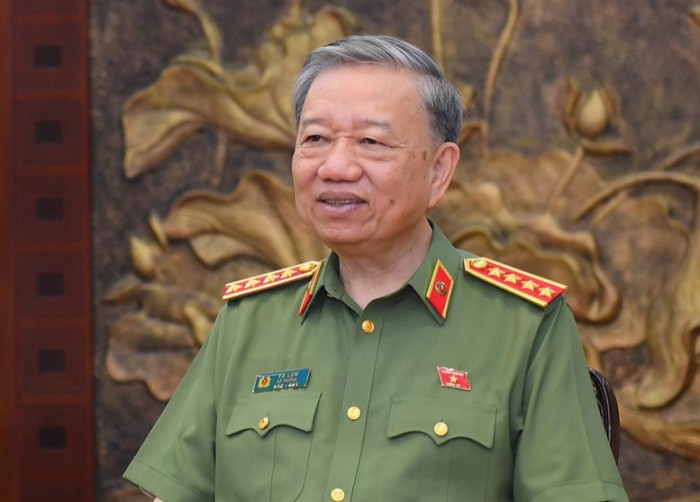 |
| To Lam during his tenure as Minister of Public Security in 2023. / Vietnam Government Portal |
45 years in public security, power door opened by the furnace
To Lam was born in 1957 in Hung Yen Province in northern Vietnam. After graduating from the People's Police Academy, he entered the public security apparatus in 1979. He rose to Vice Minister of Public Security in 2010 and Minister in 2016, dedicating 45 years to public security until stepping down from the ministerial post in 2024. Within this massive apparatus overseeing domestic security, intelligence, criminal investigations, immigration, and cybersecurity, he mastered how to run an organization by commanding intelligence and personnel while holding subordinates strictly accountable.
The decisive factor that expanded his political stature was the anti-corruption drive led by the late former General Secretary Nguyen Phu Trong, known as the "Blazing Furnace." As head of the Ministry of Public Security, To Lam was the key enforcer of the anti-corruption crackdown, investigating corruption allegations and arresting and prosecuting high-ranking figures. Between 2023 and 2024, top-level leaders stepped down one after another, including two state presidents and the National Assembly chairman. As public security investigations became the central conduit for realigning power, the political standing of To Lam, who oversaw the enforcement, grew exponentially.
The "furnace" also produced side effects. Bureaucrats delayed decisions out of fear that proactive approvals could invite legal risks, causing bottlenecks across various projects and administrative procedures. Upon rising to General Secretary, To Lam maintained his anti-corruption stance while emphasizing protection for "cadres who act boldly for the public interest." Moving beyond punishing corruption, his message is to hold accountable bureaucrats who fail to deliver results.
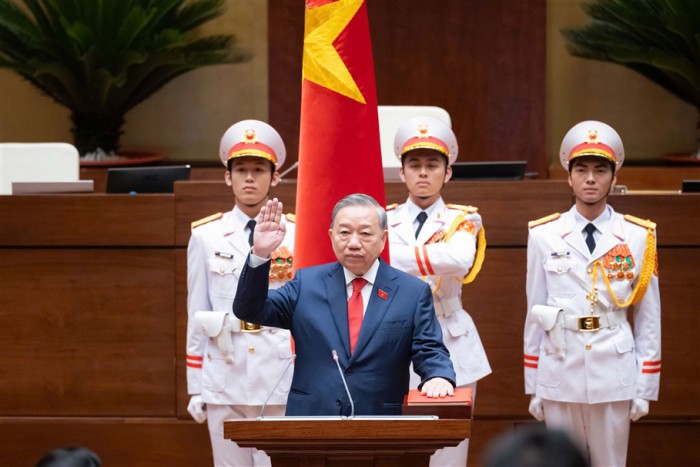 |
| General Secretary To Lam, elected as Vietnam's state president last April, takes the oath of office at the National Assembly. / National Assembly of Vietnam |
Reorganizing state apparatus and holding both seals
To Lam was elected state president in May 2024, and following the death of General Secretary Trong, he rose to General Secretary—the top post in the power hierarchy—in August of the same year. After transferring the presidency to Luong Cuong in October, he defined the streamlining and professionalization of the political system's apparatus as a "revolution" a month later.
The blueprint had already been outlined in Resolution 18 of the Party Central Committee in 2017. However, it was To Lam who elevated the restructuring—which had struggled to gain traction for years—to the nation's top priority, aggressively pushing it forward simultaneously at both the central and local levels.
In 2025, the central government was downsized from 18 ministries and four ministerial-level agencies to 14 ministries and three ministerial-level agencies. The local administrative network was also consolidated from 63 provinces and centrally run cities to 34, while the district level was eliminated. It is a structure designed to shorten command lines by stripping away intermediary layers and hold agency heads and local chiefs directly accountable for outcomes. The swift command and execution style To Lam had honed since his public security days was thus reflected in the national structural overhaul.
Having reorganized the state apparatus, To Lam secured a consecutive term as General Secretary at the 14th National Congress last January, and was subsequently re-elected as state president in April. Consequently, he has come to hold the supreme seals of both the party and the state simultaneously for the next five years.
Vietnam has long maintained a collective leadership structure where power is shared among the "four pillars": the General Secretary, State President, Prime Minister, and National Assembly Chairman. While there have been precedents of one individual holding both the general secretaryship and the presidency, To Lam is the first leader since founding father Ho Chi Minh to launch a concurrent leadership model right from the beginning of a new leadership tenure. Given that the consensus-based structures of the Politburo and the Party Central Committee remain intact, this cannot be viewed as a Chinese-style one-man rule. Nevertheless, power has undeniably concentrated in To Lam to an extent rarely seen in recent decades.
Holding consolidated power, challenging 10% growth
Backed by this concentrated authority, the next objective To Lam has set forth is an annual average growth rate of 10%. Since taking office as General Secretary, he has consecutively issued Politburo Resolution 57, which emphasizes science, technology, innovation, and digital transformation, and Resolution 68, which defines the private economy as the "most important driving force of the national economy."
At the 14th National Congress, an annual average gross domestic product (GDP) growth rate of "at least 10%" for the 2026–2030 period was officially adopted as a national target. The vision is to break away from the growth model reliant on low-wage labor and multinational processing/assembly exports, fostering technological innovation and domestic enterprises instead.
However, while strong authority can expedite approvals, it cannot command productivity and innovation. If the boundaries of anti-corruption enforcement remain blurred, bureaucrats may once again shy away from making decisions; furthermore, if private enterprise support devolves into preferential treatment for specific corporations, the very foundation of growth could be destabilized. This is precisely why predictable rules and internal checks and balances are just as crucial as swift execution.
Having risen to become a rare "strongman" in Vietnam's modern history through anti-corruption crackdowns and national organizational restructuring, what now remains for To Lam is tangible results. His ultimate success or failure hinges on whether he can translate this concentrated power into actual economic growth.
Jeong Ri-na
Most Read
-
1
Celltrion nears additional contract with major U.S..

-
2
Putin proposes trilateral U.S.-China-Russia summit..

-
3
U.S. weighs dropping MOAB, world's most powerful n..

-
4
"Aren't those foreigners on welfare?": M..

-
5
Attention centers on APEC for possible Trump-Xi-Pu..

-
6
Saudi Arabia, Iran hold first diplomatic talks to..

-
7
Saudi airport in Riyadh struck again, leaving at l..

PEOPLE







-
Address : In-Young Bldg., 34, Uisadang-daero 1-gil, Yeongdeungpo-gu, Seoul
Copyright by ASIATODAY CO., LTD. All rights resereved