



China eyes 1970s generation amid Xi Jinping's prolonged rule
Sep 01, 2026, 10:18 am


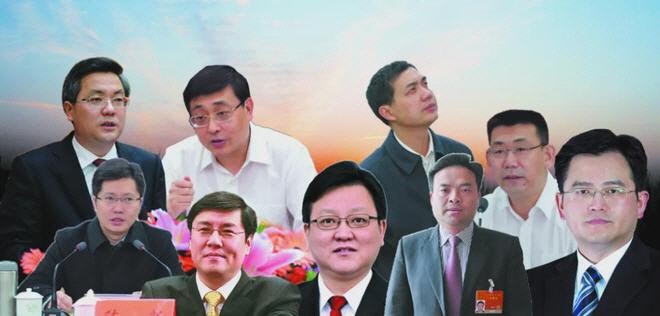 |
| Chinese politicians born in the 1970s of the last century. / Xinhua News Agency |
With General Secretary and State President Xi Jinping all but certain to secure a fourth consecutive term as General Secretary at the 21st National Congress of the Chinese Communist Party (held every five years) set to open in October next year, the era of the "Qilinghou" (those born in the 1970s of the last century) is seen as imminent in Chinese politics due to his prolonged rule. It also appears likely that his successor, or the future top leader, will emerge from this group.
According to Beijing sources well-versed in Chinese political information on the 31st, China had treated a two-term limit for top party and government leaders virtually as an unwritten rule since the 1990s. Until March 2018, a legal mechanism restricting state presidents to no more than two consecutive terms was also set in the constitution. Considering the reality that the late Jiang Zemin and former General Secretary and President Hu Jintao (85) stepped down after serving exactly two terms, this was indeed how it functioned.
However, the narrative shifted dramatically when Xi, with his pronounced strongman disposition, succeeded Hu Jintao as General Secretary at the 18th National Congress in November 2012. Concerns were raised as to whether the principle barring a third consecutive term for the top leader would hold, given his tendencies and the prevailing atmosphere.
Sure enough, the first session of the 11th Two Sessions (the National People's Congress and the Chinese People's Political Consultative Conference, or NPC and CPPCC) in March 2018 actually went so far as to abolish the presidential two-consecutive-term limit through a constitutional amendment. Since the position of General Secretary—the top ranking post in party and state power—held no term-limit provisions, it could effectively be said that the path to President Xi's long-term rule had naturally opened.
Given the current political atmosphere, he is highly likely to secure even a fifth term. In that scenario, he would remain in power until 2037. If so, considering age and other factors, it becomes nearly impossible for a successor group to emerge from the "Liulinghou" (those born in the 1960s). This is clearly the case, as even the youngest among the Liulinghou will reach the age of 70 by then. Like it or not, the Qilinghou, who are currently under 60, are bound to rise as successors.
Perhaps for this reason, though it may seem somewhat premature, numerous figures among the Qilinghou are being mentioned. The most prominent figure appears to be Zhu Zhongming, Deputy Party Secretary born in 1972, who was recently nominated as the Mayor of Shanghai. According to Hong Kong's Ming Pao and other outlets on the 31st, he was reportedly promoted and nominated as Mayor of Shanghai at a recent meeting of the Political Bureau of the Central Committee.
He was born in 1972 in Haining, Zhejiang Province, not far from Shanghai. In Shanghai, he is well known as a bureaucrat who built his career in the economic and financial sectors. His resume is formidable, having served as Vice Governor of Hunan Province and Vice Minister of Finance in the central government before rising to Deputy Party Secretary of Shanghai in 2024.
Liu Hongjian (54), Deputy Party Secretary of Yunnan Province who concurrently serves as Party Secretary of Kunming, must also be mentioned. He is known as a future leader on President Xi's radar. Liu Jie (56), Acting Governor of Zhejiang Province, should also be counted among them. Alongside Deputy Secretary Liu, he is widely recognized as a front-runner in the "post-Xi Jinping" group. In addition, A Dong (56), First Secretary of the Communist Youth League (CYLC), cannot be overlooked. He is called a future political hope who will engage in healthy competition with Deputy Secretary Liu. It is safe to say that the era of the Qilinghou is firmly opening in Chinese politics.
Hong Soon-do
Most Read
-
1
Celltrion nears additional contract with major U.S..

-
2
Putin proposes trilateral U.S.-China-Russia summit..

-
3
U.S. weighs dropping MOAB, world's most powerful n..

-
4
"Aren't those foreigners on welfare?": M..

-
5
Attention centers on APEC for possible Trump-Xi-Pu..

-
6
Saudi Arabia, Iran hold first diplomatic talks to..

-
7
Saudi airport in Riyadh struck again, leaving at l..

PEOPLE




-
Address : In-Young Bldg., 34, Uisadang-daero 1-gil, Yeongdeungpo-gu, Seoul
Copyright by ASIATODAY CO., LTD. All rights resereved