



Iceland rejects EU accession, expands security partnerships
Sep 01, 2026, 10:26 am


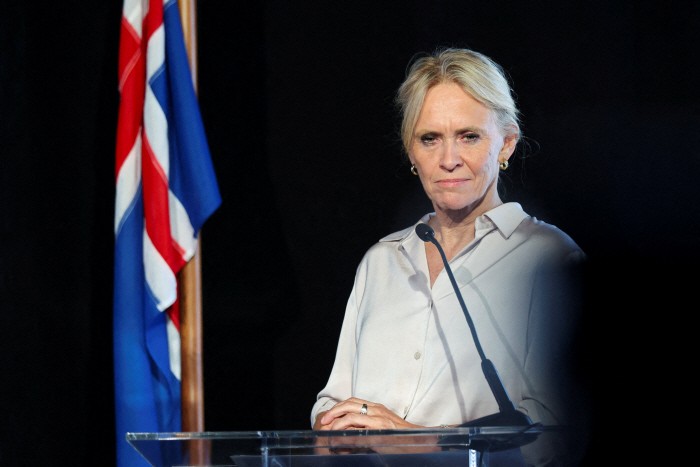 |
| Icelandic Minister for Foreign Affairs Thorgerdur Katrin Gunnarsdottir attends a press conference in Reykjavik, Iceland, on August 30 (local time) after Iceland rejected European Union (EU) accession negotiations in a closely contested referendum. / Reuters, Yonhap |
The Icelandic government has embarked on developing its own alternatives to bolster security following the rejection of a proposal to resume European Union (EU) accession negotiations in a national referendum.
In an interview with Reuters on the 31st of last month (local time), Icelandic Foreign Minister Thorgerdur Gunnarsdottir stated, "Regardless of the vote outcome, geopolitical realities persist," adding, "While deepening ties with the EU, we must seek new ways to strengthen our security through bilateral cooperation with major nations."
Minister Gunnarsdottir explained, "The EU remains an essential partner," and added, "Beyond our existing agreements with Finland and Norway, we will actively consider bilateral pacts with key partners such as Japan and Canada."
The foreign minister conveyed her intention to continue practical coordination within existing cooperation frameworks, remarking, "It is a positive outcome of this vote that all political parties in Iceland have aligned on maintaining and strengthening the EEA agreement."
Iceland rejected the resumption of EU accession talks in a referendum on the 29th of last month, with 52.8% voting against and 47.2% in favor.
Voter turnout on the day stood at 82.5%, and Reuters reported that voters did not accept the government's argument that joining the EU would enhance national security.
Prime Minister Kristrun Frostadottir of the ruling Social Democratic Alliance said, "We have learned that the public is satisfied with the EEA agreement," and announced that she would not pursue EU accession negotiations during her current term.
The security environment surrounding the Arctic region has recently emerged as a key issue as U.S. President Donald Trump reiterated his desire to purchase neighboring Greenland and expressed skepticism over U.S. defense commitments to the North Atlantic Treaty Organization (NATO).
Iceland, an Arctic island nation with a population of 400,000, has no standing army and relies for its defense on a 1951 bilateral defense agreement with the U.S. and its NATO membership.
While not an EU member, Iceland is part of the Schengen Area and has participated in the single market through the European Economic Area (EEA) agreement since 1994.
Lee Jeong-eun
Most Read
-
1
Celltrion nears additional contract with major U.S..

-
2
Putin proposes trilateral U.S.-China-Russia summit..

-
3
U.S. weighs dropping MOAB, world's most powerful n..

-
4
"Aren't those foreigners on welfare?": M..

-
5
Attention centers on APEC for possible Trump-Xi-Pu..

-
6
Saudi Arabia, Iran hold first diplomatic talks to..

-
7
Saudi airport in Riyadh struck again, leaving at l..

PEOPLE







-
Address : In-Young Bldg., 34, Uisadang-daero 1-gil, Yeongdeungpo-gu, Seoul
Copyright by ASIATODAY CO., LTD. All rights resereved