



Boston Dynamics sees CPO depart amid accelerated mass production restructuring
Aug 13, 2026, 10:05 am


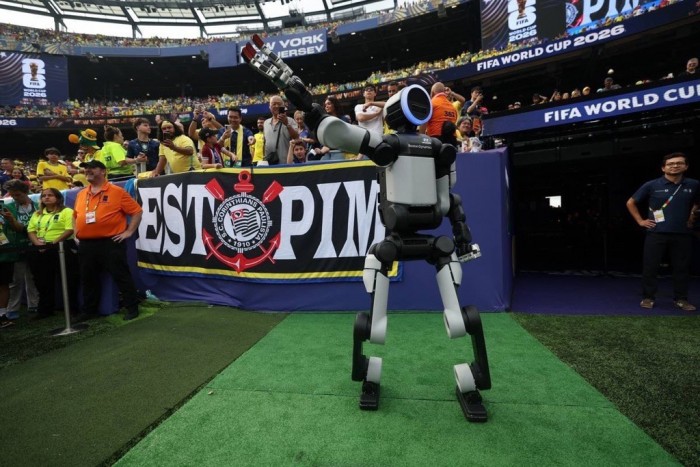 |
| Atlas waves to the crowd at New York New Jersey Stadium during the World Cup round of 16 match on July 5 (local time). / Courtesy of Hyundai Motor Group |
The swift shift in the core leadership of Boston Dynamics is reshaping Hyundai Motor Group's robotics business as top executives depart in succession. Beyond simple personnel changes, analysts see this as a comprehensive overhaul of organization and leadership, transitioning Boston Dynamics from an R&D-focused entity to one pushing forward with full-scale mass production and commercialization of humanoid robots.
According to industry sources on August 12, Rachel Salamon, Chief Product Officer (CPO) at Boston Dynamics, recently decided to leave the company. She had led product strategy as CPO since 2019.
This exit follows a series of C-level departures at Boston Dynamics this year.
In February, CEO Robert Playter stepped down after more than 30 years with the company. Appointed CEO in 2019, Playter played a key role in transitioning research achievements, such as Spot, into commercial products.
Subsequently, the Chief Operating Officer (COO) and Chief Strategy Officer (CSO) also left the company, following former Chief Technology Officer (CTO) Aaron Saunders, who moved to Google DeepMind in November last year.
The wave of executive departures coincides with Hyundai Motor Group forming a business planning Task Force Team (TFT) under Vice Chairman Chang Jae-hoon to draft blueprints for Boston Dynamics' initial public offering (IPO) and corporate restructuring.
The TFT reportedly includes numerous mergers and acquisitions (M&A) experts, bolstering interpretations that leadership on the ground is being replaced alongside accelerated preparation for listing and restructuring at the controlling shareholder level.
The successive resignations of top executives are interpreted as a sweeping leadership overhaul during the transition from an R&D-centered organizational culture to a manufacturing-based mass production and commercialization system.
Many of the departing C-level executives are engineer-led leaders who guided Boston Dynamics since its inception as an MIT research lab, focusing on academic technical validation and core technology development.
Hyundai Motor Group, the controlling shareholder of Boston Dynamics, aims to achieve large-scale mass production and field deployment of the electric humanoid robot "Atlas" by 2028. Industry observers believe that strategic differences between the legacy leadership—who spearheaded core technology development—and the controlling shareholder—which prioritizes profitability and establishing mass production systems—led to the executive turnover.
Kim Jeong-gyu
Most Read
-
1
Trump shares map on social media labeling Strait o..

-
2
Celltrion seeks rheumatoid arthritis indication ex..

-
3
Trump demands rates fall below 1% as Fed hikes for..

-
4
Chinese e-commerce giants AliExpress, Temu and She..

-
5
Trump warns countries not helping U.S. must pay re..

-
6
China expels No. 2 military official Zhang Youxia..

-
7
Houthi rebels release video claiming downing of Sa..

PEOPLE






HEADLINE NEWS
- UNC says N. Korea violated armistice agreement in DMZ landmine explosion
- U.S. 30-year Treasury yield hits 5.613% intraday, highest since 2002 as bon..
- Netanyahu faces political crisis ahead of election over allegations he igno..
- Chinese Foreign Minister Wang Yi demands retraction of Takaichi's remarks o..

-
Address : In-Young Bldg., 34, Uisadang-daero 1-gil, Yeongdeungpo-gu, Seoul
Copyright by ASIATODAY CO., LTD. All rights resereved