



Hanwha Systems begins developing AI-based military communications network
Aug 13, 2026, 09:55 am


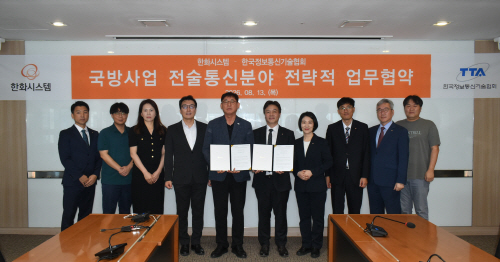 |
| Officials from Hanwha Systems and the Telecommunications Technology Association (TTA) pose for a photo on the 13th after signing a strategic partnership for developing an AI-based 5G tactical communications system and MOSS. |
Hanwha Systems is partnering with the Telecommunications Technology Association (TTA) to develop a next-generation AI-based military communications network.
The company's strategy centers on building a 5G tactical communications system that unifies terrestrial and non-terrestrial (satellite) networks into a single system, applying international standards from the development stage onward to lay the groundwork for entering the global defense market.
The effort is notable in particular for combining AI with 5G/6G mobile communication technology — developed primarily in the civilian sector — to flexibly operate communications networks tailored to battlefield conditions.
The partnership is also expected to accelerate efforts to secure technical and standards competitiveness needed to expand into overseas defense markets, including Europe and NATO member states.
According to Hanwha Systems on the 13th, the company recently agreed to pursue strategic cooperation with TTA to develop an AI-based 5G tactical communications system.
The two organizations will jointly develop next-generation military communications network technology that uses AI to integrate the operation of 5G terrestrial networks (TN) and non-terrestrial networks (NTN).
The core goal is to link various communication means — not just ground base stations but also communication satellites — into a single system to build a stable communications network even in battlefield conditions.
In modern warfare, vast amounts of data flow in real time between commanders and combatants, encompassing not just voice and video communication but also surveillance and reconnaissance information, unmanned system data, and command-and-control information. This has made connectivity, survivability, and interoperability just as important as network speed.
A multi-layered network capable of maintaining communications through non-terrestrial means like satellites, even when ground networks are disrupted by jamming or physical attacks, is considered a core technology for next-generation tactical communications.
AI is expected to serve as a key technology for efficiently operating such complex communications networks. By using AI to analyze battlefield conditions and communication environments and optimize network resources, the connection between terrestrial and non-terrestrial networks can be managed more flexibly.
Standardization efforts to apply AI and machine learning to networks are also underway in next-generation mobile communications fields such as 5G-Advanced. TTA similarly supports the incorporation of domestic technology into international standards and related standardization activities.
In this partnership, Hanwha Systems brings its experience developing military tactical communications systems, having built up capabilities in constructing tactical communications networks through its participation in the military's Tactical Information Communication Network (TICN) program.
TTA, meanwhile, will support standards compliance and interoperability based on its expertise in mobile communications standardization and testing/certification across LTE, 5G, and 6G. TTA also participates in the activities of 3GPP, the international mobile communications standardization body.
Notably, the two organizations plan to incorporate 3GPP-based 5G/6G technology and NATO communications-related standards from the early stages of development. This marks a departure from the previous approach of developing technology to domestic military-specific specifications and later modifying it to meet overseas standards, instead aiming to ensure alignment with international standards from the outset.
This is also significant for strengthening the export competitiveness of Korea's defense industry, given that in today's defense market, interoperability with existing weapons systems and allied equipment has become just as important as a weapons system's own performance. Securing a communications system built on international standards would provide a foundation for meeting overseas customers' requirements.
Hanwha Systems and TTA will also jointly participate in developing "MOSS," an integrated communications solution that can be mounted on vehicles to support multi-layered tactical communications.
MOSS is a technology that integrates a mobile tactical 5G base station, transmission equipment, satellite communication terminals, and C4I (command, control, communications, computers, and intelligence) mission equipment into a single platform. The goal is to build a communications environment centered on tactical vehicles, connecting ground and satellite networks and linking various mission equipment to enable command-and-control and information sharing even while on the move.
Through this partnership, Hanwha Systems aims to secure technical competitiveness in military communications by combining AI with 5G and satellite communications, and to expand this capability beyond domestic force deployment into overseas defense business.
The key is combining the tactical communications capabilities the company has built up through its existing defense business with TTA's standardization and testing/certification expertise to secure products and technology that can compete in the global market.
A Hanwha Systems official said, "Advancing military communications is a core capability that will determine the outcome of future battlefields," adding, "We will advance the South Korean military's hyper-connected tactical communications network and strengthen our ability to respond to international standardization, contributing to boosting the global competitiveness of Korea's defense industry."
Meanwhile, industry observers say this partnership is significant not merely as an upgrade to military communications networks, but as a move aimed at the "global standardization of Korea's domestic tactical communications system."
In particular, as mobile communications technology evolves toward 5G-Advanced and 6G, competition to standardize technology combining AI with non-terrestrial networks is also intensifying — making it a key point of interest whether Hanwha Systems can expand the technology it secures here into overseas tactical communications and defense network business.
Kim Yu-ra
Most Read
-
1
Trump shares map on social media labeling Strait o..

-
2
Celltrion seeks rheumatoid arthritis indication ex..

-
3
Trump demands rates fall below 1% as Fed hikes for..

-
4
Chinese e-commerce giants AliExpress, Temu and She..

-
5
Trump warns countries not helping U.S. must pay re..

-
6
China expels No. 2 military official Zhang Youxia..

-
7
Houthi rebels release video claiming downing of Sa..

PEOPLE






HEADLINE NEWS
- UNC says N. Korea violated armistice agreement in DMZ landmine explosion
- U.S. 30-year Treasury yield hits 5.613% intraday, highest since 2002 as bon..
- Netanyahu faces political crisis ahead of election over allegations he igno..
- Chinese Foreign Minister Wang Yi demands retraction of Takaichi's remarks o..

-
Address : In-Young Bldg., 34, Uisadang-daero 1-gil, Yeongdeungpo-gu, Seoul
Copyright by ASIATODAY CO., LTD. All rights resereved