



Securities firms, riding record earnings, brace for H2 as trading volume halves
Aug 11, 2026, 09:44 am


 |
| This image was generated by AI. |
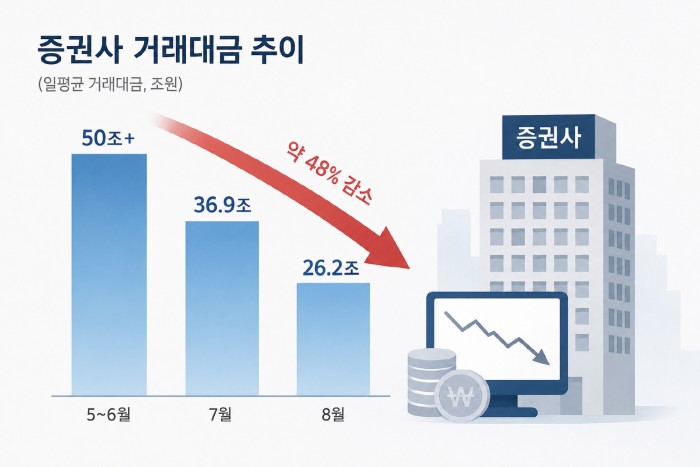
Major domestic securities firms posted record earnings in the first half of the year, riding a booming stock market, but face a slowdown in the second half as daily trading volume has dropped sharply. Average daily trading value, which topped 50 trillion won in May and June, has effectively halved to around 26 trillion won in August, while investor deposits have also fallen from the 130 trillion won range to around 104 trillion won. With the brokerage boom that drove first-half results now past its peak, securities firms' earnings are expected to have topped out in the second quarter.
According to the financial investment industry on the 9th, major securities firms saw sharp earnings growth starting in the first half of this year, with several joining the "1 trillion won net profit club." Korea Investment & Securities posted first-half net profit of 1.7311 trillion won, up 68.8% year-on-year, while Kiwoom Securities posted 1.158 trillion won, up 112.2%. KB Securities posted 796.3 billion won, up 135%, while NH Investment & Securities and Samsung Securities came close to the 1 trillion won mark with 965.1 billion won (up 107.6%) and 939.1 billion won (up 94.4%), respectively.
These strong results were driven largely by higher trading volume amid the stock market rally. Average daily trading value in the domestic market, which had hovered around 30 trillion won from January to April, surpassed 50 trillion won in May and June as the rally accelerated. As stock trading activity increased, securities firms' brokerage commission income also rose sharply.
But the trend reversed in the second half. Average daily trading value fell to 36.875 trillion won in July, then dropped further to 26.227 trillion won in August — down about 48% from June. With trading volume, which directly drives brokerage income, falling rapidly, pressure on securities firms' second-half earnings is mounting.
Analysts attribute the shift partly to weakened investor sentiment, as shares of Samsung Electronics and SK Hynix, which led the first-half rally, fell 33.8% and 39.8%, respectively, from early June through the 7th of this month. In addition, a new rule requiring a 30 million won minimum deposit for single-stock leveraged ETFs, implemented on the 31st of last month, has also constrained retail investors' trading in high-risk products.
Funds waiting on the sidelines and margin trading have also declined. Investor deposits, which stood at 132 trillion won on June 1, fell to 104.0711 trillion won as of the 6th of this month. The balance of margin loans fell 22.5% in a single month, from 37.3282 trillion won at the end of June to 28.935 trillion won at the end of July.
Industry watchers say that with key brokerage-related indicators — trading volume, deposits, and margin loans — all declining simultaneously, a drop in brokerage-related revenue in the second half appears unavoidable. Woo Do-hyung, an analyst at Yuanta Securities, said the year-on-year growth rate of average daily trading value, margin loans, and customer deposits is falling, and that based on past patterns, this is likely to be a sustained downward trend, adding that securities firms' earnings appear to have peaked in the second quarter, with brokerage income in the second half likely to decline from the first half.
Still, second-half performance is expected to vary by firm depending on business portfolio. Large securities firms with lower reliance on brokerage and more diversified revenue sources — including investment banking, wealth management (WM), and promissory notes — are seen as better positioned to cushion the impact of declining trading volume.
An industry official said that while a slowdown in brokerage income is unavoidable given falling trading volume in the second half, securities firms that have diversified their revenue base through IB, WM, and promissory notes will likely be relatively better positioned to defend their earnings, adding that second-half performance is expected to diverge across firms depending on their reliance on brokerage versus the competitiveness of their non-brokerage businesses.
Park Ju-yeon
Most Read
-
1
Celltrion nears additional contract with major U.S..

-
2
Putin proposes trilateral U.S.-China-Russia summit..

-
3
U.S. weighs dropping MOAB, world's most powerful n..

-
4
"Aren't those foreigners on welfare?": M..

-
5
Attention centers on APEC for possible Trump-Xi-Pu..

-
6
Saudi Arabia, Iran hold first diplomatic talks to..

-
7
China tightens grip on boosting domestic demand an..

PEOPLE







-
Address : In-Young Bldg., 34, Uisadang-daero 1-gil, Yeongdeungpo-gu, Seoul
Copyright by ASIATODAY CO., LTD. All rights resereved