



Zombie construction firms surge from 62 to 173 in five years
Aug 11, 2026, 09:42 am


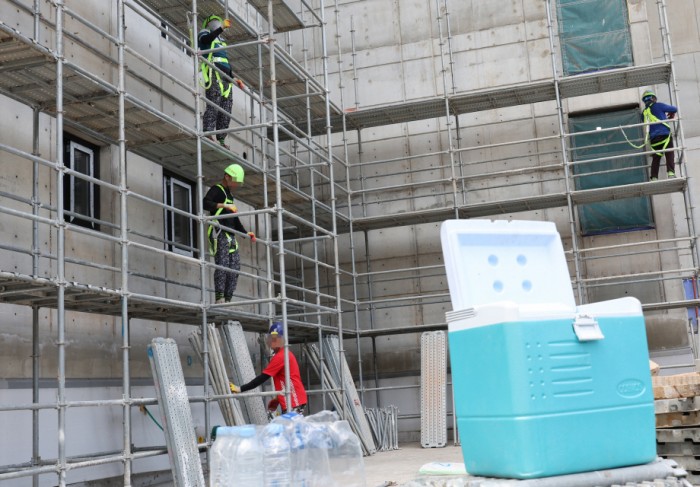 |
| Scaffolding work continues, though most outdoor work has effectively stopped, at a housing redevelopment site in Michuhol-gu, Incheon on the morning of the 5th, as a heatwave critical alert was in effect. / Yonhap |
The number of "zombie" companies in the construction industry — firms unable to cover their interest payments with operating profit — has surged roughly threefold over the past five years (2021-2025).
According to the Korea Research Institute for Construction Policy's report analyzing the financial performance and structural condition of externally audited construction companies for 2025, the share of "zombie" firms among externally audited construction companies rose from 4.5% (62 firms) in 2021 to 11.3% (173 firms) last year, an increase of about 2.8 times.
The analysis covered 2,004 externally audited construction companies, excluding 333 firms that experienced capital impairment during the period, out of 2,337 total externally audited construction firms over the past five years.
A "zombie company" is defined as a firm whose interest coverage ratio has stayed below 1 for three consecutive years, meaning its interest burden exceeds its earnings, making it difficult to sustain normal business operations without outside help.
The interest coverage ratio, including companies with very low interest expenses, rose from 8,733.0% in 2021 to 10,305.6% in 2022, but has since steadily declined, falling to 4,166.1% by 2025.
The debt ratio climbed from 129.2% in 2021 to 161.8% in 2024, easing slightly to 155.3% in 2025, but remained elevated overall.
Profitability worsened across the board. The operating margin fell from 4.5% in 2021 to 3.4% in 2025, while the net profit margin dropped from 4.2% to 2.3% over the same period. Return on assets (ROA) fell from 5.2% to 3.6%, and return on equity (ROE) fell from 10.1% to 5.6%.
The institute attributed this to rising construction costs, project delays and cancellations, and expanding project financing (PF) risk, which have squeezed operating profit while increasing the burden of interest and other financial costs.
Revenue growth, which had risen from 14.2% in 2021 to 17.9% in 2022, has since continued to shrink, turning negative at -4.5% in 2025, while total asset growth slowed from 14.8% in 2021 to 5.8% in 2025.
Total asset turnover fell from 149.1% in 2021 to 114.7% in 2025, and construction receivables turnover declined from the 900% range in 2021-2022 to the 800% range in 2023-2025.
Research fellow Lee Ji-hye said that in the short term, liquidity management and easing interest burdens are needed, while in the medium to long term, improving the PF structure and normalizing cost and payment systems must proceed in tandem.
Lee Soo-il
Most Read
-
1
Celltrion nears additional contract with major U.S..

-
2
Putin proposes trilateral U.S.-China-Russia summit..

-
3
U.S. weighs dropping MOAB, world's most powerful n..

-
4
"Aren't those foreigners on welfare?": M..

-
5
Attention centers on APEC for possible Trump-Xi-Pu..

-
6
Saudi Arabia, Iran hold first diplomatic talks to..

-
7
U.S., Israel plan to resume strikes on Iran after..

PEOPLE







-
Address : In-Young Bldg., 34, Uisadang-daero 1-gil, Yeongdeungpo-gu, Seoul
Copyright by ASIATODAY CO., LTD. All rights resereved