



Korea's shipbuilders still taking baby steps toward low-carbon steel
Aug 11, 2026, 09:36 am


 |
| / This image was generated by AI. |
As global decarbonization regulations tighten, competitiveness in the steel industry is rapidly shifting beyond price and quality toward "carbon competitiveness." However, converting to low-carbon steel production requires massive investment, and that shift depends first on securing buyers willing to commit to stable long-term purchases.
The shipbuilding industry, in particular, has moved more slowly than other demand sectors. Even if steelmakers convert to low-carbon production, they struggle to justify large-scale investment without offtake agreements — long-term purchase commitments from shipbuilders.
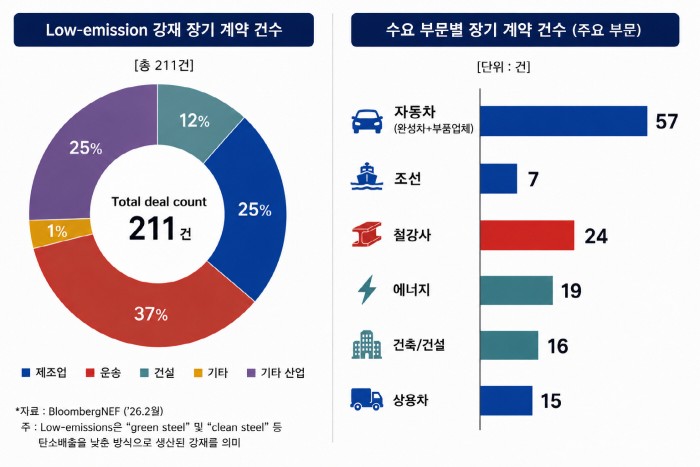
According to a POSCO Research Institute report on the 10th, only seven global low-carbon steel offtake agreements have been signed by shipbuilders. Building a stable low-carbon steel market requires long-term cooperation between steelmakers and demand industries, but such agreements remain limited within shipbuilding.
This partly reflects the fact that shipbuilding's decarbonization strategy has so far focused mainly on the vessel operation phase — reducing greenhouse gas emissions during a ship's operating life by adopting low- or zero-carbon fuels such as LNG, methanol, and ammonia, or by improving engine efficiency.
But as global decarbonization regulations expand to cover a ship's entire lifecycle, what a ship is built from is increasingly likely to emerge as a new competitive factor as well.
Low-carbon steel refers to steel produced with lower carbon emissions than conventional products. A representative example is the electric arc furnace process, which melts steel scrap using electricity and produces lower emissions than the traditional coal-based blast furnace process.
The problem lies in price and quality. Converting from a blast furnace-centered production system to low-carbon processes like electric arc furnaces requires massive capital investment, and when combined with higher energy costs such as electricity, it becomes difficult to match the price competitiveness of conventional steel.
Price sensitivity is especially acute in shipbuilding. Since thick steel plate is an essential material for ship construction, a larger price premium on low-carbon steel could directly push up shipbuilding costs. For Korean shipbuilders, who must remain price-competitive in the global market, there is concern that expanding the use of low-carbon steel could ultimately weaken their competitiveness in winning orders.
Industry observers say that transitioning to low-carbon steel ultimately requires more than just changing production processes — it also demands securing high-quality steel scrap, developing impurity-control technology, securing low-carbon electricity, and establishing long-term purchase agreements with buyers, all at once.
The shipbuilding industry, too, faces a growing need to address this structural challenge over the long term, since reducing carbon emissions solely at the operational stage through eco-friendly fuels and high-efficiency engines may not be enough to meet global decarbonization demands.
In particular, if regulations tighten to cover a ship's total lifecycle carbon emissions, whether low-carbon steel is used could become a new benchmark distinguishing shipbuilders' environmental competitiveness.
Lee Jang-hyun, a professor of naval architecture and ocean engineering at Inha University, said that if Korea's steel industry moves ahead in earnest with eco-friendly production processes, production cost burdens will rise significantly, adding that for shipbuilders to use low-carbon steel, steel prices could rise two to threefold from current levels, which would push up ship prices and make it difficult to maintain competitiveness in winning orders.
Kim So-young
Most Read
-
1
Trump demands rates fall below 1% as Fed hikes for..

-
2
Celltrion seeks rheumatoid arthritis indication ex..

-
3
Chinese e-commerce giants AliExpress, Temu and She..

-
4
Trump warns countries not helping U.S. must pay re..

-
5
China expels No. 2 military official Zhang Youxia..

-
6
Houthi rebels release video claiming downing of Sa..

-
7
Trump rejects Iran's offer to open Strait of Hormu..

PEOPLE







-
Address : In-Young Bldg., 34, Uisadang-daero 1-gil, Yeongdeungpo-gu, Seoul
Copyright by ASIATODAY CO., LTD. All rights resereved