



Government moves to legislate asset management framework
Aug 06, 2026, 10:12 am


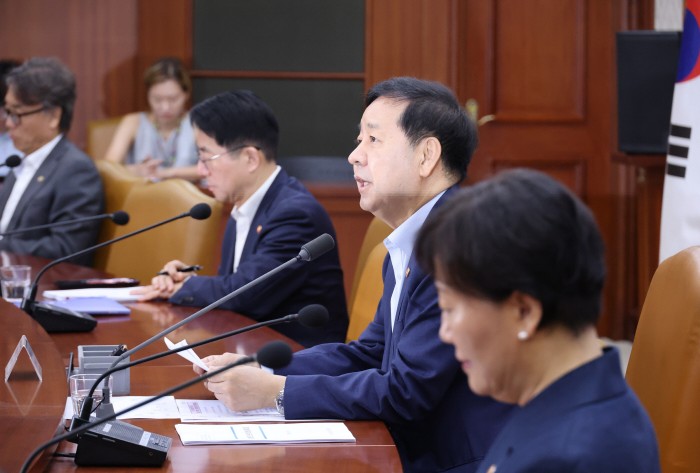 |
| Deputy Prime Minister and Minister of Economy and Finance Koo Yun-cheol speaks at a joint meeting of the Emergency Economic Response Headquarters and ministers on economic and structural reform, held at the Government Complex Seoul on the 6th. / Yonhap |
The government is overhauling the state property management system it has maintained for over 70 years, in order to systematically manage national assets that have now surpassed 1,400 trillion won. The plan is to expand the traditionally real estate-centered concept of "state property" into a broader "national assets" framework that also encompasses intellectual property, financial assets, and virtual assets, while building an AI-based integrated database to maximize asset value.
The government discussed this plan, called the "K-Asset Innovation Project: Direction for Transforming National Asset Management," at a joint meeting of the Emergency Economic Response Headquarters and ministers on economic and structural reform, chaired by Deputy Prime Minister and Minister of Economy and Finance Koo Yun-cheol on the 6th.
At the core of this overhaul is a full revision of the existing State Property Act into a new "Basic Act on National Assets," along with the construction of an AI-based national asset management system.
The government noted that while total state property has grown more than sevenfold — from 188.3 trillion won in 2001 to 1,402.7 trillion won at the end of last year — the current State Property Act still reflects the real estate-centered management system set up when it was first enacted in 1950, and has failed to keep pace with the changed asset landscape. In particular, the government said new asset classes such as intellectual property and virtual assets have emerged, but the legal framework to manage them remains inadequate.
The government therefore plans to redefine "state property" as "national assets" and build an integrated management system covering not just real estate but also movable property, financial assets, intellectual property, and virtual assets. It will establish separate regulatory frameworks for each core asset category — real estate, intellectual property, securities and equity investments, and virtual assets — to systematically manage the full lifecycle from acquisition to management and disposal.
Virtual assets will be included in national asset management for the first time. The government plans to establish a legal basis to clarify procedures for managing, entrusting, and disposing of virtual assets, with a general policy of auctioning them off immediately after acquisition, while also considering measures such as staggered sales to minimize market disruption.
For intellectual property, the government is considering establishing a national IP bank to integrate the registration and management of patents and copyrights, and will also set up systems for extending usage periods and distributing royalties. Securities and equity stakes will be managed through an integrated lifecycle system from acquisition to disposal, with standardized criteria for exercising shareholder rights.
Governance of national assets will also be strengthened. The government plans to establish a "National Asset Management Committee," an expanded and restructured version of the existing State Property Policy Deliberation Committee, to review comprehensive national asset plans and management direction, while designating a national asset officer at each ministry to strengthen accountability. It will also consider expanding the scope of entrusted management handled by the Korea Asset Management Corporation (KAMCO).
A data-driven management system will also be built. Within this year, the government plans to link asset information from the national government, local governments, and public institutions through the dBrain system, and introduce an AI chatbot to support legal interpretation and administrative work. Starting next year, it plans to build a dedicated AI-based national asset database, tentatively named "K-Asset Cloud," to identify key assets and propose optimal uses. It will also establish a regular management process that surveys asset supply and utilization demand each year to efficiently link assets across the national government, local governments, and public institutions.
The government plans to draft a bill for the Basic Act on National Assets within the year through a joint public-private working group and a research project with the Korea Development Institute (KDI), and will pursue the linkage of local government and public institution asset data and the construction of the AI system in phases.
Lee Ji-hoon
Most Read
-
1
Celltrion’s Omlyclo gains ground in major European..

-
2
Trump demands rates fall below 1% as Fed hikes for..

-
3
Hyundai Motor Group breaks ground on integrated st..

-
4
U.S. strikes 3 Iranian oil tankers, Iran vows reta..

-
5
Trump makes $1 trillion bet ahead of midterm elect..

-
6
Iran resumes ballistic missile production, assembl..

-
7
Samsung Electronics, Mistral AI to jointly develop..

PEOPLE







-
Address : In-Young Bldg., 34, Uisadang-daero 1-gil, Yeongdeungpo-gu, Seoul
Copyright by ASIATODAY CO., LTD. All rights resereved