



Trump stops strikes on Iran, driving oil prices down 8.7%
Jul 28, 2026, 10:32 am


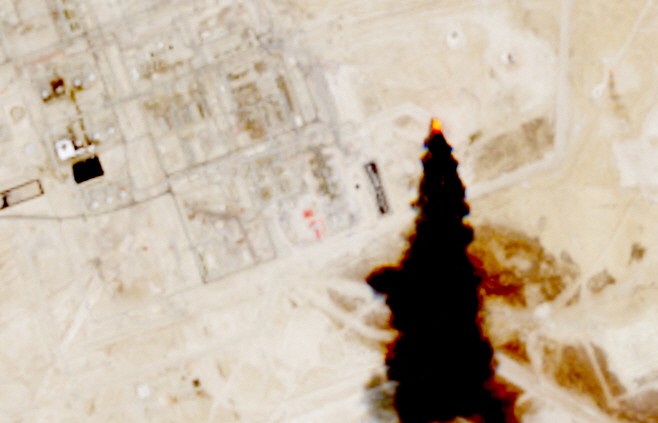 |
| On July 27 (local time), satellite imagery captures smoke rising from an oil facility in Abqaiq, Saudi Arabia. Yemen's pro-Iranian Houthi rebels stated through a statement by military spokesperson Yahya Sarea that they attacked several major crude oil supply and transport facilities. / Courtesy of European Union, Copernicus Sentinel-2 / Reuters, Yonhap News |
U.S. President Donald Trump warned on the 27th (local time) that he would resume "very strong military action" if negotiations with Iran fail to yield results.
Amid claims by Yemen's pro-Iranian Houthi rebels that they attacked crude oil supply and transport facilities connecting eastern Saudi Arabia to Yanbu on the Red Sea coast, international oil prices tumbled around 8% due to the suspension of U.S. airstrikes against Iran.
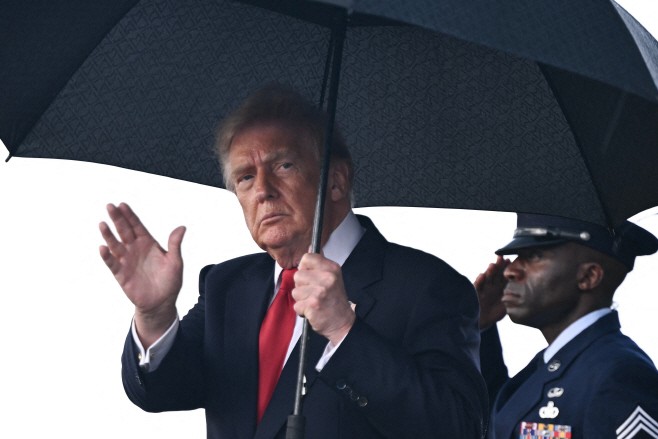 |
| U.S. President Donald Trump waves after disembarking from Air Force One at Joint Base Andrews in Maryland on the 27th (local time). President Trump returned to the White House after delivering a speech at General Motors (GM)'s Milford Proving Ground, a vehicle testing facility in Milford, Michigan. / AFP, Yonhap News |
Donald Trump halts strikes on Iran at mediator's request, but says "We will resume military action if negotiations fail"
In an interview with U.S. online news outlet Axios on the same day, President Trump stated that "we are in very deep negotiations with Iran." He said that "if the negotiations yield no results, we will return to very strong military action."
Regarding the deadline for negotiations, President Trump emphasized that "there is not much time," adding that "it will either happen quickly or not at all." President Trump explained that he halted airstrikes on July 24 because mediator countries and regional nations requested him "not to attack."
On Air Force One en route to Michigan, President Trump said there is a "good chance" of reaching an agreement with Iran. He emphasized that if the deal falls through, "we can just resume what we were doing until two days ago."
At a rally in Michigan, President Trump said "you cannot buy Iran with money," and that "they must be broken." However, he claimed that 'very friendly negotiations' are currently underway.
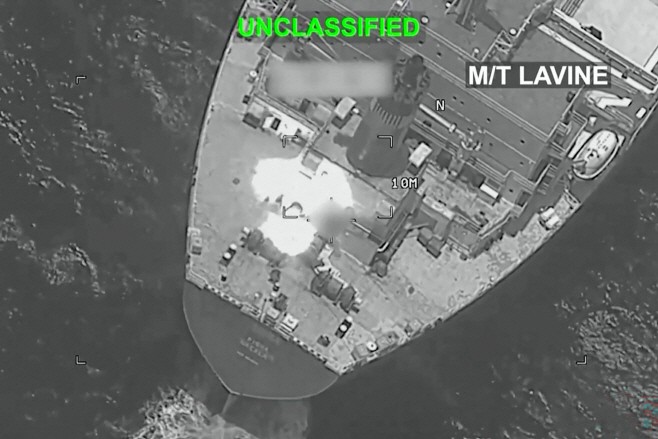 |
| In an undated video released by the U.S. Central Command (CENTCOM) on the 25th (local time), a scene is shown which it described as an operation enforcing a naval blockade against Iran. Amid reports that the U.S. military suspended airstrikes in the war now entering its fifth month and that concerns over depleting ammunition stockpiles are constraining further escalation, Iran was not subjected to U.S. airstrikes on the night of the 26th either. / Courtesy of U.S. Central Command, AFP, Yonhap News |
U.S. military leadership reports target decline and ammunition stockpile strain; Donald Trump dismisses shortage claims
Concerns were also raised over the command's operational sustainability during the U.S. military's suspension of airstrikes. Reuters reported that U.S. military commanders briefed President Trump that viable targets had decreased and the effectiveness of airstrikes had reached its limit. Dan Caine, Chairman of the U.S. Joint Chiefs of Staff, expressed concern that while resuming airstrikes is possible, it could put a strain on critical ammunition stockpiles.
President Trump dismissed claims of an ammunition shortage. He said that "we have plenty of various types of ammunition," adding that defense contractors are operating four to five plants each. He also stated that Patriot missiles are currently in production. However, President Trump acknowledged that "we certainly want to get more of the more sophisticated equipment."
He claimed that the U.S. is replenishing its stockpiles because former President Joe Biden provided extensive weaponry to Ukraine.
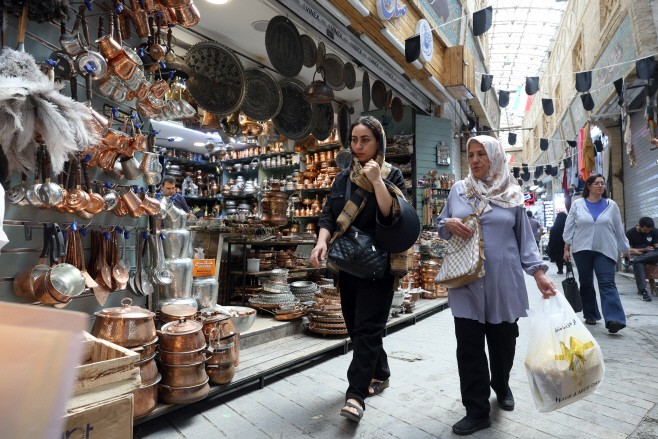 |
| Iranians shop at a bazaar in Tehran on Tuesday. / Courtesy of EPA, Yonhap |
Iran denies direct talks with U.S., discusses Hormuz passage with Oman
Iran stated that it is not holding official negotiations with the U.S., contrary to President Trump's explanation. Iranian Foreign Ministry spokesperson Esmaeil Baghaei refuted reports that Iran had requested direct talks as a fabricated claim. He said that while mediating countries could deliver messages from the U.S. side, the only current negotiations are bilateral discussions with Oman regarding the Strait of Hormuz.
Iran and Oman are discussing plans to reopen the central shipping lane of the Strait of Hormuz and manage maritime traffic. However, Iranian state media reported that Iran turned back six vessels trying to pass through the strait without authorization. Iran effectively maintains control over the strait while the U.S. continues its naval blockade of Iranian ports. Although both sides have stopped attacks, actual vessel traffic remains restricted.
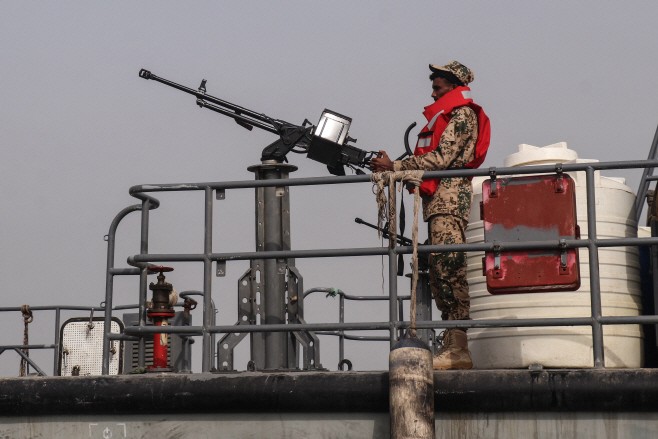 |
| A sailor with Yemen's internationally recognized government navy aims a machine gun aboard a vessel patrolling shipping lanes off Hanish Island in the Red Sea on Monday. / Courtesy of AFP, Yonhap |
Houthis claim attack on Saudi East-West oil facilities; Saudi Arabia intercepts drones from Iraq
The Houthi rebels claimed to have attacked oil supply and transport facilities connecting Saudi Arabia's Eastern Province oil fields to Yanbu on the Red Sea coast. Houthi military spokesperson Yahya Sarea stated that the attack was in retaliation for Saudi drones violating Yemeni airspace. The East-West Pipeline serves as a bypass route transporting Saudi crude to the Red Sea without passing through the Strait of Hormuz.
The Saudi Ministry of Defense announced via X that it intercepted several drones targeting oil facilities in Riyadh and the Eastern Province. Saudi Defense Ministry spokesperson Turki al-Malki stated that the drones were launched from Iraqi territory by Iran-backed militias. Asserting its right to respond accordingly, Saudi Arabia requested that the Iraqi government take measures to prevent any recurrence.
Satellite imagery from the European Union's Sentinel-2 captured smoke and flaring at Saudi Arabia's Abqaiq oil processing facility and Hawiyah gas plant. However, gas flaring does not necessarily indicate an attack on or damage to the facilities. The Saudi government and state-owned oil giant Aramco have not disclosed whether production has been disrupted.
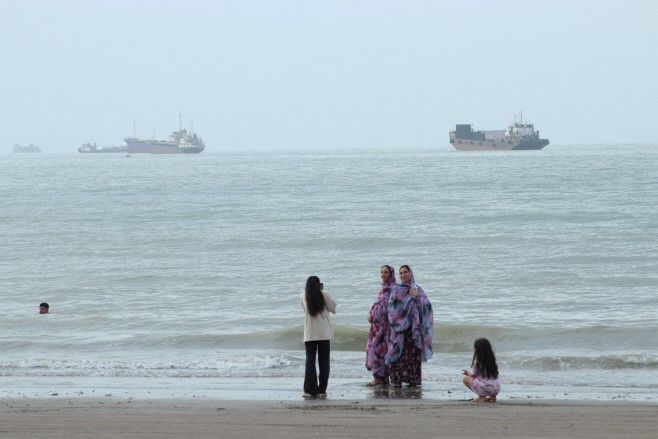 |
| Vessels transit the Strait of Hormuz near the coast of Bandar Abbas, Iran, on Monday. / Courtesy of Reuters, Yonhap |
Brent crude tumbles 8.7% to $88.36; Hormuz passage limits and Red Sea transit risks persist
Brent crude for September delivery closed at $88.36 per barrel on the day, down 8.7% from the previous session. West Texas Intermediate for September delivery fell 7.5% to settle at $82.61 per barrel. This marks the first time in a week that Brent crude has dropped below $90.
Brent crude had surpassed $100 per barrel last week due to the blockade of the Strait of Hormuz and escalating tensions in the Red Sea. While the halt in attacks between the U.S. and Iran drove prices down, maritime trade volumes have not recovered.
Alex Hodes, energy strategist at brokerage StoneX, noted that even after the brief mid-June ceasefire, maritime trade volume remains severely contracted. He stated that Saudi crude shipments must take longer and more expensive routes passing through the Red Sea and the Suez Canal.
President Trump will discuss the Iran issue with Israeli Prime Minister Benjamin Netanyahu at the White House on Tuesday.
Ha Man-joo
Most Read
-
1
Celltrion’s Omlyclo gains ground in major European..

-
2
Trump demands rates fall below 1% as Fed hikes for..

-
3
Trump makes $1 trillion bet ahead of midterm elect..

-
4
Iran resumes ballistic missile production, assembl..

-
5
Samsung Electronics, Mistral AI to jointly develop..

-
6
Trump warns countries not helping U.S. must pay re..

-
7
Apple launches first foldable, 1 million won prici..

PEOPLE






HEADLINE NEWS
- Trump to roll out ‘unprecedented welcome’ for Xi with B-2 bombers, F-22 fighters
- S. Korea, U.S., and Japan form united front on Taiwan and economic coercion..
- Trump administration moves to impose sweeping sanctions on International Cr..
- Xi to make state visit to U.S. Sept. 23-25, dispelling rumors over his heal..

-
Address : In-Young Bldg., 34, Uisadang-daero 1-gil, Yeongdeungpo-gu, Seoul
Copyright by ASIATODAY CO., LTD. All rights resereved