



Long-term unemployed youth reaching highest level since global financial crisis
Jul 24, 2026, 09:28 am


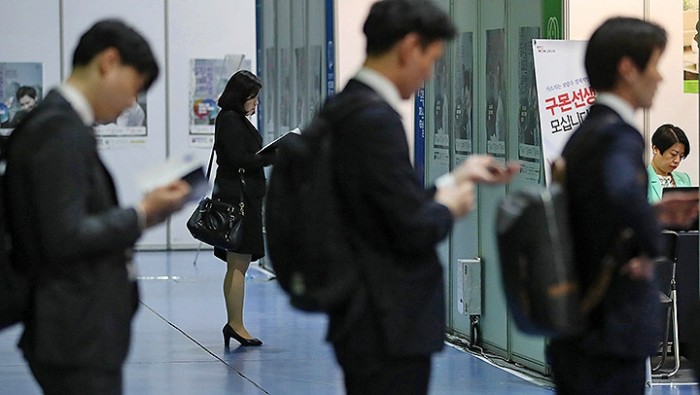 |
| / Photo courtesy of Yonhap News Agency |
The proportion of young people unable to land a job for over a year after graduation has surged to its highest level since the global financial crisis. Analysts attribute this trend to an increasingly challenging job market for new entrants, driven by corporate preferences for experienced hires and the expansion of rolling recruitment.
According to the "May 2026 Economically Active Population Survey: Youth Supplementary Survey" released by Statistics Korea on July 23, the youth population aged 15 to 29 stood at 7.822 million as of May. Among them, those who graduated from their final level of education totaled 4.003 million, down 171,000 from the previous year. Within this group, the number of employed youth decreased by 202,000 to 2.76 million, whereas the number of unemployed youth rose by 31,000 to 1.243 million.
A prolonging of youth unemployment stood out in particular. The number of young people without a job for more than a year post-graduation reached 605,000, up 39,000 from last year. They accounted for 48.6 percent of all unemployed youth, up 2.0 percentage points from a year earlier (46.6 percent)—marking the highest level since 2009 (51.7 percent).
Those unable to find employment for three years or longer reached 241,000, an increase of 12,000. Their share rose 0.5 percentage points to 19.4 percent, the highest level since relevant record-keeping began in 2007. Regarding primary activities among unemployed youth, "job training and employment exam preparation" accounted for the largest share at 39.3 percent, followed by "simply passing time" at 25.3 percent and "preparing for higher education" at 12.5 percent.
As the job shortage persists, the average duration spent completing university has also lengthened. University graduates took an average of four years and 5.7 months to graduate, up 1.3 months from the previous year—the longest duration since relevant data tracking began. The proportion of graduates who took a leave of absence also rose 2.5 percentage points to 48.9 percent.
"This appears to reflect a hiring environment that is currently quite unfavorable for young job seekers, including corporate preferences for experienced hires and an increase in rolling recruitment," said Kim Rak-hyun, director of the employment statistics division at Statistics Korea. "Extended preparation periods for employment and qualification exams are also key contributing factors."
Lee Ji-hoon
Most Read
-
1
Celltrion’s Omlyclo gains ground in major European..

-
2
Trump demands rates fall below 1% as Fed hikes for..

-
3
Hyundai Motor Group breaks ground on integrated st..

-
4
U.S. strikes 3 Iranian oil tankers, Iran vows reta..

-
5
Trump makes $1 trillion bet ahead of midterm elect..

-
6
Iran resumes ballistic missile production, assembl..

-
7
Samsung Electronics, Mistral AI to jointly develop..

PEOPLE






-
Address : In-Young Bldg., 34, Uisadang-daero 1-gil, Yeongdeungpo-gu, Seoul
Copyright by ASIATODAY CO., LTD. All rights resereved