



FSC launches 15-year technology fund worth 880 billion won
Jul 21, 2026, 10:42 am


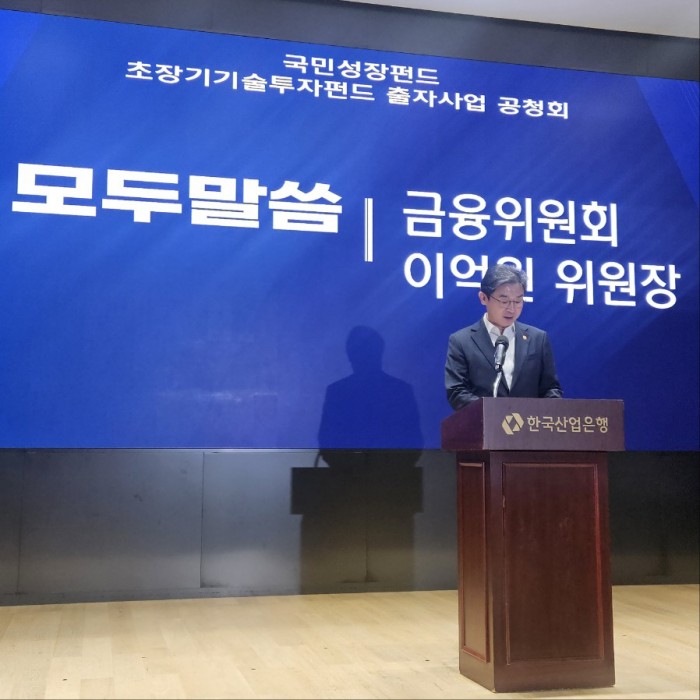 |
| Lee Eok-won, Chairman of the Financial Services Commission, delivers opening remarks during a public hearing on the Ultra-Long-Term Technology Investment Fund, part of the National Growth Fund, held at the Korea Development Bank IR Center in Yeouido, Seoul, on July 20. / Courtesy of Lee Bo-ra |
The Financial Services Commission (FSC) is launching an 880 billion won ultra-long-term technology investment fund designed to support the extended growth of advanced tech companies. By extending the fund's lifespan up to 15 years and raising public backing to 77%, the initiative seeks to remedy the short-term exit structures inherent in traditional venture capital funds.
Speaking at the public hearing for the National Growth Fund's Ultra-Long-Term Technology Investment Fund held on July 20 at the Korea Development Bank IR Center, FSC Chairman Lee Eok-won highlighted that in high-tech industries, "who can look further and wait longer matters just as much as who invests more capital." He described the move as "a new attempt to align the timeline of finance with that of technology."
Designed as an indirect investment vehicle under the National Growth Fund, the ultra-long-term fund will supply patient capital to deep-tech fields requiring extended development periods before commercialization, including AI, semiconductors, and biotechnology. Observers have noted that traditional policy funds, typically targeting redemptions within seven to ten years, face inherent limits in supporting firms that require lengthy R&D phases.
"Under a structure where funds must be recovered and returns realized within a short lifespan, it is difficult to invest boldly in technologies that demand time," Chairman Lee stated. "Rather than a fund that exits after a single investment, we will build a fund that grows alongside companies over an extended horizon."
The fund will total 880 billion won. Policy funds will supply 680 billion won—comprising 600 billion won from the Advanced Strategic Industry Fund and 80 billion won from government budget allocations—covering roughly 77% of total capital to ease fundraising burdens for private asset managers and encourage patient capital commitments. The fund's maximum lifespan will be set at 15 years, with the investment window extended up to 7 years—an increase of up to 5 years in lifespan and 2 years in investment period compared with conventional policy funds.
In selecting fund managers, the FSC plans to evaluate technical understanding, specialized personnel, and value-up capabilities alongside standard financial metrics. The commission is considering favorable terms for follow-on investments, while penalizing premature exits inconsistent with the fund's mandate.
Korea Development Bank detailed specific operational incentives. Lee Yoon-jin, head of KDB's investment management department, explained that the goal is to nurture companies from early stages before introducing them to the market, rather than stepping in right before an IPO. To address the heavy concentration of investment in AI, the fund mandates that at least 20% of target investments be allocated to 10 non-AI advanced technology sectors overlooked by private capital. Additionally, the benchmark hurdle rate will be lowered from the usual 7% for policy funds to 5% to reduce the long-term investment burden.
Attendees expressed broad consensus on expanding long-term venture capital. Ha Geon-hyeok, team leader at Shinhan Securities, observed that the 15-year lifespan and heavy policy funding target structural gaps between capital markets and industrial sites, adding that if follow-on investments and secondary market mechanisms operate effectively to draw in institutional capital, it could mark a turning point for high-tech industries.
Others pointed to the need for tailored evaluation frameworks. Hong Won-ho, CEO of SQ Investment, noted that evaluating a 15-year fund solely based on exit timing is impractical, stressing the need for institutional mechanisms that account for technological progress and capital accumulation.
Industry representatives also called for commercialization support alongside capital. Lim Gyu-sik, CEO of cochlear implant developer Todoc, noted that deep-tech startups face regulatory and market entry hurdles after completing technology development, calling for a framework that assists portfolio companies through regulatory hurdles and commercialization.
Incorporating feedback from the hearing, the FSC will finalize the operational plan and issue a call for fund managers, aiming to complete manager selections and private capital raising to begin disbursements as early as year-end.
Lee Bo-ra
Most Read
-
1
U.S. Treasury Secretary Bessent publicly warns ove..

-
2
Celltrion’s Omlyclo gains ground in major European..

-
3
Hyundai Motor Group breaks ground on integrated st..

-
4
Russia faces warning signs over prolonged war econ..

-
5
Anti-Western solidarity strengthens amid Trump's e..

-
6
U.S. strikes 3 Iranian oil tankers, Iran vows reta..

-
7
S. Korea seeks redemption from World Cup setback w..

PEOPLE







-
Address : In-Young Bldg., 34, Uisadang-daero 1-gil, Yeongdeungpo-gu, Seoul
Copyright by ASIATODAY CO., LTD. All rights resereved