



Gov't pushes to regulate youth social media, but effectiveness remains challenge
Jul 21, 2026, 09:30 am


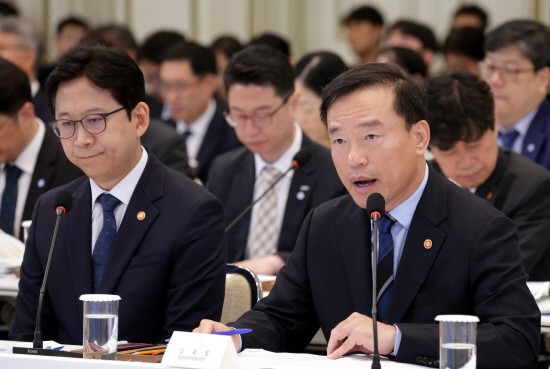 |
| Kim Jong-chul, Chairman of the Korea Media and Communications Commission, delivers a policy briefing at the Blue House Guest House on July 16. / Courtesy of Yonhap News |
The South Korean government has decided to push forward with measures to restrict teenagers' access to and use of social media services (SNS). As the risks associated with youth social media use become increasingly clear, foreign developed nations have already introduced related regulations, and domestic discussions toward legislation now appear to be accelerating. However, determining clear regulatory criteria for age brackets and platform types, as well as ensuring effectiveness in fostering digital citizenship among youth, remain key challenges.
According to the Korea Media and Communications Commission (KMCC) on July 20, the agency is currently reviewing tiered, age-based regulations to prevent youth from becoming overly absorbed in social media platforms like YouTube. During a presidential policy briefing on July 16, Chairman Kim Jong-chul stated, "We are considering a phased approach that restricts service sign-ups for children under 14 and limits exposure to addictive design features and recommendation algorithms that induce excessive engagement for youth aged 14 to 19."
This move stems from the judgment that the negative impacts of social media on youth can no longer be controlled without official regulation. By nature, social media allows open participation by any viewer or content creator, leaving teenagers exposed to harmful content before it can be classified and sanctioned.
On July 18, a YouTuber in his 50s died after drinking poison in Gwangju, South Jeolla Province, and the scene was broadcast live without filtration. Furthermore, cases have been reported where social media served as a gateway leading teenagers into various crimes, including cyber gambling and online sexual exploitation.
Kim Young-wook, a professor at Ewha Womans University's Division of Communication & Media, noted, "Digital platforms capture young people's attention through recommendation algorithms and infinite scrolling, weakening their long-term focus, capacity for reflection, and ability to plan for the future." He added, "Youth social media regulations do not restrict freedom of expression; rather, they serve as a social safety net to protect cognitive autonomy during adolescence."
Accordingly, Chairman Kim had expressed his commitment to related regulations since his candidate nomination days, stating, "I will review whether to introduce a youth social media prohibition law." The commission subsequently commissioned external research while maintaining a cautious stance regarding potential infringements on youth rights and regulatory feasibility. A research report completed in April this year concluded that banning social media use for specific age groups represents an appropriate South Korean regulatory model. Following this, the KMCC appears to have initiated concrete discussions on specific regulatory standards.
Major overseas nations have already implemented similar regulations. These generally hold major platform operators responsible for user age verification or algorithm management. On December 10 last year, Australia enforced its Online Safety Act, which blocks minors under 16 from ten social platforms, including Facebook and Instagram. France also passed legislation early this year banning social media use for minors under 15. In the United States, regulations vary by state, with Utah and Texas notably restricting social media access for youth under 18. Similar legislative movements are underway across Southeast Asian countries and the UK.
The measure currently pursued by the KMCC restricts access for children under 14 while limiting algorithmic exposure for youth under 19. However, additional discussions remain necessary regarding which platforms to target and the level of sanctions to apply. Moreover, given that platforms like YouTube also serve as educational tools, critics point out that an "outright ban" is a simplistic approach with low practical effectiveness. An Do-hyun, a professor at Jeju National University's Department of Media and Communication, observed, "Current scientific evidence justifies neither a total social media ban nor a completely passive response," emphasizing that "the core issues are what and how platforms are used, alongside a teenager's current psychological condition."
Kim Hong-chan
Most Read
-
1
Celltrion’s Omlyclo gains ground in major European..

-
2
Trump demands rates fall below 1% as Fed hikes for..

-
3
Hyundai Motor Group breaks ground on integrated st..

-
4
U.S. strikes 3 Iranian oil tankers, Iran vows reta..

-
5
Trump makes $1 trillion bet ahead of midterm elect..

-
6
Iran resumes ballistic missile production, assembl..

-
7
Samsung Electronics, Mistral AI to jointly develop..

PEOPLE






-
Address : In-Young Bldg., 34, Uisadang-daero 1-gil, Yeongdeungpo-gu, Seoul
Copyright by ASIATODAY CO., LTD. All rights resereved