



Seoul high schoolers to trace independence history in Korea, China, and Japan
Jul 20, 2026, 10:11 am


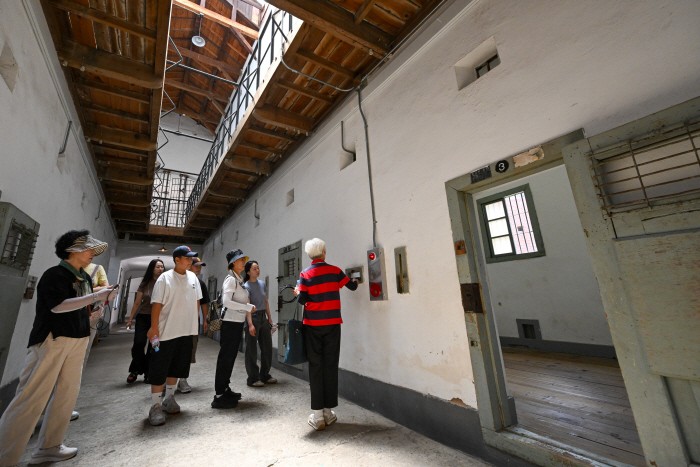 |
| Citizens take part in a walking tour while listening to the explanations of a cultural tourism commentator at the Seodaemun Prison History Hall in Seodaemun-gu, Seoul, on August 5, 2025. / Reported by Jeong Jae-hoon |
Seoul high school students are directly retracing the footsteps of patriots Ahn Jung-geun, Yoon Bong-gil, and Lee Bong-chang, whom they had previously encountered only in textbooks. This history education project examines the choices and lives of ancestors at the very sites where the independence movements took place, extending that significance into present-day democracy and civic responsibility.
The Seoul Metropolitan Office of Education announced on July 19 that an overseas exploration of independence movement historical sites, involving 80 high school student members of the Seoul Student Participation Committee, will be conducted within this month across four regions in China and Japan.
Divided into groups of 20 by respective offices of education, the students will visit independence movement sites in Chongqing and Xi'an, Harbin and Yanji, and Shanghai and Nanjing in China, as well as the Tokyo area in Japan. Students from the Gangseo-Yangcheon Office of Education departed for Chongqing and Xi'an on July 19, while students from the Bukbu Office of Education will tour the Tokyo area starting July 20. Students from the Jungbu Office of Education and the Gangdong-Songpa Office of Education will head to Harbin and Yanji, and Shanghai and Nanjing, respectively, on July 27.
This exploration is operated differently from one-off sightseeing tours of overseas historical sites. Before departure, the students attended lectures on the history of the independence movement and selected their own research topics. On July 18, they also visited the Seodaemun Prison History Hall and the National Museum of the Provisional Republic of Korea Government in Seoul to examine the traces of the independence movement remaining within the country.
On-site, they will directly verify the activity spaces of the historical events and figures they researched, while listening to commentaries. After returning home, they plan to compile their exploration findings into reports to share with other students. By connecting pre-learning, field research, and post-activities into a single project, it enables students not to stop at passively learning history but to ask questions and interpret it themselves.
Students visiting Tokyo will visit the site of the February 8 Declaration of Independence, where Korean students studying in Japan declared Joseon's independence in 1919, the site of Patriot Lee Bong-chang's heroic deed and martyrdom, and the prison sites where Patriots Park Yeol and Kim Ji-seop were incarcerated. They will also visit a memorial monument honoring Koreans sacrificed during the Great Kanto Earthquake to look back on the history of colonial rule and Koreans in Japan together.
In the Harbin and Yanji areas, they will tour Harbin Station where Patriot Ahn Jung-geun shot Ito Hirobumi, the Ahn Jung-geun Memorial Museum, and the ruins of Unit 731 where Japan's biological experiments were perpetrated. They will also explore the birthplace of Poet Yun Dong-ju, Myeongdong Village, which was a base for the anti-Japanese movement, and the site of the Japanese Consulate-General in Gando.
In Chongqing and Xi'an, they will examine the organizational foundation of the independence movement, focusing on the buildings of the Provisional Government of the Republic of Korea and the headquarters and training grounds of the Korean Liberation Army. In Shanghai and Nanjing, they will visit the buildings of the Provisional Government of the Republic of Korea, the site of Patriot Yoon Bong-gil's Hongkew Park deed, and Baekbeom Kim Gu's shelter. The process through which the Provisional Government continued the independence movement while relocating to evade Japanese pursuit will also be verified on-site.
During the exploration period, the students will also participate in dialogues with the chiefs of the local offices of education. Based on what they felt on-site, they will voice opinions regarding history education in schools and propose necessary educational policies from the perspective of the future generation. The inclusion of student government committee members in the exploration target is also intended to connect the historical experience to changes in school and educational policy, rather than letting it end as a personal impression.
Jeong Geun-sik, the Superintendent of the Seoul Metropolitan Office of Education, stated, "History can be understood more deeply when it is experienced and reflected upon in the field, beyond learning it in the classroom," adding, "We will provide support so that students can learn the lives and spirits of our ancestors at the sites of the independence movement and grow into future citizens who practice the values of democracy and citizenship."
Kim Nam-hyung
Most Read
-
1
Celltrion’s Omlyclo gains ground in major European..

-
2
Trump demands rates fall below 1% as Fed hikes for..

-
3
Hyundai Motor Group breaks ground on integrated st..

-
4
U.S. strikes 3 Iranian oil tankers, Iran vows reta..

-
5
Trump makes $1 trillion bet ahead of midterm elect..

-
6
Iran resumes ballistic missile production, assembl..

-
7
Samsung Electronics, Mistral AI to jointly develop..

PEOPLE







-
Address : In-Young Bldg., 34, Uisadang-daero 1-gil, Yeongdeungpo-gu, Seoul
Copyright by ASIATODAY CO., LTD. All rights resereved