



Week-long monsoon rain leaves Korea trapped between stifling humidity and torrential downpours
Jul 20, 2026, 10:09 am


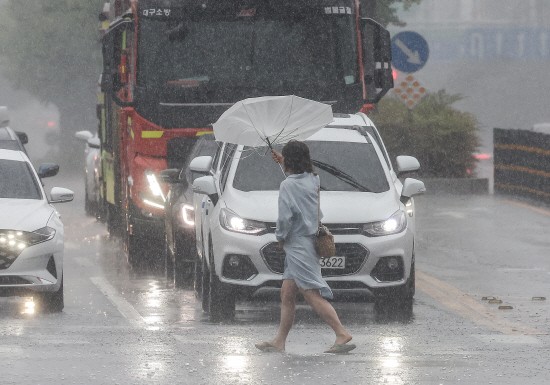 |
| A citizen struggles with an inverted umbrella while walking through Dusan Five-way Intersection in Suseong-gu, Daegu, on the 17th, when a heavy rain advisory was in effect for the region. / Yonhap News |
With the Seoul metropolitan area and other parts of the country having experienced heavy downpours of up to 200 mm last week, nationwide monsoon rains are projected to persist throughout this week as well. Driven by the effects of a late monsoon season, alternating cycles of scorching heatwaves and torrential downpours are expected to continue. In particular, a weather pattern where rain concentrates late at night followed by rapid temperature increases during the day will remain prevalent, demanding strict precautions against nighttime heavy rainfall and sweltering daytime heat during vulnerable hours.
According to the Korea Meteorological Administration on July 19, the rain that had temporarily eased starting that afternoon is forecast to pour down again from Monday, July 20. This comes as the stationary front that had shifted northward toward the capital area over the weekend moved back down below the southern region, while still maintaining its active status. Consequently, the precipitation zones are widening depending on the locations where medium-scale low-pressure systems and troughs develop along the stationary front.
On July 20, the expected precipitation stands at 20 to 60 mm for the capital area (excluding southern Gyeonggi Province), Gangwon Province, Daegu, and Gyeongsangbuk-do Province; 50 to 100 mm for the Chungcheong region; 30 to 80 mm for southern Gyeonggi Province; 5 to 40 mm for the Honam region, Busan, Ulsan, and Gyeongsangnam-do Province; and 5 to 20 mm for the Five West Sea Islands. On July 21, the KMA forecast 30 to 80 mm of rain for the capital area, Gangwon Province, the Chungcheong region, and the Five West Sea Islands; 5 to 40 mm for Jeonbuk Province, Ulsan, and Gyeongsangnam-do Province; 5 to 20 mm for Gwangju and Jeollanam-do Province; and 20 to 60 mm for Daegu and Gyeongsangbuk-do Province.
The KMA anticipated that even after July 23, low-pressure systems along the stationary front will develop, bringing nationwide rain until July 25. However, the weather agency explained that the exact amount of precipitation and affected regions remain highly variable depending on shifts in the axis of the stationary front.
In particular, a weather pattern where heatwave warnings during the day alternate with heavy rain advisories at night is highly likely to continue. This is because the hot and humid air currently flowing into the Korean Peninsula remains in a vaporized state during the scorching day, but turns instantly into water vapor as temperatures drop at night, increasing the probability of sudden downpours. Through July 22, while the overnight low temperature is expected to hit 22 degrees Celsius, the daytime high is projected to approach nearly 37 degrees Celsius. Accordingly, close attention must be paid to nocturnal downpours and humid heatwaves during the daytime. Hwang Seung-sik, a professor at the Seoul National University Graduate School of Public Health, remarked, "This summer features rain and heatwaves alternating with each other," adding, "Under conditions of humid heatwaves, the availability of air conditioning directly translates into health disparities, making it imperative to constantly check for potential damages."
Kim Hong-chan
Most Read
-
1
Celltrion’s Omlyclo gains ground in major European..

-
2
Trump demands rates fall below 1% as Fed hikes for..

-
3
Hyundai Motor Group breaks ground on integrated st..

-
4
U.S. strikes 3 Iranian oil tankers, Iran vows reta..

-
5
Trump makes $1 trillion bet ahead of midterm elect..

-
6
Iran resumes ballistic missile production, assembl..

-
7
Samsung Electronics, Mistral AI to jointly develop..

PEOPLE






-
Address : In-Young Bldg., 34, Uisadang-daero 1-gil, Yeongdeungpo-gu, Seoul
Copyright by ASIATODAY CO., LTD. All rights resereved