



DAPA signs MOUs with four defense innovation cluster regions
Jul 16, 2026, 09:31 am


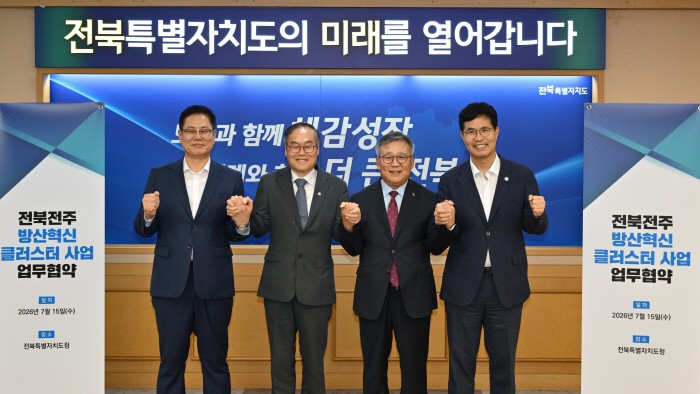 |
| The Defense Acquisition Program Administration (DAPA) signed a memorandum of understanding (MOU) over two days from July 14 to 15 with four local government consortiums to promote the Defense Innovation Cluster project. Shown from left are Jeonju Mayor Jo Ji-hun, DAPA Minister Lee Yong-chul, and Jeonbuk Governor Lee Won-taeg. / Courtesy of Defense Acquisition Program Administration |
The Defense Acquisition Program Administration announced that it has signed memorandums of understanding over two days from July 14 to 15 with four local government consortiums to promote the Defense Innovation Cluster project, officially launching the regional specialized defense innovation cluster initiatives.
The Defense Innovation Cluster is a regionally centered defense promotion initiative designed to build a local defense innovation ecosystem by uniting regional capabilities while supporting the growth and technological competitiveness of defense small- and medium-sized enterprises and venture businesses. Starting with the Gyeongnam-Changwon pilot project in 2020, the initiative expanded to Daejeon in 2022 and Gyeongbuk-Gumi in 2023. With the four new clusters beginning full operations this year, a strengthened nationwide defense innovation network is highly anticipated.
The specialized areas for each of the four local governments are Gyeongnam-Busan-Ulsan-Jeonnam (naval vessel MRO), Jeonbuk-Jeonju (advanced materials), Chungnam-Nonsan (AI military robotics), and Incheon (edge AI-based aviation and aerospace).
Together with the participating local governments, the Defense Acquisition Program Administration plans to invest approximately 50 billion won by 2030 to establish specialized research and testing infrastructure in each region, while promoting collaborative projects among industry, academia, and research institutes. Additionally, the administration will carry out tailored package support programs to revitalize regional defense industries, including backing the commercialization of research technologies and outcomes in new defense sectors.
Specifically, the Busan-Gyeongnam-Ulsan-Jeonnam consortium intends to leverage local shipbuilding and maritime industry foundations to establish a comprehensive cooperative system and build a naval vessel MRO hub. The Jeonbuk-Jeonju cluster will focus on the advanced composite materials sector, establishing an industrial ecosystem that spans the entire life cycle of core defense materials—from production and processing to testing and evaluation.
The Chungnam-Nonsan cluster plans to establish a comprehensive support center along with testing and certification infrastructure for the systematic development of AI military robotics. Meanwhile, Incheon will focus on the aviation and aerospace sector, building a foundation for the development of edge AI-based aerospace weapons systems to foster a future aerospace defense ecosystem.
"As the future battlefield environment is rapidly shifting toward high-tech sectors such as AI, unmanned systems, robotics, aerospace, and advanced materials, linking excellent regional industrial capabilities with the national defense sector is more critical than ever," Defense Acquisition Program Administration Minister Lee Yong-chul said. "Through the Defense Innovation Cluster project, we will foster a sustainable ecosystem where regional SMEs and venture companies can thrive."
Lee Han-sol
Most Read
-
1
Celltrion nears additional contract with major U.S..

-
2
Putin proposes trilateral U.S.-China-Russia summit..

-
3
U.S. weighs dropping MOAB, world's most powerful n..

-
4
"Aren't those foreigners on welfare?": M..

-
5
Attention centers on APEC for possible Trump-Xi-Pu..

-
6
Saudi Arabia, Iran hold first diplomatic talks to..

-
7
China tightens grip on boosting domestic demand an..

PEOPLE







-
Address : In-Young Bldg., 34, Uisadang-daero 1-gil, Yeongdeungpo-gu, Seoul
Copyright by ASIATODAY CO., LTD. All rights resereved