



Labor and management lock horns over next year’s minimum wage
Jun 24, 2026, 09:09 am


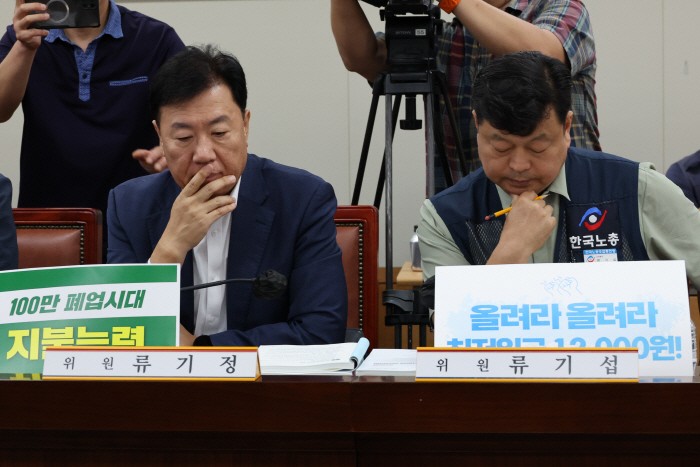 |
| Ryu Ki-jung, executive director of the Korea Enterprises Federation (left), and Ryu Ki-seop, secretary-general of the Federation of Korean Trade Unions, listen with grim expressions to remarks during the 8th plenary session of the Minimum Wage Commission, held at the Government Complex Sejong on June 23. / Yonhap News |
Labor and management have entered substantive wage negotiations for next year's minimum wage after exchanging their initial proposals. Labor demanded a steep hike, citing the crushing burden of living costs driven by high inflation. In stark contrast, management proposed a freeze, arguing that the paying capacity of small business owners and small and medium-sized enterprises (SMEs) has reached its absolute limit. With the gap between the two opening salvos sitting at 1,680 won, bridging the divide is expected to be a grueling process once again this year.
During the 8th plenary session of the Minimum Wage Commission held at the Government Complex Sejong on June 23, the worker members proposed an hourly wage of 12,000 won, representing a 16.3% increase from the current rate. The employer members countered with an initial proposal to freeze the wage at the current rate of 10,320 won per hour. For labor, their proposed hourly rate translates to a monthly salary of 2,508,000 won based on a standard 209-hour work month.
This session marked the first direct deliberation on the wage level since the commission voted down both the separate application of the minimum wage for piece-rate workers and the differential application by industry. Because the existing framework of applying a single, uniform minimum wage across all sectors will remain intact for next year, the focus of the commission's debate has naturally shifted entirely to the scale of the adjustment.
Labor grounded its argument for a major hike on the eroding real wages of low-income workers and the soaring burden of basic living expenses. They maintained that because the Minimum Wage Act explicitly enshrines workers' living costs as a primary determining factor, the rate should not be judged solely through the lens of business paying capacity or productivity.
Ryu Ki-seop, a worker member and secretary-general of the Federation of Korean Trade Unions, urged the commission to look closely at the legislative intent of the act, which mandates the reflection of workers' living costs above all else. He stated that the demand for 12,000 won per hour is the most practical measure to stabilize the livelihoods of low-income and vulnerable groups whose real wages have plummeted amid protracted high oil prices and rampant inflation.
Lee Mi-sun, vice chair of the Korean Confederation of Trade Unions, added that after various deductions, the current hourly rate of 10,320 won—or a monthly salary of 2,156,880 won—merely passes through a worker's bank account. She argued that since the cost of living has skyrocketed to unlivable levels, a minimum wage increase is essential for basic survival.
Conversely, management stressed the necessity of a wage freeze, asserting that the minimum wage is already excessively high and has outpaced the market's capacity to absorb it. Since the proposal for industry-by-industry differentiation was rejected, meaning a uniform rate will apply across the board, employers argued that the wage level must be set based on the financial threshold of the most struggling sectors and micro-enterprises.
Ryu Ki-jung, an employer member and executive director of the Korea Enterprises Federation, stated that because the commission must establish a single minimum wage that every single workplace is legally bound to honor without sectoral exceptions, next year's level must be determined with the most vulnerable industries and smallest-scale businesses in mind.
Ryu argued that over the past decade, the minimum wage has surged by 79.7%, vastly outstripping the 39.6% growth in nominal wages and the 22.9% rise in consumer prices over the same period. He claimed that businesses are currently in a state where even complying with the existing minimum wage is a massive struggle.
Yang Ok-seok, head of the human resources policy division at the Korea Federation of Small and Medium Business, warned that any further increase would mean small business owners on the brink of collapse will simply no longer be able to afford staff. He cautioned that a continuous hike would only accelerate the adoption of kiosks, unmanned operations, and AI automation, ultimately wiping out employment opportunities for vulnerable workers.
Minimum wage deliberations traditionally progress by having labor and management repeatedly submit revised proposals to narrow their differences after tabling their initial demands. If the impasse persists, the independent public members step in to establish a "deliberation facilitation range." The two sides then submit their final offers, and the matter is put to a vote.
Seong Jae-min, a public member and vice president of the Korea Labor Institute, noted that the session was the opening salvo in determining the wage level. He urged both sides to fully air their positions but emphasized that keeping the discussions rooted in objective data and facts is paramount.
The legal deadline for the commission to conclude its deliberations is June 29. However, given that a considerable amount of time was spent debating the differential application by industry and the separate application for piece-rate workers, coupled with the massive rift between the initial proposals, the commission is highly unlikely to meet the deadline this year. Following administrative procedures, including a formal objection period, the Minister of Employment and Labor must officially finalize and announce the next year's minimum wage by August 5.
Kim Nam-hyung
Most Read
-
1
Trump demands rates fall below 1% as Fed hikes for..

-
2
Celltrion seeks rheumatoid arthritis indication ex..

-
3
Chinese e-commerce giants AliExpress, Temu and She..

-
4
Trump warns countries not helping U.S. must pay re..

-
5
Turkish Airlines named main club partner of Liverp..

-
6
China expels No. 2 military official Zhang Youxia..

-
7
Houthi rebels release video claiming downing of Sa..

PEOPLE






-
Address : In-Young Bldg., 34, Uisadang-daero 1-gil, Yeongdeungpo-gu, Seoul
Copyright by ASIATODAY CO., LTD. All rights resereved