



Trump moves to restrict citizenship for "birth tourism" babies
Aug 07, 2026, 10:22 am


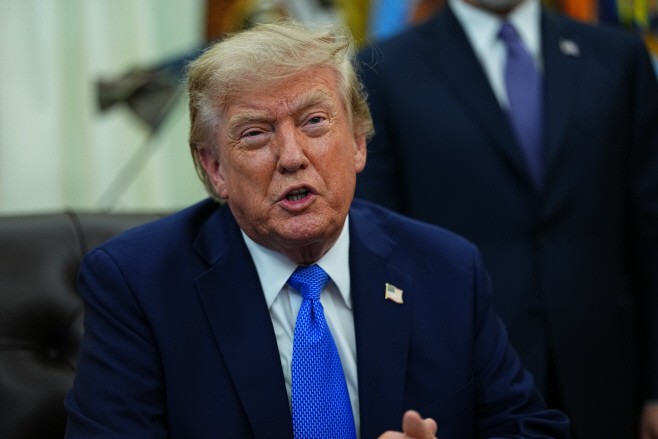 |
| U.S. President Donald Trump speaks during a signing ceremony for executive orders on birthright citizenship and the polysilicon industry at the Oval Office in Washington, D.C. on the 6th (local time). / EPA-Yonhap |
On the 6th (local time), U.S. President Donald Trump signed two executive orders aimed at cracking down on "birth tourism" and restricting birthright citizenship for the U.S.-born children of certain foreign nationals.
The sweeping birthright citizenship order Trump signed on his first day in office was ruled unconstitutional under the 14th Amendment by the Supreme Court on June 30. This latest move narrows the scope to birth tourism and the U.S.-born children of certain foreign nationals, but is expected to face fresh legal challenges.
Trump signs two executive orders restricting citizenship tied to birth tourism, certain foreign nationals' children
Trump signed the orders that day at the Oval Office, one targeting birth tourism and the other restricting citizenship for the U.S.-born children of certain foreign nationals. He called the Supreme Court's earlier ruling "very unfortunate," claiming, "It's very unfair, so we're adjusting it."
Trump stressed that the 14th Amendment was intended for the "babies of slaves," not for wealthy millionaires and billionaires. He criticized wealthy individuals for building a business around birthright citizenship and said they are "trying to buy citizenship with money," calling it a "disgrace."
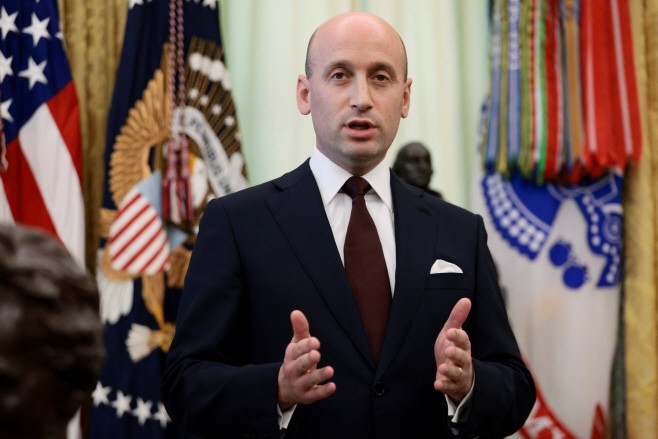 |
| Deputy White House Chief of Staff for Policy Stephen Miller speaks during President Trump's signing ceremony for executive orders on birthright citizenship and the polysilicon industry at the Oval Office in Washington, D.C. on the 6th (local time). / Reuters-Yonhap |
White House invokes INA Section 215(a) to crack down on visa fraud, birth tourism operators
The first target of the new measures is pregnant women who enter the U.S. while concealing their true purpose for travel, aiming to secure citizenship for their child. Commercial birth tourism arrangements involving surrogacy are also included in the restrictions.
The second executive order directs the secretaries of State and Homeland Security to develop regulations and guidance to block birth tourism and crack down on domestic and foreign brokers facilitating it. The U.S. has already prohibited, since 2020, the use of tourist or business visas primarily to obtain citizenship for a child.
The White House cited Section 215(a) of the Immigration and Nationality Act (INA) as the legal basis for the measures.
Deputy White House Chief of Staff for Policy Stephen Miller argued that claiming a tourist purpose while actually giving birth at a birth-tourism facility constitutes "fraud" against the U.S. government, describing Section 215(a) as one of the most powerful laws in the federal code.
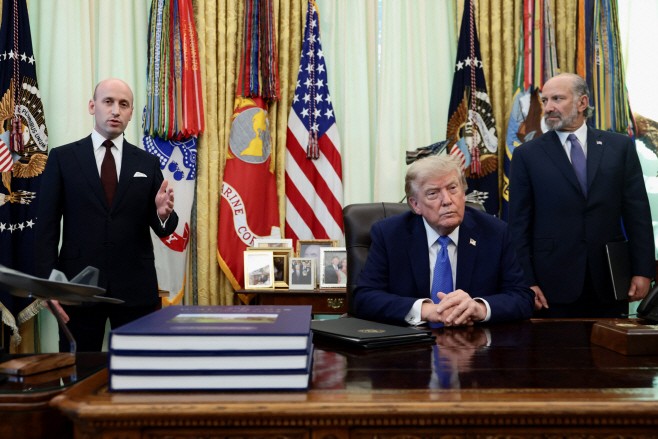 |
| Deputy White House Chief of Staff for Policy Stephen Miller (left) speaks during a signing ceremony for executive orders on birthright citizenship and the polysilicon industry at the Oval Office in Washington, D.C. on the 6th (local time), as President Donald Trump (center) and Commerce Secretary Howard Lutnick listen. / Reuters-Yonhap |
Trump administration expands citizenship exclusions to diplomatic staff and children of "alien enemies"
The scope of the order isn't limited to birth tourism. It also excludes the children of certain foreign mission staff working in the U.S. on behalf of a foreign government from automatic citizenship. U.S. outlet Axios interpreted this as an effort to extend the existing exception for ambassadors and diplomats' families to other non-citizen staff.
The order also covers U.S.-born children of individuals the U.S. government classifies as "alien enemies" and members of federally designated foreign terrorist organizations. A White House official said children of certain individuals lobbying or acting on behalf of a foreign government could also be included, but did not disclose the specific scope.
U.S. political outlet The Hill noted that courts have historically recognized several exceptions to birthright citizenship, including children of foreign sovereigns and diplomats, children of hostile occupying forces, children born aboard foreign government vessels, and children of Native American tribal members.
Restricting citizenship for those born in U.S. territories will not take effect immediately. Congress would first need to change the existing law granting automatic citizenship to people born in U.S. territories. A related bill was introduced last month but is unlikely to pass. If enacted, Axios reported that people born in Puerto Rico would be the main group affected.
U.S. Congress investigates birth tourism industry tied to China, Russia; legal experts anticipate 14th Amendment lawsuits
The U.S. Congress is also investigating the birth tourism industry. The House Oversight Committee requested documents in May from a company called "Have My Baby in Miami." The committee expressed concern that pregnant women coming to the U.S. for birth tourism are mostly from China and Russia, potentially posing a threat to national security and election integrity. The Senate Homeland Security Committee also released a report on birth tourism in 2022.
However, the U.S. government does not compile official statistics on the scale of birth tourism. Reuters reported that the Center for Immigration Studies, which supports reduced immigration, estimated that 20,000 to 25,000 women came to the U.S. for birth tourism in the single year from 2016 to 2017. Total U.S. births in 2025 numbered 3.6 million.
The key legal question is whether the president can restrict citizenship guaranteed under the 14th Amendment through executive order alone. Axios and Bloomberg both projected that the new orders are likely to face lawsuits on the grounds that they violate the 14th Amendment.
University of Virginia immigration law professor Amanda Frost said, "If birth tourism is a problem, the solution is to enforce that regulation," suggesting that enforcing existing rules — rather than creating new exceptions — is the appropriate solution.
Ha Man-ju
Most Read
-
1
Celltrion’s Omlyclo gains ground in major European..

-
2
Trump demands rates fall below 1% as Fed hikes for..

-
3
Trump makes $1 trillion bet ahead of midterm elect..

-
4
Iran resumes ballistic missile production, assembl..

-
5
Samsung Electronics, Mistral AI to jointly develop..

-
6
Trump warns countries not helping U.S. must pay re..

-
7
Seoul faces triple squeeze over troop deployment t..

PEOPLE






-
Address : In-Young Bldg., 34, Uisadang-daero 1-gil, Yeongdeungpo-gu, Seoul
Copyright by ASIATODAY CO., LTD. All rights resereved