



Kim Jung-un condemns S. Korea's push for nuclear subs
Jun 23, 2026, 05:17 pm


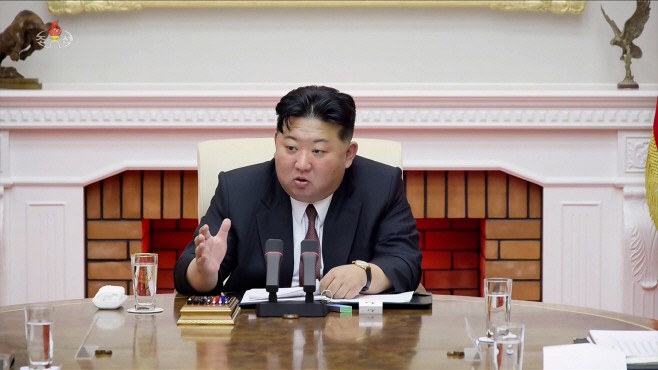 |
| North Korea convened the 3rd Political Bureau Meeting of the 9th Central Committee of the Workers' Party on June 22 to review proposals raised during sectoral consultative meetings along with the budget deliberation committee’s progress report, finalizing the draft resolution for the upcoming plenary meeting, the Korean Central Television (KCTV) reported on June 23. / Yonhap News |
North Korean leader Kim Jong Un claimed that South Korea's pursuit of nuclear-powered submarines is "driving the situation on the Korean Peninsula to a point of extreme aggravation," using the move to justify Pyongyang's nuclear weapons program and call for a strengthened united front with anti-imperialist, independent forces. The remarks are interpreted as a flat rejection of international calls for denuclearization, signaling Pyongyang's intent to counter such pressure by cementing its alignment with China and Russia.
According to the state-run Korean Central News Agency (KCNA) on June 23, Kim delivered his concluding remarks during the 2nd Plenary Meeting of the 9th Central Committee, held from June 20 to 22. In his speech, he emphasized that North Korea will "more aggressively push forward initiatives to expand and bolster a powerful, absolutely reliable self-defensive deterrent in response to the geopolitical crisis." He also stated that the regime must "strictly adhere to the party's principle of adversarial struggle, which officially recognizes South Korea as the most hostile state."
Kim specifically pointed to South Korea's acquisition of nuclear submarines, joint U.S.-South Korea military exercises, and the bilateral Nuclear Consultative Group (NCG) as the root causes behind the deteriorating security climate on the peninsula, utilizing them as pretexts to justify its nuclear arsenal and capabilities. Observers note that Kim's directives to ramp up "formidable defense assets"—including expediting the construction of a 10,000-ton strategic guided-missile cruiser to serve as a maritime platform for naval nuclear forces—are aimed at countering the U.S. and South Korea. Furthermore, his reiteration of the "adversarial struggle principle" against Seoul is seen as a direct rebuttal to the recent joint statement by South Korea and the European Union (EU), which condemned North Korea-Russia military cooperation and Pyongyang's nuclear program.
Kim In-tae, a senior research fellow at the Institute for National Security Strategy (INSS), noted, "It is highly significant that Kim went into such specific detail regarding the expansion of military capabilities, such as the 10,000-ton cruiser." He analyzed that "since the defense sector is currently North Korea's most cutting-edge field and the one yielding the most visible results, the message is intended to rationalize its nuclear buildup to both domestic and foreign audiences while signaling a continued concentration of resources there."
With speculation growing in some quarters that Washington will pivot its focus back to the North Korean issue after concluding end-of-war negotiations elsewhere, analysts suggest Pyongyang is preemptively broadcasting messages to shut down any possibility of denuclearization talks. In particular, with Russia recently defending North Korea's nuclear program and China offering tacit approval on the surface, the geopolitical environment has effectively allowed Pyongyang to solidify its status as a de facto nuclear-armed state. Consequently, experts assess that the likelihood of North Korea returning to the negotiating table for denuclearization has grown even more remote, as it increasingly anchors its foreign policy on solidarity with Moscow and Beijing.
Meanwhile, the plenary meeting yielded an unusual reshuffle with the political resurrection of Jo Yong Won, a close confidant of Kim Jong Un, who was reappointed as Party Organizing Secretary and Director of the Organization and Guidance Department (OGD) after a three-month hiatus. According to North Korean media, the move comes amid an ongoing investigation into corruption allegations involving Major General Pak Hui Chol, vice director of the Korean People's Army General Political Bureau. Kim Jae Ryong, the incumbent OGD director, was dismissed due to a "change in official duties," paving the way for Jo's return. The shakeup is presumed to be a disciplinary and corrective measure aimed at addressing corruption within the military's political bureau, tightening loose discipline within party organs, and refreshing the organizational structure.
Senior Research Fellow Kim In-tae analyzed the move as "highly unprecedented and anomalous," adding that "it indicates that issues arose not only regarding corruption within the military but also in connection with the Workers' Party's operations, and this reshuffle appears to be a crisis-management measure to clean up the fallout."
Mok Yong-jae
Most Read
-
1
Trump demands rates fall below 1% as Fed hikes for..

-
2
Celltrion seeks rheumatoid arthritis indication ex..

-
3
Chinese e-commerce giants AliExpress, Temu and She..

-
4
Trump warns countries not helping U.S. must pay re..

-
5
Turkish Airlines named main club partner of Liverp..

-
6
China expels No. 2 military official Zhang Youxia..

-
7
Houthi rebels release video claiming downing of Sa..

PEOPLE







-
Address : In-Young Bldg., 34, Uisadang-daero 1-gil, Yeongdeungpo-gu, Seoul
Copyright by ASIATODAY CO., LTD. All rights resereved