



Logistics giant JD.com announces full robotization, rattling Chinese industry
Jun 23, 2026, 10:48 am


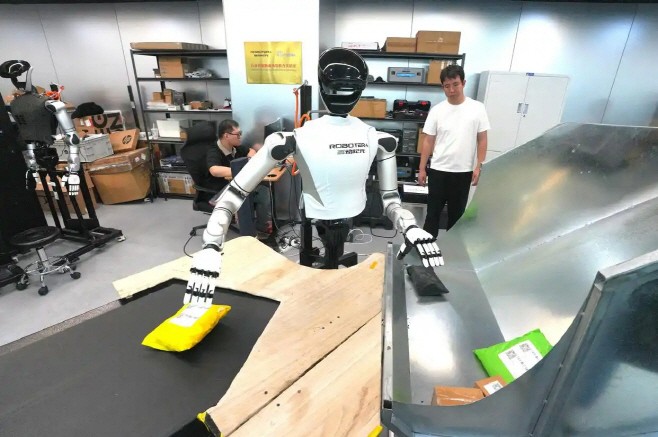 |
| A robot sorting parcels to be delivered at a logistics company in Jiuxianqiao, Chaoyang District, Beijing. Robots are expected to directly handle the actual deliveries in the near future. / Courtesy of The Beijing News |
JD.com, a titan of China's e-commerce industry and recognized as one of the world's largest logistics enterprises, recently announced a transition to complete robotization, leaving competing firms and tech giants scrambling to formulate countermeasures. Conversely, some enterprises are maintaining a more positive outlook, viewing the shift as an inevitable progression and resolving to proactively adapt to the changing landscape.
According to a synthesis of reports from The Beijing News and other media outlets on June 22, Richard Liu (Liu Qiangdong), the founder and chairman of JD.com, strongly expressed his commitment to full robotization during his address at the APEC CEO Forum held in Beijing the previous day. "We have consistently made significant investments in artificial intelligence (AI) and robotics technology," Liu noted during his speech. He firmly established that JD.com would soon pioneer an era of unmanned delivery, stating, "Robot delivery will be fully realized in the near future. When that happens, delivery couriers will no longer be necessary."
In truth, his remarks are not entirely unprecedented, especially given the rapid advancement of China's embodied AI technology—which rival-to-exceeds that of the United States—and the increasing integration of robotics across various industrial sectors. This is particularly evident considering that Xiaomi, another leading Chinese tech giant, has been operating "dark factories" (unmanned, fully automated manufacturing facilities running 24/7 utilizing AI and robotics) for over seven years.
Nevertheless, Chairman Liu's influence carries substantial weight, and JD.com holds massive nationwide influence as China's equivalent to dominant logistics and delivery platforms. Furthermore, because corporate executives have traditionally refrained from making overt statements regarding robot implementation due to concerns over employment stability across industries, his declaration delivered a profound shock to the market.
In response, competitors and major tech firms are closely monitoring the potential ripple effects while moving swiftly to devise strategic countermeasures. Concurrently, over 2,000 workers in the logistics and food delivery sectors are facing a sudden wave of anxiety over potential downsizings. Highly educated individuals who reluctantly turned to gig labor amid the persistent employment shortage of recent years are particularly vulnerable to renewed professional setbacks.
In an effort to address these anxieties, Chairman Liu pledged to secure employment for the company's workforce through a newly launched initiative. "We have initiated the 'Phoenix Resurgence Plan,' which aims to provide technical training to our 70,000 frontline delivery couriers," Liu explained. "These workers will be transitioned to technical and administrative roles, taking charge of the repair and maintenance of the robots, which are prone to frequent malfunctions. This shift will ensure they no longer have to endure grueling physical labor outdoors in harsh weather conditions." However, frontline staff are unlikely to take these assurances at face value, and it remains highly questionable whether such transitions can accommodate the entirety of the displaced workforce. Regardless of the internal skepticism, the dawn of the robotic era in China's logistics industry has undeniably begun.
Hong Soon-do
Most Read
-
1
Celltrion’s Omlyclo gains ground in major European..

-
2
Trump demands rates fall below 1% as Fed hikes for..

-
3
Trump makes $1 trillion bet ahead of midterm elect..

-
4
Iran resumes ballistic missile production, assembl..

-
5
Samsung Electronics, Mistral AI to jointly develop..

-
6
Trump warns countries not helping U.S. must pay re..

-
7
Seoul faces triple squeeze over troop deployment t..

PEOPLE







-
Address : In-Young Bldg., 34, Uisadang-daero 1-gil, Yeongdeungpo-gu, Seoul
Copyright by ASIATODAY CO., LTD. All rights resereved