



Oil prices tumble 3.3% as U.S. issues 60-day Iranian sanctions waiver
Jun 23, 2026, 09:08 am


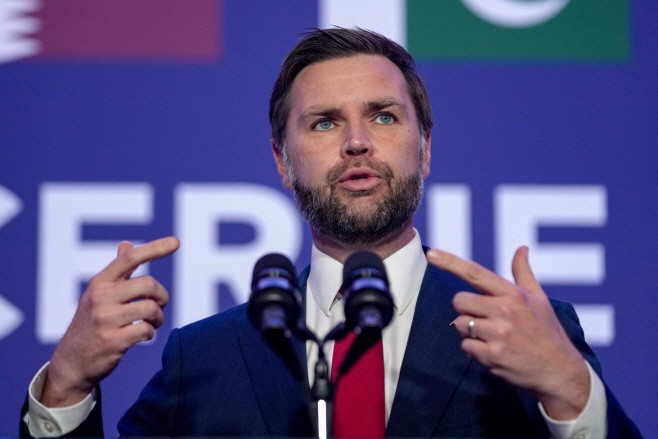 |
| U.S. Vice President J.D. Vance speaks on the peace negotiations with Iran, which commenced the previous day, at the Bürgenstock Resort near Lucerne, Switzerland, on June 22. / Reuters, Yonhap |
The U.S. Department of the Treasury issued a 60-day temporary general license allowing the production, delivery, and sale of Iranian crude oil, Treasury Secretary Scott Bessent announced on June 22.
Bessent explained that the measure follows Iran's pledges to ensure free and open navigation through the Strait of Hormuz and to permit the reentry of International Atomic Energy Agency (IAEA) inspectors.
U.S. Vice President J.D. Vance confirmed that Iran has agreed to the return of IAEA inspectors. However, Iran’s Ministry of Foreign Affairs countered the claim, stating it has neither negotiated on the nuclear issue nor accepted any new obligations.
U.S. Treasury eases Iran oil sanctions for 60 days, giving breathing room for dollar payments and crude exports
Secretary Bessent announced the issuance of the temporary general license via X (formerly Twitter). The waiver runs until 12:01 a.m. Eastern Time on August 21, enabling Iran to receive oil export payments in U.S. dollars.
Reuters reported that the general license clears the way for both the sale of Iranian crude and settlements in dollars. Miyad Maleki, a former official responsible for Iran sanctions at the U.S. Treasury Department, told the Wall Street Journal that the waiver effectively exempts financial institutions, including the Central Bank of Iran, from certain sanctions. Maleki noted that this represents a fundamental departure from the Iran sanctions framework built by Congress over the past two decades.
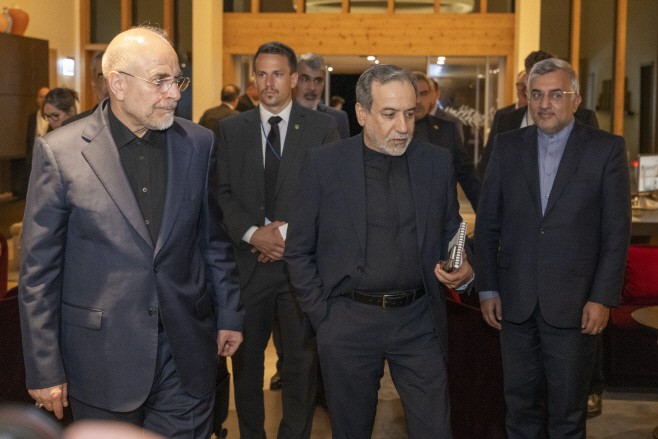 |
| Iranian Parliament Speaker Mohammad Bagher Ghalibaf (left) and Foreign Minister Abbas Araghchi (center) attend a four-party meeting at the Bürgenstock Resort in Obbürgen, near Lucerne, Switzerland, on June 21. / EPA, Yonhap |
Vance: "Iran agrees to IAEA inspectors' return"; Iran: "No nuclear negotiations or new obligations"
Vice President Vance held a press conference at the Bürgenstock Resort in Lucerne, Switzerland, following the conclusion of the first high-level follow-up negotiations since the signing of a wartime cessation Memorandum of Understanding (MOU). "Iran has agreed to reinvite IAEA inspectors back into the country," Vance emphasized, adding, "This is the first step toward permanently denuclearizing or permanently ending Iran’s nuclear weapons program." He noted that the inspectors' monitoring activities are scheduled to resume this week, and could potentially start as early as today.
Iranian Foreign Ministry Spokesman Esmaeil Baghaei told Iran’s state-run IRNA news agency, "Mutual cooperation between Iran and the IAEA will continue according to current procedures, based on the approvals of the Islamic Consultative Assembly (Majlis) and decisions made by the Supreme National Security Council." IRNA further reported that the Iranian delegation did not engage in any negotiations regarding the nuclear issue during the Swiss meetings, nor did they accept any new obligations.
Signs of recovery in the Strait of Hormuz; U.S. and Iran activate Lebanon de-confliction mechanism
Furthermore, Vice President Vance revealed that the U.S. and Iran have established a "mechanism to keep the Strait of Hormuz open" along with a "de-confliction mechanism" for the region, including Lebanon.
Mediating nations, such as Qatar and Pakistan, announced in a joint statement summarizing the talks that all parties have agreed to a 60-day roadmap, the formation of a high-level committee, and the launch of technical working groups.
Indeed, Reuters reported that four Qatari-operated liquefied natural gas (LNG) tankers passed through the Strait of Hormuz into the Persian Gulf earlier today, marking the first such transit since hostilities broke out between Iran, the U.S., and Israel. Shipbroking firm Clarksons noted in a report that "while daily transits remain below the pre-conflict level of 125, the trajectory is positive." Following the news of progress in the negotiations, Brent crude futures slid 3.31% to settle at $77.90 per barrel.
Friction over the use of frozen funds; Vance says "purchasing U.S. agricultural goods" while Iran stays silent
Vice President Vance stated that if Iran’s frozen foreign assets are released, the U.S. and Qatar will hold approval authority, and the funds will be used to purchase U.S. soybeans, corn, and wheat. The Iranian side did not release a separate statement regarding this blueprint, which was devised with Qatar by President Trump’s eldest son-in-law, Jared Kushner. Qatar currently holds $6 billion in Iranian oil revenues that were previously transferred from South Korea.
Daniel Tannebaum, a senior fellow at the Atlantic Council, a U.S. think tank, pointed out to the New York Times that the current sanctions relief appears hasty compared to the Joint Comprehensive Plan of Action (JCPOA)—the 2015 Iran nuclear deal struck under the Barack Obama administration and later dismantled during Trump's first term. "It is worth noting that when the JCPOA was signed, sanctions relief was not provided immediately," Tannebaum remarked. "It only occurred on 'Implementation Day,' six months after the IAEA verified that Iran had fulfilled its nuclear obligations."
Ha Man-joo
Most Read
-
1
Trump shares map on social media labeling Strait o..

-
2
Kia Sportage outperforms Mazda CX-5 in German auto..

-
3
Houthis launch successive attacks on Saudi airport..

-
4
U.S. deploys carrier, 10,000 more troops to Middle..

-
5
Trump rejects Iran's offer to open Strait of Hormu..

-
6
N. Korea conducts first swarm attack drill with dr..

-
7
U.S.-China summit falls short on substance as Trum..

PEOPLE






HEADLINE NEWS
- Seoul dismisses Ukraine's claim of 'S. Korean support for Russia' as "inaccurate and inappropriate"
- S. Korea, Japan race to develop nuclear-powered submarines
- Henri Kagan, Kenso Soai win Nobel Prize in Chemistry for uncovering how mol..
- Vance says Alaska LNG cooperation will move forward with Seoul's current or..

-
Address : In-Young Bldg., 34, Uisadang-daero 1-gil, Yeongdeungpo-gu, Seoul
Copyright by ASIATODAY CO., LTD. All rights resereved