



[Exclusive] Han Sung-sook calls for keeping prosecution reform on track while mending side effects
Jun 23, 2026, 09:19 am


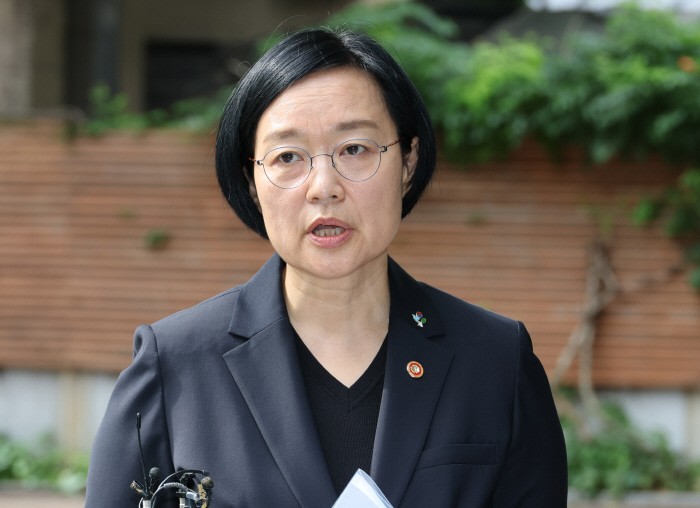 |
| Prime Minister nominee Han Sung-sook arrives at her temporary office prepared for the parliamentary confirmation hearing at the Financial Supervisory Service’s Training Institute in Tongui-dong, Jongno-gu, Seoul, on June 22. / Yonhap News |
Prime Minister nominee Han Sung-sook has expressed her stance on the fate of the prosecution's supplementary investigative powers, emphasizing the core principle of prosecution reform—the separation of investigation and indictment—while simultaneously calling for measures to prevent side effects, such as loopholes in the state's crime response capabilities. As the debate over abolishing supplementary investigative powers intensifies within the ruling bloc, attention is focusing on how the nominee's cautious approach will shape the outcome.
In a written response submitted to the office of Representative Kang Seung-gyu of the ruling People Power Party on June 23, Han stated, "I view the issue of supplementary investigative powers as a dual problem combining the redistribution of centralized prosecutorial authority on one hand, and the public's right to receive fair and prompt criminal justice services on the other."
Han refrained from taking a direct stance for or against the abolition. "President Lee Jae-myung has instructed that prosecution reform undergo thorough deliberation and public consensus-building," Han explained. "I understand that the government, keeping this intent in mind, has strived to reflect the public's voice in the reform proposal by gathering feedback through advisory committees and relevant agencies, as well as holding public forums." She added, "Taking various concerns and potential issues into account, I will actively support the National Assembly's legislative discussions to create a system that causes no inconvenience to the public."
Han maintained her reserved stance, offering no definitive response to concerns that stripping the prosecution of its supplementary investigative powers could weaken oversight of police investigations and create gaps in the protection of victims' rights, repeating only that she would "actively support the National Assembly's discussions."
Addressing criticisms that her corporate background leaves her lacking expertise in the criminal justice sector, Han remarked, "Revisions to the Criminal Procedure Act should be reviewed under the overarching principle of prosecution reform: the separation of investigation and indictment." However, she added, "Mindful of the anxiety surrounding potential chaos from abrupt institutional shifts, I will work to devise countermeasures against side effects, such as preventing the erosion of the state's crime-fighting capabilities and strengthening victim protection."
Some legal circles interpret Han's remarks as a cautious approach, wherein she aligns with the general trajectory of prosecution reform but chooses to monitor the legislative debate before committing to the abolition of supplementary investigative powers.
Opinions within the ruling camp remain divided between those advocating for the total elimination of supplementary investigative powers and others arguing that a certain scope of authority must be preserved to protect the rights and interests of citizens.
Meanwhile, ahead of the party's national convention in August, leadership contenders within the Democratic Party of Korea have successively called for the "complete abolition" of the prosecution's supplementary investigative powers, appealing to hardline party loyalists. Representative Jung Chung-rae, the party leader, reiterated the call for abolition during a Supreme Council meeting on June 22. Prime Minister Kim Min-suk also publicly stated during a press briefing on the same day that the elimination of supplementary investigative powers has become inevitable at this juncture.
Conversely, Justice Minister Jung publicly voiced concerns over the Democratic Party's push for abolition. Speaking to reporters on June 12 after attending the 55th National Correctional Officers Martial Arts Tournament at the Legal Research and Training Institute in Jincheon, Chungcheongbuk-do, Minister Jung countered, "If the prosecution steps away from investigations entirely, what alternatives do we have to protect the victims?" He underscored, "The most critical factor in prosecution reform and revisions to the Criminal Procedure Act must be victim protection."
Jeong Min-hoon
Most Read
-
1
Trump demands rates fall below 1% as Fed hikes for..

-
2
Celltrion seeks rheumatoid arthritis indication ex..

-
3
Chinese e-commerce giants AliExpress, Temu and She..

-
4
Trump warns countries not helping U.S. must pay re..

-
5
Turkish Airlines named main club partner of Liverp..

-
6
China expels No. 2 military official Zhang Youxia..

-
7
Houthi rebels release video claiming downing of Sa..

PEOPLE







-
Address : In-Young Bldg., 34, Uisadang-daero 1-gil, Yeongdeungpo-gu, Seoul
Copyright by ASIATODAY CO., LTD. All rights resereved