



Ministry of Justice stays cautious on bar exam reform, seeks 'optimal' pass rate
Jun 23, 2026, 10:43 am


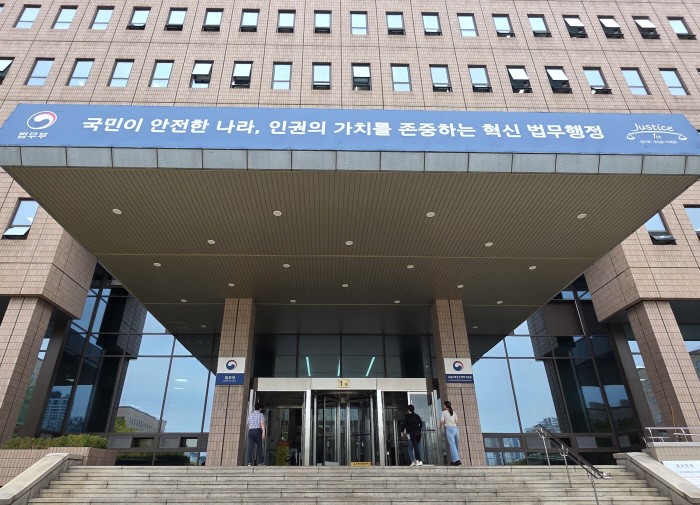 |
| The Ministry of Justice / Reporter Jung Min-hoon |
 |
The annual conflict between the legal industry and academia surrounding the number of successful bar exam candidates continues to repeat itself. Despite the ongoing friction, the Ministry of Justice—which holds the ultimate authority over the final decision—has refrained from taking a definitive stance, leaving discussions on reforming the bar examination system at a perpetual standstill.
Asia Today conducted interviews with six deans of law schools nationwide starting April 20. The deans unanimously argued that the bar exam, which currently functions as a competitive "selection exam" maintaining a pass rate of around 50% relative to total applicants, should be transitioned into a "qualification-based exam." They further demanded a comprehensive overhaul of the examination system, emphasizing that the absence of a predictable standard for the number of passing candidates exacerbates uncertainty for both law schools and examinees.
In response to the law schools' position, the Ministry of Justice maintained a cautious tone, stating, "We are continuously striving to determine an appropriate scale of successful candidates from a comprehensive perspective, taking into account the criteria for bar exam passing decisions in accordance with the annual deliberations of the Bar Examination Management Committee." The ministry added, "The details of the committee's deliberations involve matters currently under decision-making and internal review, which could compromise the impartial performance of official duties if disclosed, and will therefore remain confidential."
The Ministry of Justice typically announces the bar exam results around April each year. Prior to the announcement, the Bar Examination Management Committee under the ministry holds closed-door meetings to deliberate on the appropriate number of successful candidates. The committee is comprised of the Vice Minister of Justice, law professors, and judges, prosecutors, and attorneys with more than ten years of professional experience.
Subsequently, the Ministry of Justice finalizes the exact number of successful candidates by synthesizing the committee's deliberation results with opinions gathered from the Supreme Court, the Korean Bar Association, and the Korean Association of Law Schools. According to the ministry, the baseline standard for the passing quota is set at "75% or more of the total law school enrollment capacity (at least 1,500 candidates)." However, the final figure is determined by comprehensively weighing factors such as previous passing numbers and rates, the original purpose of introducing the law school system, the growing number of total applicants, the current distribution of legal professionals, academic management status, and grading outcomes.
Nevertheless, the actual process through which the passing quota is determined remains entirely opaque, leaving the specific calculation methods and the contents of the committee discussions undisclosed. This "blind determination process" forces the legal industry and academia into a repetitive, exhausting debate over the optimal number of passing candidates year after year.
Ahead of the 9th nationwide simultaneous local elections, Asia Today identified 52 municipal and county districts that completely lack a practicing attorney and visited these areas to hear from residents isolated from legal services. In some regions, residents had to dedicate an entire day or more just to receive a single legal consultation, and a significant portion of the population was entirely unaware of the existence of accessible legal services. Even the few attorneys providing legal assistance to these remote communities agreed that establishing practical operating conditions, such as baseline financial or administrative support, is essential to ensure the sustainability of the system.
A core priority for expanding regional legal services is the cultivation of local legal talent. While regional law schools select students through a mandatory regional talent quota system, a substantial portion of these graduates eventually relocate to the Seoul metropolitan area. When asked by this newspaper whether the regional talent quota system is successfully achieving its goal of nurturing local legal professionals, the Ministry of Justice replied in a written statement, "The quota system falls under the jurisdiction of the Ministry of Education, and we will continue to hold consultations regarding the matter." In effect, the government has placed the entire administrative burden of recruiting regional talent on law schools without establishing sufficient preferential treatments or supportive policies for those individuals.
"While we understand the Ministry of Justice's underlying intentions, the operation of the system needs to be far more transparent to ensure predictability for the examinees," a law school professor remarked. The professor added, "There is an urgent need to reform the ministry's current structure for managing the bar exam. It is time to seriously reconsider this dualized framework—where education is overseen by the Ministry of Education and the examination is run by the Ministry of Justice—in a way that aligns with the fundamental objectives of both law schools and the bar exam."
Son Seung-hyun
#Ministry of Justice #Bar exam
Copyright by Asiatoday
Most Read
-
1
Trump demands rates fall below 1% as Fed hikes for..

-
2
Celltrion seeks rheumatoid arthritis indication ex..

-
3
Chinese e-commerce giants AliExpress, Temu and She..

-
4
Trump warns countries not helping U.S. must pay re..

-
5
Turkish Airlines named main club partner of Liverp..

-
6
China expels No. 2 military official Zhang Youxia..

-
7
Houthi rebels release video claiming downing of Sa..

PEOPLE







-
Address : In-Young Bldg., 34, Uisadang-daero 1-gil, Yeongdeungpo-gu, Seoul
Copyright by ASIATODAY CO., LTD. All rights resereved