



LG Chem to pump 15tn won into R&D, eyeing chip, mobility, and robotics materials
Jun 23, 2026, 09:47 am


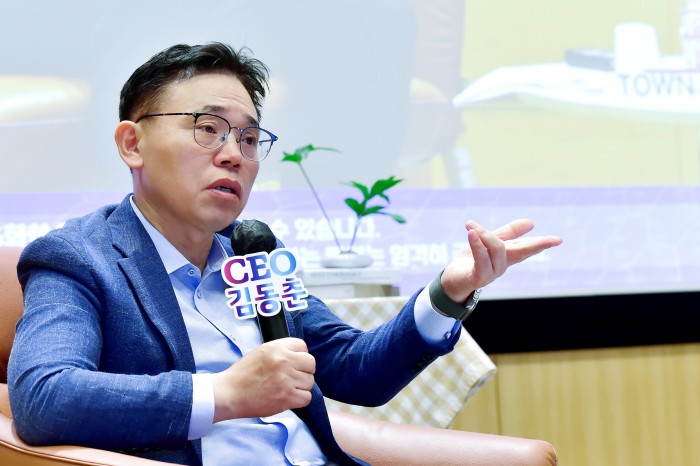 |
| Kim Dong-chul, President of LG Chem, outlines the company's growth strategies for future core businesses, including semiconductors, mobility, and robotics, during a town hall meeting. / Courtesy of LG Chem |
LG Chem is embarking on a full-scale transformation into an AI-based high-value materials company by pumping 15 trillion won into research and development (R&D) through 2035.
According to LG Chem on June 23, Kim Dong-choon, President of LG Chem, announced during a town hall meeting on June 22 that the company will upgrade its portfolio by fostering semiconductor, mobility, and robotics materials, along with anti-cancer therapeutics, as its future core growth engines.
This strategic pivot comes as the profitability of the traditional chemical industry slows due to global oversupply and intensifying competition. LG Chem aims to advance its revenue structure around high-growth industries, expanding the share of high-value businesses based on its technological edge and customer base while continuing to reinforce the competitiveness of its existing operations. Through these initiatives, LG Chem plans to achieve a double-digit operating profit margin by 2030.
To bankroll this vision, the company will commit a total of 15 trillion won to R&D by 2035. Notably, 70% of these R&D resources will be allocated to future growth sectors, including semiconductor, mobility, and robotics materials, with a sharp focus on securing AI-driven new application areas and pioneering technologies. To back this execution, the company established a new business development organization directly under the CEO this past June to accelerate strategic implementation.
Furthermore, within the boundaries of manageable financial resources, LG Chem intends to leverage external growth strategies such as mergers and acquisitions (M&A) to fast-track business expansion and sharpen its global competitiveness.
By business segment, the company will focus on securing competitiveness in advanced packaging materials within the semiconductor and infrastructure sectors. It plans to expand the development of high-value products, including packaging adhesives, low-dielectric materials, thermal management materials, and glass substrates. Backed by its core competence in materials like Photo-imageable Dielectric (PID), Die Attach Film (DAF), and Copper Clad Laminate (CCL), the company aims to scale its electronic materials business to 2 trillion won by 2030.
In the mobility and robotics sector, LG Chem will extend its scope beyond electric vehicles and future mobility materials into structural materials for robots, as well as precision actuation and bonding materials. By leveraging technological barriers built through joint development projects with clients, the company intends to establish a sustainable and stable profit foundation.
For the anti-cancer therapeutics business, the company will strengthen its pipeline competitiveness centering on global clinical trials and strategic partnerships. It plans to elevate commercialization potential through technology transfers and M&As, nurturing the segment into a mid-to-long-term growth engine.
Alongside these efforts, LG Chem is shifting its business model from a mere materials supplier into an "integrated solution provider" that co-designs both product performance and manufacturing processes with its customers. This strategy aims to break away from price-centered competition and build a stable, sustainable, and highly profitable structure.
"While strengthening the competitiveness of our existing businesses, LG Chem will concentrate its capabilities on future growth axes centering on semiconductor, mobility, and robotics materials, as well as anti-cancer therapeutics," said Kim Dong-choon, President of LG Chem. "Through this, we will leap forward as a tech-driven converting company."
Son Kang-hoon
Most Read
-
1
Kia Sportage outperforms Mazda CX-5 in German auto..

-
2
Houthis launch successive attacks on Saudi airport..

-
3
Saudi Arabia, Iran hold first diplomatic talks to..

-
4
U.S. deploys carrier, 10,000 more troops to Middle..

-
5
Saudi airport in Riyadh struck again, leaving at l..

-
6
Putin's ally visits China on the 8th ahead of APEC..

-
7
Chinese military support and training center opens..

PEOPLE




HEADLINE NEWS

-
Address : In-Young Bldg., 34, Uisadang-daero 1-gil, Yeongdeungpo-gu, Seoul
Copyright by ASIATODAY CO., LTD. All rights resereved