



AI boom, low birthrates devastate humanities majors in China
Jun 22, 2026, 10:16 am


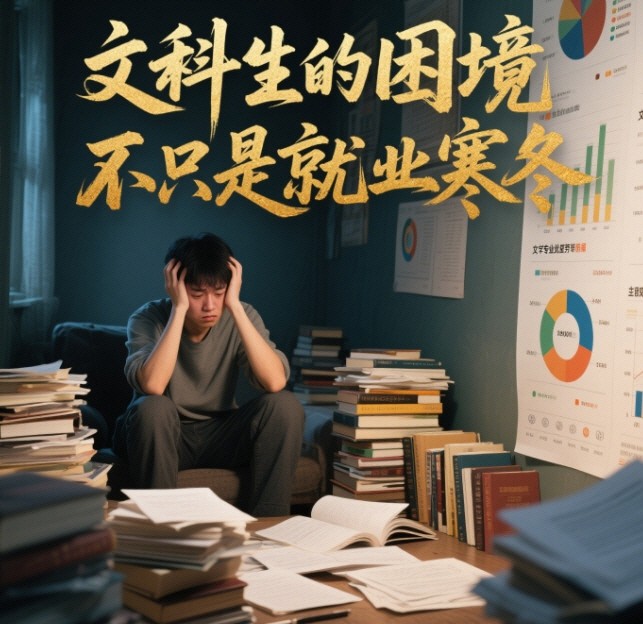 |
| A media report starkly captures the grim reality facing humanities majors in China, a trend that is becoming increasingly undeniable amid the massive AI boom. / Courtesy of The Beijing News |
According to Beijing sources familiar with Chinese education trends on June 21, humanities majors at Chinese universities have historically struggled with low popularity—a dynamic that aligns naturally with the pragmatic culture of Chinese society, which deeply values the principle of "seeking truth from facts." However, with the recent explosion of the AI industry, this trend has accelerated into an undeniable shift. Across the country, language and other humanities departments are facing structural mergers or outright elimination.
In stark contrast, science, technology, engineering, and mathematics (STEM) departments are expanding exponentially through massive, simultaneous initiatives nationwide. The severity of the crisis is echoed by Renmin University Political Science Professor Huang Dahui, who expressed deep concern over the current landscape. "No matter how much the world changes, this approach is problematic," Huang warned. "Neglecting the humanities—the bedrock of foundational academia—to focus exclusively on launching AI-related departments is the wrong direction. If this persists, universities will become houses built on sand."
Education and teacher-training majors face a similar predicament, overshadowed by STEM fields as a plunging birthrate destroys future demand. This shift is most visible in the sharp reduction of state-funded slots for education majors. Synthesizing June 20 reports from local media outlets, including The Beijing News, recent administrative changes by the Henan Province education ministry illustrate the broader crisis.
Last year, Henan Province recruited 2,249 students under its "Tuition-Free Normal Students" initiative (a state-sponsored program providing full tuition, housing, and living stipends) and its regional "Excellent Teacher Plan." This year, however, the target dropped to just 1,117 students—a 51.3% plunge. Notably, the province entirely cancelled recruitment for tuition-free early childhood education majors.
A similar pattern is unfolding in the southern Guangxi Zhuang Autonomous Region. After admitting 2,843 and 1,571 tuition-free education students in 2024 and last year respectively, the region plans to recruit only 666 students this year. Other provinces and municipalities, including Hunan, are following a similar trajectory. Beyond scaling back state-funded programs, authorities are strictly regulating enrollment for non-education-focused universities offering education-related degrees. Consequently, teacher-training programs have been sidelined just as aggressively as traditional humanities departments.
The downsizing of humanities and education disciplines is poised to become the new normal across Chinese higher education for the foreseeable future. This sharp decline mirrors the meteoric rise of AI-related fields, demonstrating how the AI boom is comprehensively restructuring the landscape of Chinese universities.
Hong Soon-do
Most Read
-
1
Celltrion’s Omlyclo gains ground in major European..

-
2
Trump demands rates fall below 1% as Fed hikes for..

-
3
Trump makes $1 trillion bet ahead of midterm elect..

-
4
Iran resumes ballistic missile production, assembl..

-
5
Samsung Electronics, Mistral AI to jointly develop..

-
6
Trump warns countries not helping U.S. must pay re..

-
7
Seoul faces triple squeeze over troop deployment t..

PEOPLE






-
Address : In-Young Bldg., 34, Uisadang-daero 1-gil, Yeongdeungpo-gu, Seoul
Copyright by ASIATODAY CO., LTD. All rights resereved