



Lebanon holds ceasefire talks back from day one
Jun 22, 2026, 09:16 am


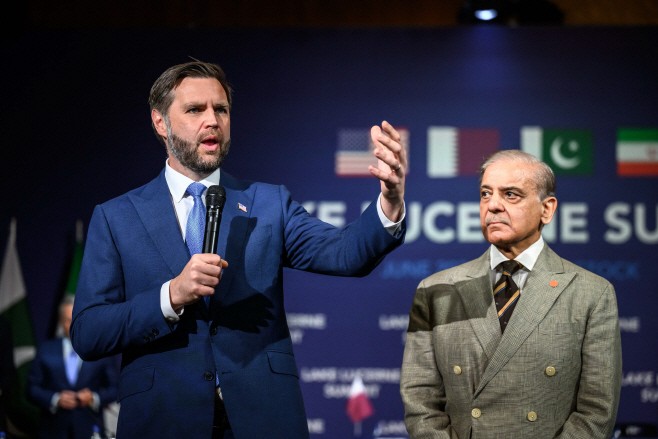 |
| U.S. Vice President J.D. Vance (left) speaks next to Pakistani Prime Minister Shehbaz Sharif ahead of a quadrilateral meeting between the U.S., Iran, Pakistan, and Qatar at the Bürgenstock Resort overlooking Lake Lucerne, Switzerland, on the 21st (local time). / AFP·Yonhap |
Although the United States and Iran held follow-up high-level negotiations to implement the ceasefire Memorandum of Understanding (MOU) at the Bürgenstock Resort near Obbürgen, Switzerland, on the 21st (local time), the talks fell into a deadlock on the very first day due to U.S. President Donald Trump's threats of renewed airstrikes and complications regarding the Lebanese front.
While Iranian media outlets reported that the Iranian delegation walked out of the venue following an 80-minute quadrilateral meeting, Western news agencies, including AP and Bloomberg, reported that the talks have not collapsed entirely, as Iranian officials maintain contact with mediating nations. The session was attended not only by the U.S. and Iran but also by representatives from Pakistan and Qatar, who are serving as mediators.
With Washington considering the 60-day negotiation window to have commenced on the 18th—the day after both presidents signed the MOU—the final deadline for a conclusive agreement is set for August 16.
Trump threatens renewed airstrikes over Hezbollah, clashing with MOU non-aggression clause
"Iran must immediately stop its highly funded Lebanese proxies from causing trouble," Trump warned on his social media platform, Truth Social, on the same day. "Otherwise, we will hit Iran again very hard, just as we did last week, and the strikes will be even stronger."
In a separate interview with Fox News, Trump also delivered a stark warning to Iranian officials, stating, "If you block the strait, you won't have a country, and you won't even be able to go back to your fu*king country."
The Wall Street Journal (WSJ) pointed out that Trump's remarks touching upon renewed airstrikes and control of the Strait of Hormuz provided Iran with leverage to argue that Washington is violating the MOU clause, which explicitly dictates that both sides refrain from the threat or use of force against each other.
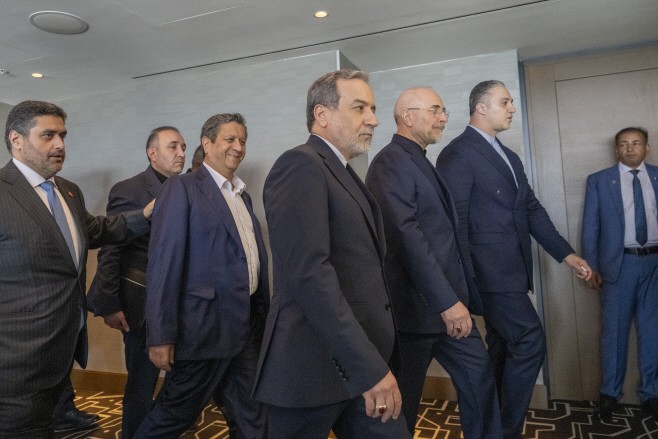 |
| Iranian Foreign Minister Abbas Araghchi (left) and Iranian Parliament Speaker Mohammad Bagher Ghalibaf (second from left) walk to attend the U.S.–Iran ceasefire negotiations, mediated by Pakistan and Qatar, at the Bürgenstock Resort in Obbürgen near Lucerne, Switzerland, on the 21st (local time). / EPA·Yonhap |
Iran refuses nuclear talks before Lebanon ceasefire; Ghalibaf warns "unfazed by threats, military will respond"
Upon hearing President Trump's threatening remarks, the Iranian delegation led by Parliament Speaker Mohammad Bagher Ghalibaf lodged a strong protest with the U.S. side and walked out of the negotiating venue, Iran's state-run IRNA news agency reported.
"Don't they realize that if their threats had even the slightest effect, they wouldn't be in such a desperate state today?" Ghalibaf wrote on X (formerly Twitter). "We never take American threats seriously." He further warned, "The U.S. would do well to speak with caution. Our military is prepared to respond in a different manner, and we remain unshaken by whatever they say."
Iran's hardline posture also led to a refusal to engage in nuclear talks on that day. Iran's state broadcaster IRIB reported that during the 80-minute quadrilateral meeting, no discussions regarding Iran's nuclear program took place, with the session focusing entirely on the Lebanese issue and reviewing the implementation of the MOU.
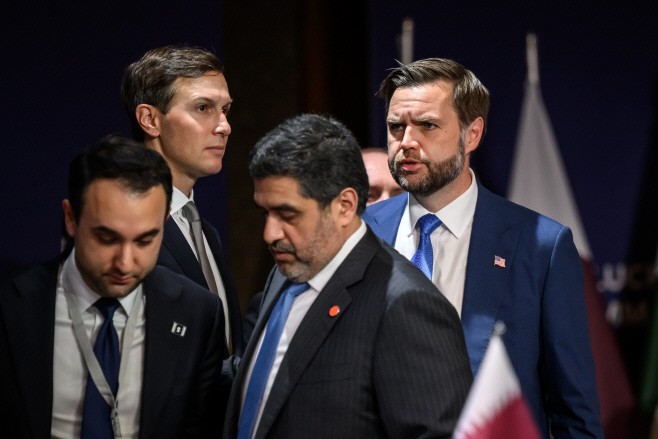 |
| U.S. Vice President J.D. Vance (right) speaks next to U.S. President Donald Trump's son-in-law Jared Kushner ahead of a quadrilateral meeting between the U.S., Iran, Pakistan, and Qatar at the Bürgenstock Resort overlooking Lake Lucerne, Switzerland, on the 21st (local time). / AP·Yonhap |
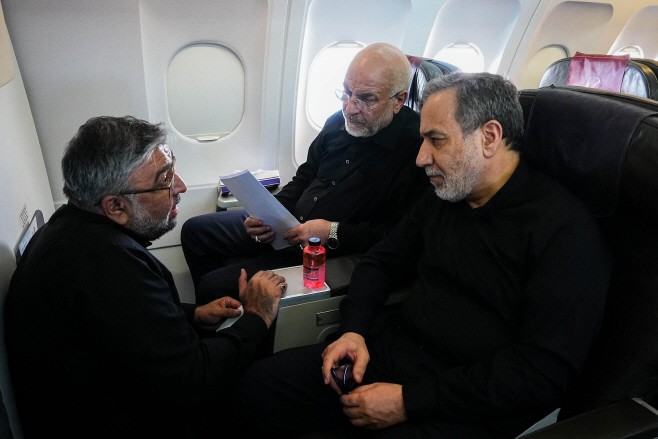 |
| Iranian Parliament Speaker Mohammad Bagher Ghalibaf (center), who serves as the head of the Iranian negotiation delegation, and Foreign Minister Abbas Araghchi (right) converse with a fellow delegation member aboard an aircraft bound for Zurich, Switzerland, on the 21st (local time). / Provided by the Iranian Parliament Speaker's Office·AFP·Yonhap |
Vance suggests potential shift in Iran relations; US energy secretary says "no frozen funds released without progress in nuclear talks"
U.S. Vice President J.D. Vance stated before the negotiations that "what President Trump has asked us to do is to open a new chapter to transform our relationship with the Iranian people," adding that Washington is willing to fundamentally alter relations if Iran abandons its role in fostering regional instability and demonstrates a willingness to give up nuclear weapons. The U.S. negotiating team included Special Envoy to the Middle East Steve Witkoff and President Trump's son-in-law Jared Kushner.
While the United States is offering permission for crude oil exports as an incentive, it is conditioning the release of frozen funds on progress in nuclear talks. U.S. Energy Secretary Chris Wright emphasized in an interview with ABC News on that day, "All Iran is getting is the ability to sell oil again," adding, "Without meaningful, verifiable progress in nuclear negotiations, Iran will not see its frozen funds released."
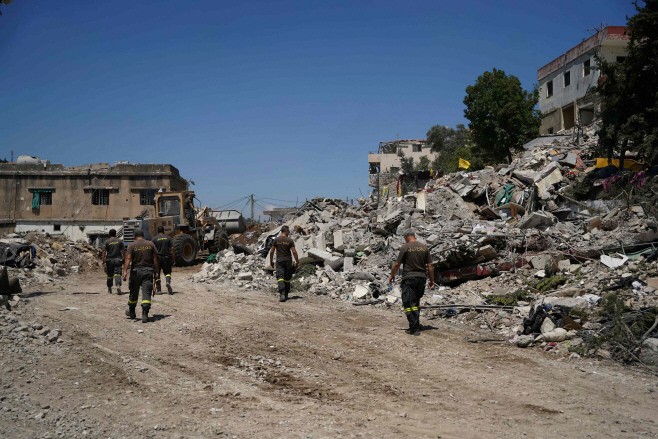 |
| Lebanon's civil defense workers clear debris on the 21st (local time) at a marketplace in the southern city of Nabatieh destroyed by the Israeli military. / AFP·Yonhap |
Israel reject withdrawal demand from Lebanon
The biggest obstacle to the U.S.–Iran negotiations remained outside the negotiating room. Israeli Defense Minister Israel Katz stated in a corporate statement on that day that "there are no restrictions whatsoever on the Israel Defense Forces (IDF) operations to eliminate threats within Lebanon, and we will absolutely not withdraw from the Lebanese security zone."
IDF Chief of the General Staff Eyal Zamir also visited southern Lebanon, noting that "the currently declared ceasefire is precarious, and we must maintain a high level of readiness for a swift transition to an offensive."
However, The New York Times (NYT) reported that the Israeli government had instructed the military to limit its operations to defensive measures, adding that there were no reports of Israeli airstrikes or Hezbollah attacks on Israeli targets until that night.
While Israel is simultaneously displaying signals of a limited easing of attacks and a refusal to withdraw its troops, Bloomberg News, citing an anonymous source familiar with the negotiations, reported that resolving the Lebanese conflict is the ultimate key to the success of the Swiss talks and ultimately hinges on Israel's backing.
"Iran's attention is focused on Israel's expansionist policy in Lebanon more than any other area in the Middle East," Mohamed Amersi, a global advisory council member and Iran expert at the Wilson Center, a U.S. think tank, told the WSJ.
Ha Man-joo
Most Read
-
1
Trump shares map on social media labeling Strait o..

-
2
Kia Sportage outperforms Mazda CX-5 in German auto..

-
3
Houthis launch successive attacks on Saudi airport..

-
4
U.S. deploys carrier, 10,000 more troops to Middle..

-
5
Trump rejects Iran's offer to open Strait of Hormu..

-
6
N. Korea conducts first swarm attack drill with dr..

-
7
U.S.-China summit falls short on substance as Trum..

PEOPLE






HEADLINE NEWS
- Seoul dismisses Ukraine's claim of 'S. Korean support for Russia' as "inaccurate and inappropriate"
- S. Korea, Japan race to develop nuclear-powered submarines
- Henri Kagan, Kenso Soai win Nobel Prize in Chemistry for uncovering how mol..
- Vance says Alaska LNG cooperation will move forward with Seoul's current or..

-
Address : In-Young Bldg., 34, Uisadang-daero 1-gil, Yeongdeungpo-gu, Seoul
Copyright by ASIATODAY CO., LTD. All rights resereved