



1 in 3 Americans see US-Iran MOU favoring Tehran, half call it equal
Jun 22, 2026, 01:29 pm


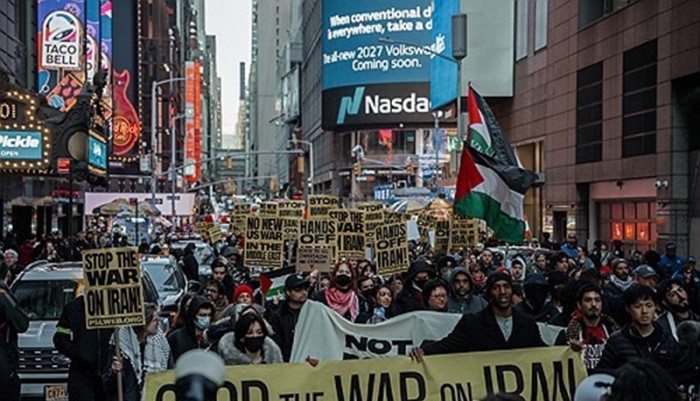 |
| Citizens march through the streets during a protest against the war with Iran in New York on April 8 (local time). / Photo by EPA via Yonhap News |
A recent public opinion poll released on June 21 (local time) revealed that more Americans believe the war-ending memorandum of understanding (MOU) between the United States and Iran favors Tehran rather than Washington.
According to the survey conducted by CBS News and the data analytics firm YouGov between June 17 and 19 among 2,519 American adults, approximately 37% of respondents answered that the MOU is more favorable to Iran. In contrast, 22% stated it favors the United States, while about 41% evaluated that the agreement was structured to provide equal benefits to both sides.
The survey sample was weighted based on gender, age, race, and education to represent the nationwide adult population, with a margin of error of plus or minus 2.4 percentage points.
When asked about the primary reason the Donald Trump administration signed the MOU with Iran, 66% of all respondents replied that it was because the administration wanted the conflict to end, while 34% believed it was because the US judged that its objectives had been achieved.
Regarding whether the United States successfully prevented Iran from threatening other nations, 68% answered negatively, while 32% agreed.
On whether the US managed to steer the Iranian government toward a pro-American stance, approximately 78% said it failed to do so, compared to 21% who said it succeeded.
As for whether Iran would threaten Middle Eastern nations within the next few months, roughly 59% responded with "probably will" or "definitely will," whereas 41% believed otherwise.
When questioned about what the United States should do as a next step, about 78% of respondents answered that the US should end the conflict now, while the remaining 22% argued that the conflict should be sustained until Iran makes more concessions.
The poll comes amid spreading anxieties over a potential resumption of hostilities, even as the United States and Iran continue discussions to finalize a permanent agreement within the designated 60-day follow-up negotiation period.
On June 20, Iran claimed that the airstrikes conducted by Israel against the Tehran-backed Lebanese militant group Hezbollah constituted a violation of the ceasefire agreement, threatening to shut down the Strait of Hormuz in retaliation.
In response, President Trump warned Iran the following day that the US would launch strikes against the country if it failed to resolve the ongoing conflict with Lebanon.
Kim Hyun-min
Most Read
-
1
Trump shares map on social media labeling Strait o..

-
2
Kia Sportage outperforms Mazda CX-5 in German auto..

-
3
Houthis launch successive attacks on Saudi airport..

-
4
U.S. deploys carrier, 10,000 more troops to Middle..

-
5
Trump rejects Iran's offer to open Strait of Hormu..

-
6
N. Korea conducts first swarm attack drill with dr..

-
7
U.S.-China summit falls short on substance as Trum..

PEOPLE






HEADLINE NEWS
- Seoul dismisses Ukraine's claim of 'S. Korean support for Russia' as "inaccurate and inappropriate"
- S. Korea, Japan race to develop nuclear-powered submarines
- Henri Kagan, Kenso Soai win Nobel Prize in Chemistry for uncovering how mol..
- Vance says Alaska LNG cooperation will move forward with Seoul's current or..

-
Address : In-Young Bldg., 34, Uisadang-daero 1-gil, Yeongdeungpo-gu, Seoul
Copyright by ASIATODAY CO., LTD. All rights resereved