



KEF urges minimum wage restraint as Korea's rate outpaces G7 average
Jun 21, 2026, 02:00 pm


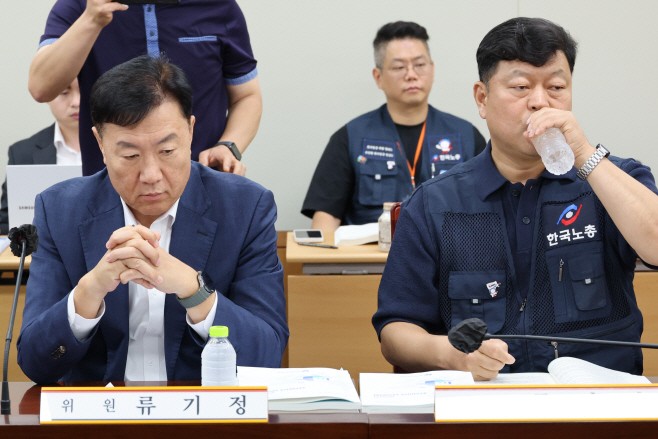 |
| At the 7th plenary session of the Minimum Wage Commission held at the Government Complex Sejong on the 18th, employer commissioner Ryu Kee-jung, Executive Director of the Korea Enterprises Federation (left), and employee commissioner Ryu Kee-seop, Secretary General of the Federation of Korean Trade Unions, wear solemn expressions while listening to remarks regarding the implementation of differential minimum wage rates by industry. / Yonhap |
Arguments have been raised that the determination of next year's minimum wage must take into account that Korea's minimum wage level is high compared to major advanced nations, whereas its labor productivity remains relatively low.
The Korea Enterprises Federation (KEF) released a report on the 21st titled "Analysis of Adjustment Factors for the 2027 Minimum Wage Based on Major Statistics," revealing that Korea's annualized minimum wage is 6.4% higher than the average of the Group of Seven (G7) nations on a purchasing power parity (PPP) basis.
The KEF explained that on a post-tax basis, which reflects the low tax burden on minimum wage earners, Korea's rate stands 17.9% higher than the G7 average.
The analysis also showed that the minimum wage relative to the median wage is internationally high. As of 2024, Korea's ratio of minimum wage to median wage exceeded 60%, a figure widely evaluated as the upper limit of an appropriate level. This is higher than most advanced economies except for the United Kingdom and France, and significantly surpasses the G7 average of 49.3%.
Conversely, labor productivity was relatively low. According to the KEF, Korea's hourly labor productivity stood at $55.2, remaining at just 68.8% of the G7 average of $80.2.
Over the past decade, the increase in the minimum wage has also substantially outpaced growth in regular wages and inflation. Compared to 2015, nominal wages rose by 39.6% and consumer prices by 22.9% as of 2025, but the minimum wage surged by 79.7%. The statutory minimum wage including weekly holiday allowances registered a 115.9% increase during the same period.
The KEF pointed out that compliance with the minimum wage is also deteriorating. The non-compliance rate—the percentage of workers earning less than the minimum wage—rose to 12.4% in 2025, roughly three times the 4.3% recorded in 2001, while the number of such workers ballooned from 577,000 to 2,769,000. In the accommodation and food services sector, the non-compliance rate reached 31.6%, and it stood at 30.3% for workplaces with fewer than five employees.
Business conditions for micro-enterprises were also found to be challenging. Citing data from the Korea Federation of Micro Enterprise, the KEF noted that 4 out of 10 small business owners reported a monthly average operating profit of less than 2 million won this year, falling short of the current monthly minimum wage equivalent of 2,096,000 won.
"While Korea's minimum wage has reached an internationally very high level in terms of its ratio to median wage and annualized amount, our labor productivity falls short of the average," emphasized Ha Sang-woo, Executive Director of the KEF and an employer commissioner on the Minimum Wage Commission. He added, "As the 2027 minimum wage is determined under a single unified standard, this legally mandatory wage must be set based on the capacities of workplaces that already find the current minimum wage difficult to bear, such as the accommodation and food services sector and businesses with fewer than five employees."
Kim Jung-kyu
Most Read
-
1
Celltrion nears additional contract with major U.S..

-
2
Putin proposes trilateral U.S.-China-Russia summit..

-
3
U.S. weighs dropping MOAB, world's most powerful n..

-
4
"Aren't those foreigners on welfare?": M..

-
5
Attention centers on APEC for possible Trump-Xi-Pu..

-
6
Saudi Arabia, Iran hold first diplomatic talks to..

-
7
China tightens grip on boosting domestic demand an..

PEOPLE






-
Address : In-Young Bldg., 34, Uisadang-daero 1-gil, Yeongdeungpo-gu, Seoul
Copyright by ASIATODAY CO., LTD. All rights resereved