



What the Luddite movement teaches us about navigating the AI era
Jun 17, 2026, 01:18 pm


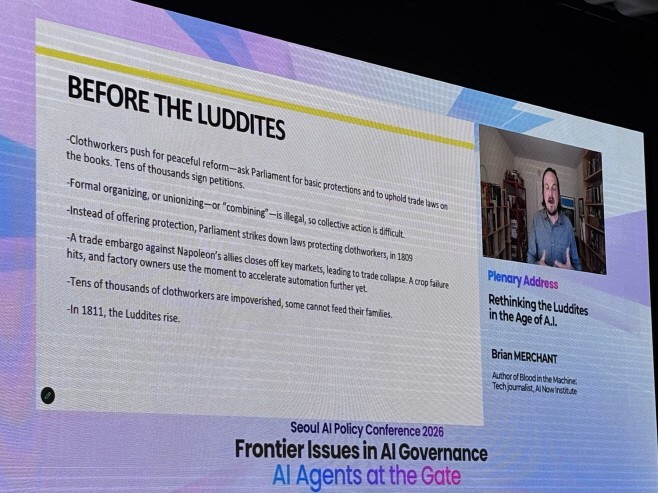 |
| Brian Merchant, an IT columnist, delivers a keynote speech titled "The Industrial Revolution and the Luddite Movement: Re-evaluating the AI Era" at the Seoul AI Policy Conference held at The Plaza Hotel in Jung-gu, Seoul, on June 17. / Photo courtesy of Reporter Kim Yun-hee |
As the dawn of the artificial intelligence (AI) era accelerates sweeping changes across society, the term "Luddite" is frequently deployed to label and dismiss critics of AI. However, a closer look reveals that the true legacy of the historical Luddite movement lies not in a blind, unconditional opposition to technology itself. Rather, it underscores the need to shift the focus from rejecting AI to discussing how the technology is deployed and utilized, and exactly who reaps the benefits and bears the costs.
Brian Merchant, an IT columnist, delivered a keynote address titled "The Industrial Revolution and the Luddite Movement: Re-evaluating the AI Era" at the Seoul AI Policy Conference held at The Plaza Hotel in Jung-gu, Seoul, on June 17.
Today, a Luddite is generally understood to be someone who rejects technological advancement or fears new innovations. Merchant noted, "In fact, ChatGPT defines a Luddite as someone who opposes or distrusts new technology and is reluctant to use it, and Google offers a similar definition." However, he countered this narrative, stating, "The historical Luddite movement was not a protest against technology itself, but rather resistance against technology being used in a way that sacrificed workers and communities. The Luddites did not hate technology or reject progress; they were people who opposed the deployment of technology to exploit workers."
The Luddite movement emerged in the early 19th century during the British Industrial Revolution. At the time, textile workers operated within a cottage industry framework, maintaining a relatively autonomous lifestyle. However, the proliferation of automated machinery and the factory system abruptly upended their reality. Factory owners leveraged the new technology to hire cheap, unskilled laborers, triggering a rapid decline in the wages of skilled artisans. For years, workers submitted petitions and staged protests demanding the introduction of a minimum wage and labor protections, but their pleas went unheeded.
"The Luddites did not reject the machines themselves," Merchant explained. "They took issue with the fact that automation was being harnessed solely to enrich a handful of factory owners while degrading the lives of working people." He added that their anger was rooted in having absolutely no voice in the introduction of technologies that directly impacted their livelihoods.
For a time, the Luddite movement wielded considerable influence. Some factory owners raised wages or entered into negotiations with workers, and the Luddites garnered widespread support among the working class. However, the British government responded with a heavy-handed crackdown, deploying large military forces to industrial regions and making the destruction of machinery a capital offense. The movement eventually drew to a close in the late 1810s as numerous Luddites were arrested, imprisoned, or executed.
Merchant argued that the contemporary conflicts surrounding AI raise strikingly parallel questions. Concerns over AI, he suggested, do not stem from a simple phobia of technology. Instead, the core battlegrounds involve training data scraped without the creators' consent, the threat of job displacement due to automation, the consolidation of power within big tech conglomerates, and the breakneck speed of technological diffusion outpacing regulatory frameworks. Indeed, artists and writers are filing lawsuits alleging that their intellectual property was used for AI training without consent, while local communities are resisting the construction of massive data centers. Professionals across diverse fields, including software developers, translators, and designers, are also facing mounting anxieties over employment instability brought on by AI.
He stressed that these movements must not be misconstrued as mere anti-technology sentiment. What people are questioning is not the existence of AI itself, but rather for whom it is developed, who profits from it, and who suffers the consequences. "The pushback against AI is not because of the technology itself, but out of dissatisfaction with how it is being integrated into society," Merchant said. "Many people do not want a handful of corporate giants deciding the future of a technology that profoundly affects their lives." He asserted that the defining challenge of the AI era is not halting technological progress, but democratizing its control. Workers, citizens, and users must have a meaningful seat at the table in the development and deployment of AI to ensure it serves the broader public good.
"What we need is neither unconditional adulation nor blanket rejection of AI," he concluded. "We need social discourse and civic participation regarding what kind of society AI will shape, and who will dictate that future. The trajectory of the AI era depends not on the technology itself, but on our collective choices regarding how we choose to employ it."
Kim Yun-hee
Most Read
-
1
Kia Sportage outperforms Mazda CX-5 in German auto..

-
2
Houthis launch successive attacks on Saudi airport..

-
3
Saudi Arabia, Iran hold first diplomatic talks to..

-
4
U.S. deploys carrier, 10,000 more troops to Middle..

-
5
Saudi airport in Riyadh struck again, leaving at l..

-
6
Putin's ally visits China on the 8th ahead of APEC..

-
7
Chinese military support and training center opens..

PEOPLE






HEADLINE NEWS

-
Address : In-Young Bldg., 34, Uisadang-daero 1-gil, Yeongdeungpo-gu, Seoul
Copyright by ASIATODAY CO., LTD. All rights resereved