



Most of Korean Peninsula to become subtropical before 22nd century
Jun 17, 2026, 10:18 am


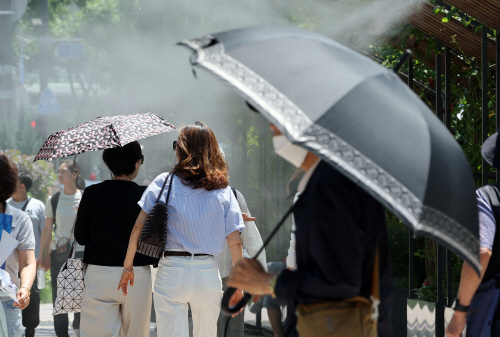 |
| Citizens carrying parasols walk past a cooling fog device spraying a water mist in front of Seoul City Hall on June 13, when daytime temperatures reached around 30 degrees Celsius nationwide and the UV index soared high. / Photo courtesy of Yonhap News Agency |
An analysis reveals that most regions in South Korea will transform into a subtropical climate before the dawn of the 22nd century. This indicates that the Korean Peninsula, historically characterized by four distinct seasons, will transition into an environment resembling the relatively warm year-round Mediterranean coast of Southern Europe. Observations suggest that within the coming decades, this shift will go beyond a mere rise in temperature, completely reshaping the ecosystem and society at large.
On June 16, the Korea Meteorological Administration (KMA) announced the subtropical climate characteristics of South Korea alongside the future outlook results from the national climate change standard scenarios. This outlook forecasts the country's climate up to the year 2100, based on observed data for average temperatures and precipitation collected across 66 stations nationwide over the past 45 years (1981–2025).
A subtropical climate represents an intermediate level between a temperate climate with four distinct seasons and a tropical climate with summer weather all year round. Specifically, under the Trewartha climate classification, it refers to a climate where the average temperature of the coldest month is 18 degrees Celsius or below, while the number of months with a monthly average temperature of 10 degrees Celsius or above lasts for 8 months or more out of the year. This implies that summers will lengthen and temperatures will remain high even during winter. Until now, South Korea has been classified as a temperate climate country, with 80% of its total territory experiencing monthly average temperatures of 10 degrees Celsius or above for 7 months (April to October) of the year.
According to the KMA, in the 30-year interval from 1981 to 2010, 13 stations had already satisfied the conditions for a subtropical climate, centered around Jeju's 4 stations and southern coastal areas such as Busan, Yeosu, and Mokpo. Subsequently, from 1991 to 2020, Ulsan—a coastal region along the East Sea—was added as a subtropical climate station as its average November temperature surged to 10 degrees Celsius or above. This pattern remained identical through the 2001–2025 period.
However, as the climate warming of the Korean Peninsula has accelerated over the past decade, this trend has become even more pronounced. In the 10-year block analyses, 14 stations satisfied the subtropical climate criteria during both the 1990s and 2000s. In the 2010s, Gwangju was added, followed by Uljin and Gangneung along the East Sea coast during the 2016–2025 period, bringing the total to 17 stations. The analysis noted that during this recent period, subtropical climate characteristics gradually migrated northward from the southern coast into the inland areas of South Jeolla Province and the East Sea coastal regions. The central region is not entirely safe either; although a temperate climate still prevails, signs of approaching a subtropical climate have been confirmed in certain areas, including Boryeong, Cheongju, and Daejeon. The KMA pointed out, "This appears to be driven by the rapid rise in sea surface temperatures along the East Sea over the past 10 years."
The subtropical transition of the Korean Peninsula is highly likely to continue accelerating moving forward. For the past 53 years from 1973 to last year, the annual average temperature of South Korea has risen by 0.3 degrees Celsius every 10 years. In particular, last year's annual average temperature in South Korea was recorded as the second highest in history following 2024, meaning that the past three consecutive years have taken the top three slots historically. The warming trend was most pronounced during the months corresponding to spring and autumn—namely February to March, September, and November. This mirrors a typical subtropical climate pattern where high temperatures persist from early spring through late autumn.
The KMA projected the national climate change standard scenarios based on the Sixth Assessment Report of the Intergovernmental Panel on Climate Change (IPCC). The results revealed that under all scenarios up to 2040, a subtropical climate is expected to appear in the southern regions, South Gyeongsang Province, coastal areas, and some major cities. Furthermore, if additional efforts to reduce greenhouse gas emissions are not made, most regions across the country, with the exception of the Yeongseo region in Gangwon Province, are predicted to transition into a subtropical climate by the late 21st century (2081–2100). The KMA warned, "This implies that the climatological characteristics of our country could manifest in a completely different manner from the present," adding, "Such a transformation could exert a widespread impact not only on weather phenomena like heatwaves and heavy rains, but across the entire ecological environment, including crop cultivation zones, animal habitats, plant growth, and fish species."
Kim Hong-chan
Most Read
-
1
Trump demands rates fall below 1% as Fed hikes for..

-
2
Celltrion seeks rheumatoid arthritis indication ex..

-
3
Chinese e-commerce giants AliExpress, Temu and She..

-
4
Trump warns countries not helping U.S. must pay re..

-
5
Turkish Airlines named main club partner of Liverp..

-
6
China expels No. 2 military official Zhang Youxia..

-
7
Houthi rebels release video claiming downing of Sa..

PEOPLE






-
Address : In-Young Bldg., 34, Uisadang-daero 1-gil, Yeongdeungpo-gu, Seoul
Copyright by ASIATODAY CO., LTD. All rights resereved