



Philippines' government websites hit by waves of hacks
Jun 17, 2026, 09:47 am


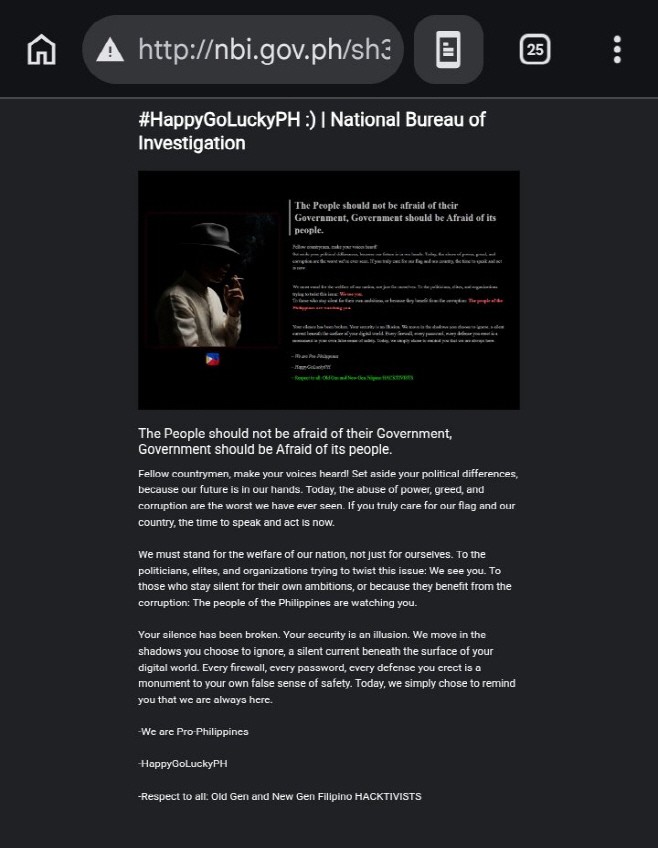 |
| The official website of the National Bureau of Investigation of the Philippines, which came under a cyberattack by hackers on June 14 (local time), displays a message reading, "People should not be afraid of their government. Governments should be afraid of their people." / Captured from social media |
The official website of the National Bureau of Investigation (NBI), a core investigative agency in the Philippines, was hacked and defaced with anti-government slogans. Following breaches of both the Senate and House of Representatives websites within less than a week, even the site of a law enforcement agency has now been penetrated.
According to local media reports and the South China Morning Post (SCMP) on June 16 (local time), the defacement hacking of the NBI website followed consecutive intrusions into the Senate website on June 10 and the House website on June 13. In all three cyberattacks, the hackers posted messages criticizing government corruption on the websites. Although the attacks were short-lived and limited to altering the visual appearance of the websites, the systems of a law enforcement agency were ultimately breached.
In the successive hacks, different hacker groups operating under distinct names left behind slogans targeting corruption. On the NBI website, a hacker claiming to be "#HappyGoLuckyPh" altered a line from the movie 'V for Vendetta,' displaying a sentence that read, "People should not be afraid of their government. Governments should be afraid of their people." Meanwhile, as many as 22 groups claimed responsibility for hacking the House website, where a warning message had been posted stating, "The truth behind the government circus cannot be hidden."
On the Senate website, hackers calling themselves 'Nullsec PH' posted a message stating, "Transparency is not an option," and included a Facebook link to 'SentinelX,' a group that has long claimed to expose security vulnerabilities. The same website also featured the phrase, "We do not forgive, we do not forget," which is frequently used as a closing signature by the international hacker collective Anonymous.
The NBI immediately launched a tracking operation. NBI Director Melvin Matibag stated during a press conference on the previous day that authorities had identified suspects behind the defacement of the three websites, declaring, "We will track them down to the end and hold them accountable." He explained that while multiple individuals were involved in the hacking, they all belonged to the same organization. However, he withheld their identities, citing the need for further investigation, and confirmed that no sensitive data had been leaked during the intrusions.
The Philippine National Police also urged government agencies to strengthen their cybersecurity under the name of the police chief, while deploying its cybercrime response team to determine the hacking routes and the extent of the damage.
In the Philippines, 19 government websites were previously hacked in September last year when the "1-Trillion Peso March" protests against corruption took place. At that time, authorities identified AnonymousPH, a local group borrowing the expressions and symbols of the international collective Anonymous, as the mastermind behind the hacks.
Jung Lee-na
Most Read
-
1
Celltrion’s Omlyclo gains ground in major European..

-
2
Trump demands rates fall below 1% as Fed hikes for..

-
3
Hyundai Motor Group breaks ground on integrated st..

-
4
U.S. strikes 3 Iranian oil tankers, Iran vows reta..

-
5
Trump makes $1 trillion bet ahead of midterm elect..

-
6
Iran resumes ballistic missile production, assembl..

-
7
Samsung Electronics, Mistral AI to jointly develop..

PEOPLE







-
Address : In-Young Bldg., 34, Uisadang-daero 1-gil, Yeongdeungpo-gu, Seoul
Copyright by ASIATODAY CO., LTD. All rights resereved