



Trump warns Iran: "Last chance before decapitation"
Aug 04, 2026, 09:07 am


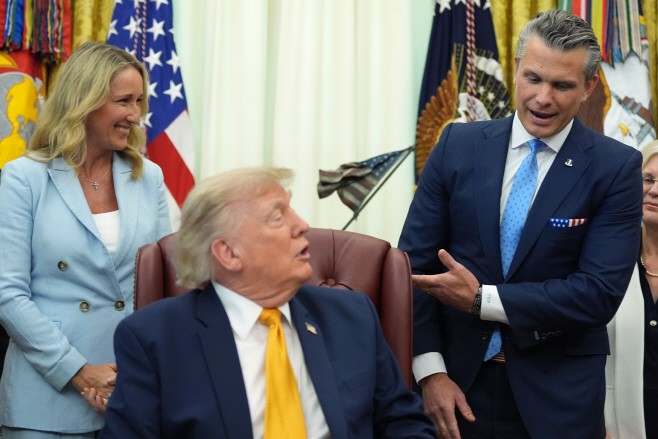 |
| U.S. Secretary of Defense (War) Pete Hegseth (right) speaks during a meeting on military families at the Oval Office in the White House in Washington, D.C. on the 3rd (local time). U.S. President Donald Trump (center) and Hegseth's wife, Jennifer Hegseth, listen. / AP-Yonhap |
U.S. President Donald Trump said on the 3rd (local time) that negotiations with Iran are underway, pressing that this is the last chance to sign a "good deal."
Iran pushed back, saying there are no negotiations or scheduled talks with the U.S., and that it is only discussing a temporary shipping corridor with Oman to ensure safe vessel transit.
While the two sides' statements diverged, markets reacted first to the possibility of the U.S. holding off on airstrikes and a resumption of diplomacy. Global oil prices fell around 5%, while Wall Street rose more than 1%.
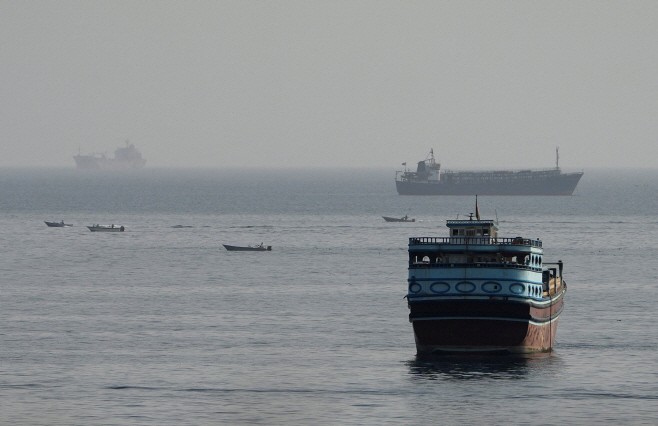 |
| Vessels sail through the Strait of Hormuz, as seen from Musandam, Oman, on the 3rd (local time). / Reuters-Yonhap |
Trump presses "last chance" on Iran, offers two-step plan: Open Hormuz, then denuclearization
President Trump said at the White House that day, "We are currently talking with Iran," adding, "This is the last chance to sign a good deal." He said, "I want to give every last chance before decapitation," warning of intense military action if negotiations fail.
He claimed that an operation he called off on the evening of the 1st, at the request of Saudi Arabia, the UAE, and Qatar, would have been the largest attack since World War II had it gone ahead.
President Trump said the first step would be fully reopening the Strait of Hormuz by the 4th, with the second step being negotiations on Iran's denuclearization. He also said he would not allow Iran to impose tolls on ships passing through the strait.
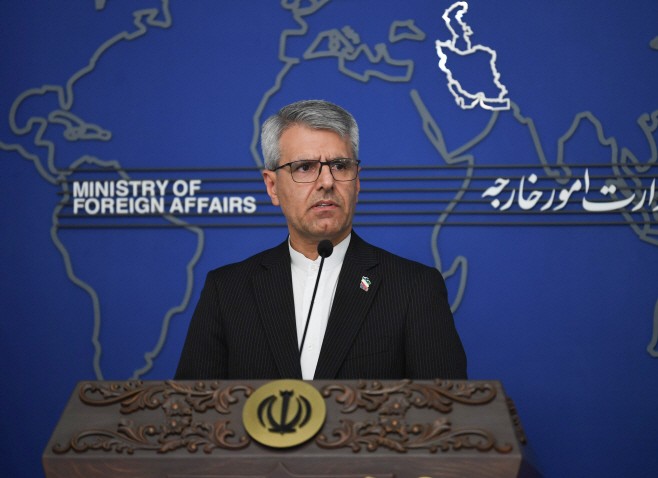 |
| Iran's Foreign Ministry spokesman Esmaeil Baghaei holds a regular press briefing in Tehran on the 3rd (local time). Baghaei said negotiations between Iran and Oman are focused on agreeing to designate a "temporary" corridor to ensure the safe passage of vessels through the Strait of Hormuz. He said Iran will take all necessary measures to hold Ukraine accountable for its recent attack on an Iranian vessel. / Xinhua-Yonhap |
Iran denies negotiating with U.S., confirms only temporary corridor talks with Oman
Iran's Foreign Ministry spokesman Esmaeil Baghaei said that day there are no ongoing or scheduled negotiations with the U.S., and no plans to receive foreign delegations or send negotiators abroad in the coming days, Iran's state news agency IRNA and Reuters reported.
He explained that all of Iran's negotiating officials remain inside the country, with the exception of Foreign Minister Abbas Araghchi, who is on a religious pilgrimage in Iraq, according to Reuters and the Wall Street Journal (WSJ).
Baghaei said the current talks are a bilateral discussion between Iran and Oman, the two coastal states, focused on establishing a new corridor for the safe passage of vessels through the Strait of Hormuz, IRNA reported.
He argued that an agreement with Oman is a necessary condition for reopening the strait, but not a sufficient one as long as the U.S. maritime blockade and military attacks continue, according to IRNA and the Financial Times (FT).
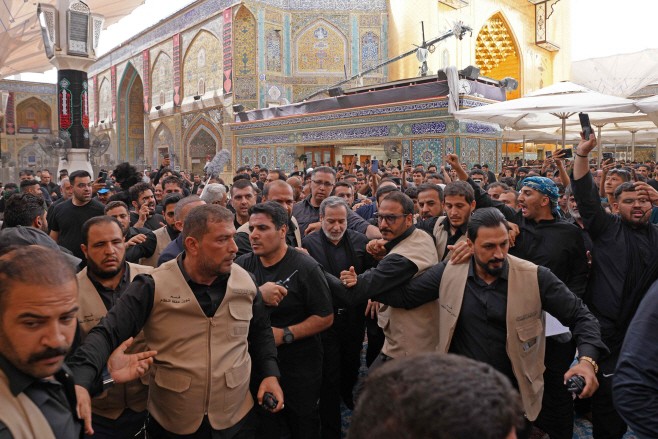 |
| Iranian Foreign Minister Abbas Araghchi (center) visits the Imam Ali Shrine in Najaf, Iraq on the 3rd (local time). Iran's Foreign Ministry said that day there are no ongoing negotiations with the U.S., and that it is instead in talks with Oman over managing the strategically vital Strait of Hormuz. / AFP-Yonhap |
Iran, Oman weigh separate entry/exit corridors — fee arrangement, IRGC approval remain sticking points
WSJ reported that the proposed arrangement would create a temporary corridor under which vessels entering the Persian Gulf would use Iranian waters and those exiting would use Omani waters.
Iran demanded assurances against renewed U.S. attacks and the lifting of oil sanctions, and Iran's Islamic Revolutionary Guard Corps (IRGC) has not yet responded to the proposal, WSJ reported.
The New York Times (NYT) reported that a plan was also discussed under which Iran and Oman would split a service fee — covering environmental, security, and personnel costs — evenly between them. This could conflict with Trump's stated position of not imposing any charge on strait transit.
WSJ projected that if a temporary corridor agreement is reached, the two sides could move on to negotiations to restore an existing memorandum of understanding (MOU) that manages the dispute for 60 days. Pakistan has proposed hosting the next round of U.S.-Iran talks.
Brent falls 4.7%, WTI falls 5.1%; Dow closes at record high
October-delivery Brent crude fell 4.7% to close at $83.77 per barrel. September-delivery U.S. West Texas Intermediate (WTI) crude dropped 5.1% to $80.34, its lowest level since the 16th of last month.
The Dow Jones Industrial Average rose 1.32% to close at a record high of 53,178.41. The S&P 500 gained 1.48%, and the Nasdaq rose 2.13%.
Oil trading advisory firm Ritterbusch and Associates described the sharp sell-off in crude futures as another overreaction to Trump's remarks.
FT reported that even after Iran later denied negotiating with the U.S., there was no significant further movement in global oil prices.
Ha Man-ju
Most Read
-
1
Celltrion’s Omlyclo gains ground in major European..

-
2
Trump demands rates fall below 1% as Fed hikes for..

-
3
Trump makes $1 trillion bet ahead of midterm elect..

-
4
Iran resumes ballistic missile production, assembl..

-
5
Samsung Electronics, Mistral AI to jointly develop..

-
6
Trump warns countries not helping U.S. must pay re..

-
7
Apple launches first foldable, 1 million won prici..

PEOPLE






HEADLINE NEWS
- Trump to roll out ‘unprecedented welcome’ for Xi with B-2 bombers, F-22 fighters
- S. Korea, U.S., and Japan form united front on Taiwan and economic coercion..
- Trump administration moves to impose sweeping sanctions on International Cr..
- Xi to make state visit to U.S. Sept. 23-25, dispelling rumors over his heal..

-
Address : In-Young Bldg., 34, Uisadang-daero 1-gil, Yeongdeungpo-gu, Seoul
Copyright by ASIATODAY CO., LTD. All rights resereved