



Inflation dips back into 2% range after three months
Aug 04, 2026, 09:45 am


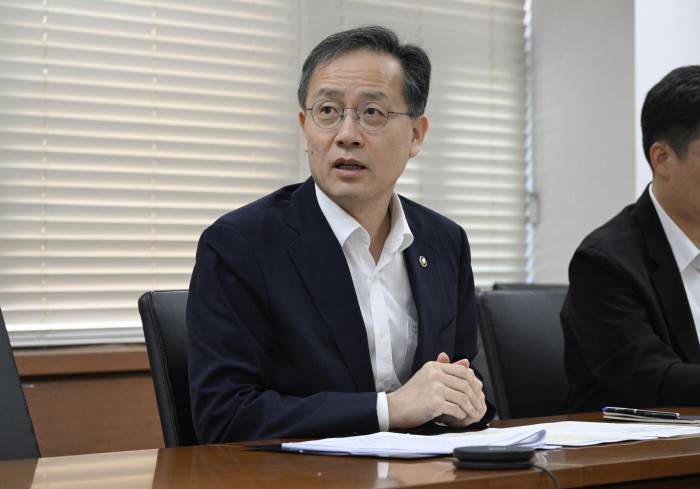 |
| Vice Minister of Economy and Finance Lee Hyung-il chairs a meeting on price policy coordination at the Government Complex Seoul on the 4th. / Courtesy of the Ministry of Finance and Economy |
Vice Minister of Economy and Finance Lee Hyung-il said on the 4th, "July consumer prices fell month-on-month for the first time in eight months, and the year-on-year inflation rate eased back into the 2% range for the first time in three months," adding, "Thanks to policy efforts such as the largest-ever discount support program and price cap reductions to stabilize prices affecting people's livelihoods, both agricultural, livestock, and fishery products and petroleum products declined month-on-month."
Vice Minister Lee made these remarks regarding last month's consumer prices at a meeting on price policy coordination held at the Government Complex Seoul that day. According to the National Statistics Office, July consumer prices rose 2.8% year-on-year. Month-on-month, prices fell 0.2%, marking the first decline in eight months since last November. The consumer price inflation rate also eased from 3.2% in June to 2.8% in July, dropping back into the 2% range for the first time in three months.
The government attributed the price stabilization to the effects of its June package of measures to stabilize prices affecting people's livelihoods and the implementation of a petroleum price cap system. Agricultural, livestock, and fishery products fell 0.7% and petroleum products fell 5.3% month-on-month, while their year-on-year inflation rates also eased — from 3.2% to 0.9% for agricultural, livestock, and fishery products, and from 24.7% to 15.5% for petroleum products. In particular, the price cap system, which lowered prices by 150 won per liter, is estimated to have reduced the July inflation rate by about 0.3 percentage points.
Vice Minister Lee said, "Despite the easing of the upward trend, prices remain elevated due to the cumulative effect of past increases, and the burden on people's livelihoods remains significant, so we must maintain a sense of vigilance and do our utmost," adding, "In particular, upside risks to prices persist — including uncertainty from the Middle East conflict, the base effect from last year's temporary telecom fee discount, the impact of abnormal weather such as the heat wave, and food prices — so all ministries should make an all-out effort to minimize future upward pressure and ease the burden on people's livelihoods."
The government plans to proactively address inflationary factors expected from August onward. Since the August inflation rate is projected to rise by about 0.8 percentage points due to the base effect from the expiration of last year's one-month temporary mobile phone fee discount, policy efforts will be concentrated on stabilizing prices for other items.
First, to stabilize petroleum prices, the government will maintain the price cap system, designate additional "good-price gas stations" on the 4th, and ensure there are no disruptions to crude oil imports and stockpiling. For agricultural, livestock, and fishery products, the largest-ever discount events will continue into August, and imports of eggs and mackerel will continue. To stabilize seafood prices, the government also plans to directly purchase and supply mackerel, hairtail, and squid at discounted prices if their prices rise. Vegetable and farmed fish supply, affected by the heat wave and heavy rain, will also be closely monitored.
The government will continue working with the food industry to monitor trends in raw material and logistics costs to minimize factors driving up prices, and plans to announce a "Chuseok Livelihood Stabilization Package" in September, including expanded supply of holiday staples and support for vulnerable groups.
Lee Ji-hoon
Most Read
-
1
Celltrion’s Omlyclo gains ground in major European..

-
2
Trump demands rates fall below 1% as Fed hikes for..

-
3
Hyundai Motor Group breaks ground on integrated st..

-
4
U.S. strikes 3 Iranian oil tankers, Iran vows reta..

-
5
Trump makes $1 trillion bet ahead of midterm elect..

-
6
Iran resumes ballistic missile production, assembl..

-
7
Samsung Electronics, Mistral AI to jointly develop..

PEOPLE







-
Address : In-Young Bldg., 34, Uisadang-daero 1-gil, Yeongdeungpo-gu, Seoul
Copyright by ASIATODAY CO., LTD. All rights resereved