



Malaysia rises as AI manufacturing hub
Aug 04, 2026, 10:07 am


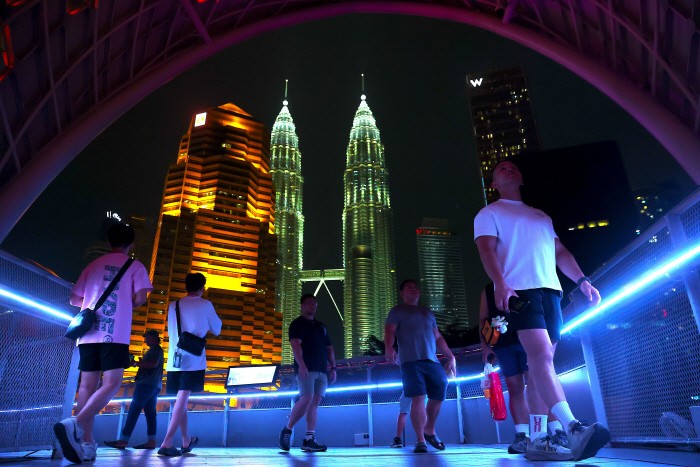 |
| Visitors cross the Saloma Link, a Kuala Lumpur landmark, on July 2 (local time). / EPA-Yonhap |
Malaysia is emerging as an AI manufacturing hub, driven by geopolitical factors such as the U.S.-Iran conflict and expanding foreign corporate investment, and has become one of the world's top four exporters of AI-related hardware, Bloomberg reported on the 2nd (local time).
According to the International Monetary Fund (IMF), Malaysia ranks alongside South Korea, Taiwan, and Thailand as one of the world's top four net exporters of AI-related hardware. Multinational banking group HSBC noted that Malaysia's data center investment in the second quarter of this year reached about 18% of its gross domestic product (GDP) for the period.
HSBC analysts noted that while most countries typically invest only 1-5% of GDP in data centers, Malaysia is pouring in a massive amount equal to roughly one-fifth of its GDP.
Boosted by AI investment, Malaysia's growth rate has already exceeded expectations. Second-quarter GDP grew 5.8% year-on-year, surpassing the projected 5.2%. Global investment bank JPMorgan raised its forecast for Malaysia's growth this year to 5.3%, expecting it to outpace most of its regional peers.
Malaysia's status as a net energy exporter is also an advantage. While energy-importing countries such as South Korea, Japan, and the Philippines are grappling with rising oil prices and inflationary pressure, Malaysia is able to shore up its finances and maintain economic stability thanks to the foreign currency earned from energy exports.
Thanks to investment from both the government and private companies, Malaysia's competitiveness has grown significantly in recent years, rising to 15th out of 70 countries on the World Competitiveness Index — a sharp jump from 34th out of 67 countries two years ago.
 |
| Nvidia logo. / Nvidia |
Government projects and private-sector AI infrastructure investment are indeed continuing. Global firms including German semiconductor company Infineon, U.S. AI company Nvidia, and Chinese global internet platform ByteDance are investing billions of dollars to build semiconductor chip manufacturing hubs in Malaysia. Data center investment in Malaysia, including from these companies, totaled 144.4 billion ringgit (about 42 trillion won) from 2021 through the first half of 2025.
Penang, long established as the center of Malaysia's semiconductor industry, is pursuing a massive land reclamation project called "Silicon Island." The project involves filling in the sea to create new industrial land, aiming to attract numerous semiconductor firms and advanced manufacturers and turn Penang into an Asian hub comparable to Silicon Valley.
Malaysian construction firm Gamuda posted record order intake thanks to the "Silicon Island" project. Restaurant chain Oriental Kopi is also expanding its outlets amid the population inflow driven by the investment boom.
Malaysia's central bank said easing tensions in the Middle East, rising demand for electronics, and a tourism revival could serve as additional growth drivers.
Cheah Cheng Siu, chief investment officer at Malaysian asset manager Areca Capital, said the massive investment inflows of recent years are now translating into full-scale industrial output, strengthening growth momentum, and called this year a turning point for Malaysia's economy.
Justin Chin, engineering managing director at Gamuda, added that Malaysia's appeal to investors stems from its English-speaking workforce and low labor costs, calling these key reasons global companies are choosing Malaysia.
Park Jin-sook
Most Read
-
1
Celltrion’s Omlyclo gains ground in major European..

-
2
Trump demands rates fall below 1% as Fed hikes for..

-
3
Trump makes $1 trillion bet ahead of midterm elect..

-
4
Iran resumes ballistic missile production, assembl..

-
5
Samsung Electronics, Mistral AI to jointly develop..

-
6
Trump warns countries not helping U.S. must pay re..

-
7
Apple launches first foldable, 1 million won prici..

PEOPLE






HEADLINE NEWS
- Trump to roll out ‘unprecedented welcome’ for Xi with B-2 bombers, F-22 fighters
- S. Korea, U.S., and Japan form united front on Taiwan and economic coercion..
- Trump administration moves to impose sweeping sanctions on International Cr..
- Xi to make state visit to U.S. Sept. 23-25, dispelling rumors over his heal..

-
Address : In-Young Bldg., 34, Uisadang-daero 1-gil, Yeongdeungpo-gu, Seoul
Copyright by ASIATODAY CO., LTD. All rights resereved