



Red light on DX's performance prompts Roh to push for AI-centric strategy
Jun 17, 2026, 09:39 am


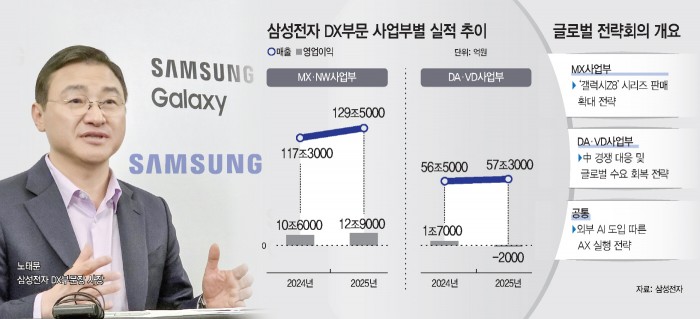 |
Samsung Electronics' Device Experience (DX) division, which oversees the company's set business, has entered into the process of charting its survival strategy for the second half of the year. Although the division has previously served as a financial buffer for the company by offsetting the slump in the semiconductor business centered around its traditional bread-and-butter sectors like home appliances and smartphones, it is currently struggling across all business areas due to a global slowdown in IT demand, rising raw material prices, and intensifying market competition. As these challenges also served as the background for the "labor-labor conflict" that flared up this year, the necessity to improve profitability has heightened further. Major executives, including President Roh Tae-moon (Head of the DX Division), will put their heads together through the global strategy meeting to discuss expanding product sales, enhancing technological competitiveness, and restructuring the business framework with a focus on AI.
According to Samsung Electronics on June 16, a global strategy meeting will be held for three days until June 18 to discuss business strategies for the second half of the year. This is a venue where domestic and overseas executives assemble en masse twice a year (June and December). The strategy meetings for the DX division will take place on June 16 and 17, followed by the Device Solutions (DS) division on June 18. The DX division, led by President Roh Tae-moon, proceeded with the MX Business Corporate, which is in charge of smartphones, starting on this day, followed by the DA and VD Business Corporations, which handle home appliances and TVs, on June 17, and company-wide sessions on June 18.
As this strategy meeting is being held amid heightened a sense of crisis regarding the DX division, attention from both inside and outside the company is focused on the details of the discussions. Last year, the DX division's operating profit stood at 12.9 trillion KRW, representing a mere 4% increase compared to the previous year. By business unit, the MX Business Corporate (including networks) recorded 12.9 trillion KRW, an increase of more than 21% year-on-year, whereas the DA and VD Business Corporations turned a deficit, posting an operating loss of 200 billion KRW. This is the result of multiple adverse factors coming together, including a sharp decline in replacement demand for home appliances, low-price and volume offensives from Chinese competitors, and rising raw material prices. Furthermore, this year, even the MX Business Corporate, which had been sustaining the performance, is faltering under the aftermath of memory price hikes, leading to significant worries directed toward the DX division.
At the strategy meeting on this day, the MX Business Corporate is expected to discuss strategies to expand sales of the new foldable smartphone "Galaxy Z8" series, which is ahead of its unveiling next month. The "Galaxy S26" series launched in the first half of the year faced difficulties in sales due to the aftermath of factory price hikes, leaving profitability pressures heightened. In the case of foldable phones, Samsung maintains its "No. 1" position, but the market share gap with China's Huawei has narrowed to 10 percentage points (based on last year's shipments), and with Apple expected to join the competition this year, Samsung is in a situation where it must firmly solidify its footing. Sources inside and outside the company anticipate that discussions will take place regarding whether to freeze or increase the factory price of the Galaxy Z8 series, alongside marketing strategies for the newly introduced book-type model.
The DA and VD Business Corporations, which face growing profitability pressure, will also intensively seek breakthrough measures against the crisis. They are expected to discuss sales strategies centered on high-value-added product groups, such as home appliances incorporating AI and OLED (organic light-emitting diode) TVs. In particular, for the DA Business Corporate, which welcomed "content and marketing expert" President Lee Won-jin as its new head this year, major agendas are anticipated to include measures to boost competitiveness by reorganizing the existing hardware-centered TV business into a software- and platform-centered model. In addition, following the end-of-war agreement between the United States and Iran, discussions on re-targeting the Middle East region are anticipated for both business units. The implementation plan for AX (AI Transformation) through the adoption of external AI is also projected to be a hot topic. As of June 12, the DX division has introduced external generative AI services, including ChatGPT, Gemini Enterprise, and Claude, across all work areas. The goal is to enhance productivity and boost execution capabilities across the entire organization by utilizing customized AI for each task. Whether M&A (mergers and acquisitions) will be discussed to enhance technological competitiveness is also a matter of interest. In January at CES, President Roh selected air conditioning, automotive electronics, meditech, and robots as the four major new growth engines, demonstrating his willingness to expand investments.
An industry official stated, "The sense of crisis is so heightened that many stock market forecasts suggest this year's operating profit for the DX division will remain at half the level of the previous year," adding, "Rebound strategies for each business unit will take concrete shape after the strategy meeting."
Yeon Chan-mo
Most Read
-
1
Kia Sportage outperforms Mazda CX-5 in German auto..

-
2
Houthis launch successive attacks on Saudi airport..

-
3
Saudi Arabia, Iran hold first diplomatic talks to..

-
4
U.S. deploys carrier, 10,000 more troops to Middle..

-
5
Saudi airport in Riyadh struck again, leaving at l..

-
6
Putin's ally visits China on the 8th ahead of APEC..

-
7
Chinese military support and training center opens..

PEOPLE






HEADLINE NEWS

-
Address : In-Young Bldg., 34, Uisadang-daero 1-gil, Yeongdeungpo-gu, Seoul
Copyright by ASIATODAY CO., LTD. All rights resereved