



Gov't boosts support for abused migrant women with 11-language guide
Jun 16, 2026, 11:22 am


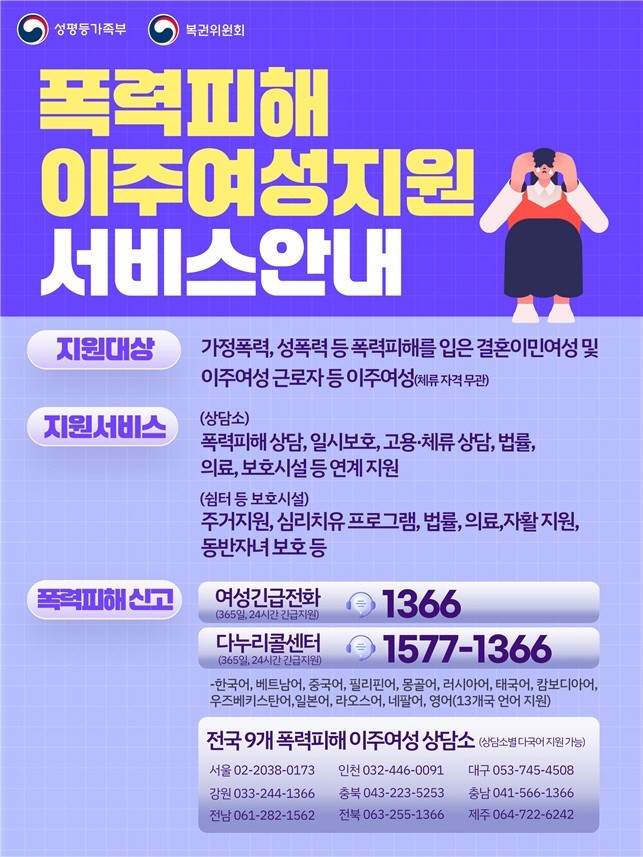 |
| An official information poster outlining comprehensive support services and emergency resources for migrant women affected by violence. / Photo courtesy of the Ministry of Gender Equality and Family |
The South Korean government announced on June 16 that it will launch a comprehensive multi-language public awareness campaign featuring web posters translated into 11 languages to lower informational barriers for migrant women affected by violence, facilitating their swift recovery and stable integration into Korean society. The initiative aims to prevent instances where victims are left without recourse due to linguistic friction or unfamiliarity with institutional frameworks, regardless of their immigration status.
The Ministry of Gender Equality and Family disclosed that it will distribute the educational web posters—which consolidate administrative resources and protective measures for victims of domestic violence, sexual assault, and dating violence—to major immigrant assistance centers across the nation.
A core tenet of the policy framework is the unconditional provision of protective services irrespective of a victim's legal residency status. Marriage immigrants, foreign laborers, and undocumented migrant women are fully entitled to access professional counseling and institutional shelter services if they have fallen victim to violence.
The web posters outline criteria for state assistance, available protection services, and official reporting and counseling channels. To ensure maximum reach among domestic immigrant communities, the materials were adapted into 11 languages: Vietnamese, Chinese, Tagalog, Mongolian, Russian, Thai, Khmer, Uzbek, Japanese, Lao, and Nepali.
Under these provisions, eligible recipients transcend documented marriage immigrants to encompass foreign female workers and undocumented migrant women. Any immigrant woman facing violence can access specialized counseling, emergency shelter housing, medical treatments, legal representation, immigration-related administrative aid, and professional interpretation services.
Currently, specialized counseling networks for migrant women are operational across nine primary regions—including Seoul, Daegu, Incheon, Gangwon, Chungbuk, Chungnam, Jeonbuk, Jeonnam, and Jeju—comprising dedicated regional offices and 33 affiliated counseling branches. These facilities deploy multilingual immigrant counselors to deliver clinical counseling, medical and legal assistance, residency status protection, translation support, and temporary emergency housing for victimized women and their accompanying children.
Victims can reside in state-run protective shelters for up to two years. Upon discharge following a rigorous screening process, individuals are eligible to receive resettlement grants of 5 million won for the mother and 2.5 million won for each accompanying child to support their transition back into independent living.
Furthermore, immigrant women encountering domestic abuse, sexual violence, forced prostitution, stalking, or dating violence can request immediate intervention through the Women's Emergency Hotline (1366), the Danuri Portal Call Center, or local migrant women's counseling centers. Both the 1366 hotline and the Danuri Call Center operate 24 hours a day, 365 days a year.
The Ministry intends to amplify the efficacy of this outreach campaign by distributing the web posters to front-line administrative touchpoints, including 20 immigration offices and foreign offices nationwide, 7 regional employment and labor administrations, and local community service centers.
"We hope these web posters will allow migrant women facing violence to seamlessly access vital protective resources in their native languages," stated Kim Sung-chul, Director-General for the Safety and Human Rights Policy Bureau at the Ministry. "The government will continuously fortify our institutional safety nets to ensure their holistic recovery and stable resettlement within Korean society."
Kim Bo-young
Most Read
-
1
Trump demands rates fall below 1% as Fed hikes for..

-
2
Celltrion seeks rheumatoid arthritis indication ex..

-
3
Chinese e-commerce giants AliExpress, Temu and She..

-
4
Trump warns countries not helping U.S. must pay re..

-
5
Turkish Airlines named main club partner of Liverp..

-
6
China expels No. 2 military official Zhang Youxia..

-
7
Houthi rebels release video claiming downing of Sa..

PEOPLE






-
Address : In-Young Bldg., 34, Uisadang-daero 1-gil, Yeongdeungpo-gu, Seoul
Copyright by ASIATODAY CO., LTD. All rights resereved