



Sidelined victim protection leaves grieving families exposed to secondary abuse
Jun 16, 2026, 09:24 am


 |
"To report it, I eventually had to find that post again. I had to copy the URL, take screenshots, and organize the posting time and nickname. Even for posts that were already deleted, if they were re-uploaded elsewhere, I had to start the whole process all over again."
A, a victim who suffered from online secondary victimization, said the very process of reporting malicious posts was another form of suffering. Since the incident, A’s name and details of the case have been repeatedly posted online. Unverified claims spread as if they were true, and some posts expanded in a way that shifted the blame to the victim or mocked them.
A said, "At first, I thought I just had to endure the incident itself. But even as time passed, my name and the story of the incident kept floating around the internet." A added, "Seeing posts where strangers judged my life as they pleased made me feel that the incident was not over."
The dissemination of false rumors and mocking posts targeting victims of disasters and incidents is recurring in online spaces. While suffering from mental distress caused by malicious posts, victims are left in a situation where they must personally organize and report the post URLs, screenshots, author nicknames, and posting times.
Secondary victimization does not stop at malicious comments. There are cases where victims' personal information, including their names, photos, details of the incident, and family relationships, is leaked together. Some posts spread by piecing together fragmentary information to blame the victim or by presenting unverified suspicions as facts.
Deletion measures do not immediately lead to the recovery from damage either. It is not uncommon for saved screenshots of posts to migrate to other communities, social media platforms, or video platforms. From the victims' perspective, they have to discover the same content multiple times and report it again.
Another victim, B, said, "It didn't end just because it was deleted once. If someone took a screenshot and uploaded it again, I had to find it and explain it all over again." B added, "I don't know why the person who suffered the damage has to keep proving the victimization. The hardest part was that I had to look at that content again in order to report it."
Cases of repeated online secondary victimization were also confirmed in police investigations. According to the National Investigation Headquarters of the National Police Agency, a man in his 50s was arrested for posting false claims and defamatory content against the bereaved families of the Sewol ferry and Itaewon disasters more than 70 times on domestic and international online platforms from 2021 to 2024. The police investigation revealed that some posts unauthorizedly used actual photos of the bereaved families to fabricate false claims, making it appear as though the Sewol ferry families and Itaewon families were the same individuals.
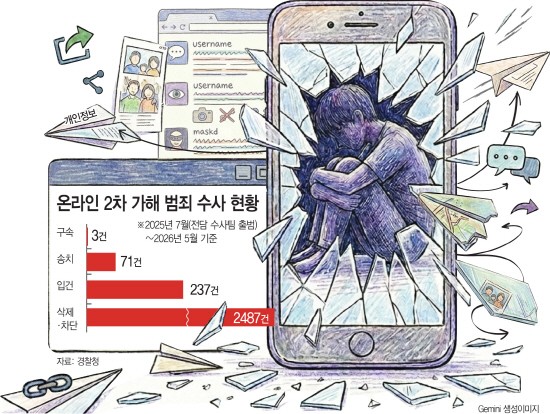
The police are raising their level of response. In July last year, the National Investigation Headquarters of the National Police Agency established a specialized investigation team for secondary victimization crimes targeting victims of major disasters and incidents. Since the creation of the specialized team, the police have launched investigations into 237 cases of secondary victimization crimes, sending 71 of them to the prosecution. There have been three arrests, including the recent case. For 2,487 secondary victimization posts, requests for deletion or blocking were made.
However, victims say that launching an investigation alone is not enough to stop the spread of damage. This is because online posts can migrate to other platforms in a short period, and even after being deleted, they can be redistributed as screenshots or reprocessed images. The burden of continuously verifying additional posts while the investigation and deletion procedures are underway also remains with the victims.
The fact that victim support procedures are divided across different agencies is also pointed out as a limitation. Police reporting goes through the investigation procedure, platform reporting goes through the deletion procedure, and psychological counseling is conducted under a separate support system. This can create situations where victims must repeatedly explain the same damage to multiple agencies.
The Ministry of the Interior and Safety’s guidelines on support for victims of the 10/29 Itaewon disaster define acts that defame or insult victims or the deceased through malicious comments and doxing as secondary victimization. Related agencies are in charge of monitoring, receiving reports, investigating, and handling deletion and blocking procedures, while psychological support is provided through trauma centers and mental health welfare centers nationwide.
Attorney Kim Tae-yeon, who has handled numerous cyber defamation cases, said, "The deletion request procedures differ slightly by site, and there are cases where requests are rejected due to a lack of evidence. Victims often do not know the procedures themselves or find it difficult to approach the legal process of filing a complaint."
Kim emphasized, "Secondary victimization is a crime where dissemination is the core element. Platforms must swiftly implement temporary measures or blind treatments, and the structure where victims repeatedly prove their damage must be reduced." Kim added, "A system must be established where reporting, deletion, investigation, and counseling are connected all at once."
Sul So-young
Kim Hong-chan
Most Read
-
1
Trump demands rates fall below 1% as Fed hikes for..

-
2
Celltrion seeks rheumatoid arthritis indication ex..

-
3
Chinese e-commerce giants AliExpress, Temu and She..

-
4
Trump warns countries not helping U.S. must pay re..

-
5
Turkish Airlines named main club partner of Liverp..

-
6
China expels No. 2 military official Zhang Youxia..

-
7
Houthi rebels release video claiming downing of Sa..

PEOPLE







-
Address : In-Young Bldg., 34, Uisadang-daero 1-gil, Yeongdeungpo-gu, Seoul
Copyright by ASIATODAY CO., LTD. All rights resereved