



Big 5 financial groups bet big on capital markets via securities push
Jun 15, 2026, 10:13 am


 |
In the first quarter of this year, the profit contribution of securities subsidiaries under the five major financial holding companies jumped to the highest level in five years. While their net profit contribution had previously languished under the aftermath of losses from alternative investments and real estate project financing (PF), the net profit scale for the first quarter alone surpassed 1 trillion won, propelled by a surge in trading volume amid a booming stock market since the beginning of this year. Some of these firms have cemented their positions as the second-largest net profit contributors within their respective groups following the flagship banking units, once again highlighting the status of securities subsidiaries as core non-banking cash cows.
The attention of chairmen at major financial holding companies is also turning toward the capital markets. Embracing the capital markets as a core engine for group growth, they have not only hosted management meetings in Yeouido but have also initiated large-scale capital expansions for their securities subsidiaries. Analysts evaluate that this reflects their commitment to positioning the capital market sector at the center of the groups' non-banking growth strategies and mid-to-long-term profit diversification, given that growth via a bank-centric revenue structure has encountered clear limits.
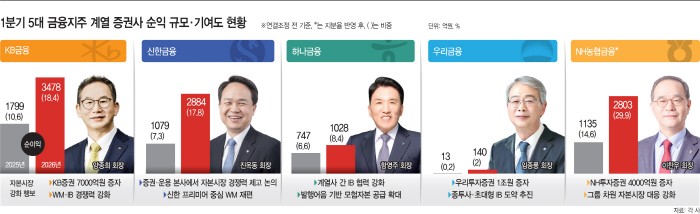
According to financial industry sources on June 14, the aggregate net profit of securities subsidiaries under the five major financial holding groups (KB, Shinhan, Hana, Woori, and NH Nonghyup Financial)—reflecting NH Nonghyup Financial’s equity stake—stood at 1.0333 trillion won in the first quarter of this year. This represents a 116% surge compared to the same period last year (4773 billion won). The average proportion of group net profit accounted for by each securities subsidiary also rose to 15.3% on a simple average basis. This is nearly double the figure from the same period last year (7.8%) and marks the highest level recorded in the past five years.
By holding company, Shinhan Investment & Securities' profit contribution to the group in the first quarter rose by more than 10 percentage points year-on-year to 17.8% from 7.3%. This is the highest level since its incorporation into Shinhan Financial Group. Over the same period, the net profit contribution of KB Securities and Hana Securities expanded from 10.6% to 18.4%, and from 6.6% to 8.4%, respectively. The profit contribution of NH Investment & Securities also more than doubled from 14.6% to 29.9% based on equity interest. Consequently, at KB Financial and Shinhan Financial, the securities arms surpassed existing insurance and credit card subsidiaries to become the second-largest net profit generators within the groups, while further solidifying their standing as the leading non-banking subsidiaries at Hana and NH Nonghyup Financial.
The expanding presence of securities subsidiaries within financial holding companies this year is attributed to increased investment demand driven by a vibrant stock market. This is because securities firms' brokerage commission income grew as the daily average trading volume in the domestic stock market during the first quarter reached 66.6 trillion won, more than a 3.5-fold increase compared to the same period last year (18.6 trillion won). Furthermore, the financial performance was positively impacted by the "money move" phenomenon, where funds previously sitting in bank deposits shifted toward investment products such as exchange-traded funds (ETFs) and public mutual funds.
As the presence of securities subsidiaries grows, chairmen of financial holding companies are throwing their weight behind nurturing the capital markets as a core growth engine for their groups. Shinhan Financial Group Chairman Jin Ok-dong noted, "The future growth of the group hinges on our competitiveness in the capital markets," urging the strengthening of related businesses. Hana Financial Group Chairman Ham Young-joo has consistently called for an expanded role for securities firms amid the money move, while KB Financial Group Chairman Yang Jong-hee highlighted the importance of the securities sector by presenting the transition toward capital-efficient Investment Banking (IB) businesses as a primary task.
The movements of financial group CEOs are also shifting toward the capital markets. On June 10, Shinhan Financial held an executive management meeting at the TP Tower in Yeouido, Seoul, where the headquarters of Shinhan Investment & Securities and Shinhan Asset Management are located. Hana Financial has also held the "Hana One-IB Market Forum" twice this year at Hana Securities’ headquarters to review the IB collaboration system among subsidiaries, including the bank, securities, capital, and ventures arms. Similarly, NH Nonghyup Financial held a business strategy and synergy promotion committee meeting at NH Investment & Securities’ headquarters in March to discuss strengthening capital market competitiveness and group-wide collaboration measures.
The injection of financial ammunition to bolster competitiveness has also begun in earnest. In February, KB Financial conducted a paid-in capital increase of 700 billion won for KB Securities to strengthen its Wealth Management (WM) and IB competitiveness. NH Nonghyup Financial also recently decided to contribute 400 billion won to NH Investment & Securities. This demonstrates that the vision of Chairman Lee Chan-woo, who has consistently emphasized the vitalization of capital markets, has materialized into actual investment. Woori Financial Group also executed a 1 trillion won paid-in capital increase for Woori Investment & Securities. In line with the push by Chairman Yim Jong-yong to reinforce a comprehensive financial group structure, Woori Financial is considering further phased capital expansions in the future.
The securities industry views the financial holding companies' stance on fostering securities firms not merely as a move to strengthen non-banking operations, but as a strategic approach to secure additional revenue streams and improve profitability. Eun Kyung-wan, a researcher at Shinhan Investment & Securities, said, "Since the financial holding companies' capacity to expand financial leverage has effectively neared its limit, an increase in Return on Assets (ROA) is required for further improvement in Return on Equity (ROE). The capital market sector sits at the heart of that effort."
Yu Su-jung
Han Sang-wook
Most Read
-
1
Celltrion’s Omlyclo gains ground in major European..

-
2
Trump demands rates fall below 1% as Fed hikes for..

-
3
Trump makes $1 trillion bet ahead of midterm elect..

-
4
Iran resumes ballistic missile production, assembl..

-
5
Samsung Electronics, Mistral AI to jointly develop..

-
6
Trump warns countries not helping U.S. must pay re..

-
7
Apple launches first foldable, 1 million won prici..

PEOPLE






HEADLINE NEWS
- Trump to roll out ‘unprecedented welcome’ for Xi with B-2 bombers, F-22 fighters
- S. Korea, U.S., and Japan form united front on Taiwan and economic coercion..
- Trump administration moves to impose sweeping sanctions on International Cr..
- Xi to make state visit to U.S. Sept. 23-25, dispelling rumors over his heal..

-
Address : In-Young Bldg., 34, Uisadang-daero 1-gil, Yeongdeungpo-gu, Seoul
Copyright by ASIATODAY CO., LTD. All rights resereved