



"Basic pension should shift to minimum income guarantee for low‑income workers," experts say
Jun 10, 2026, 09:46 am


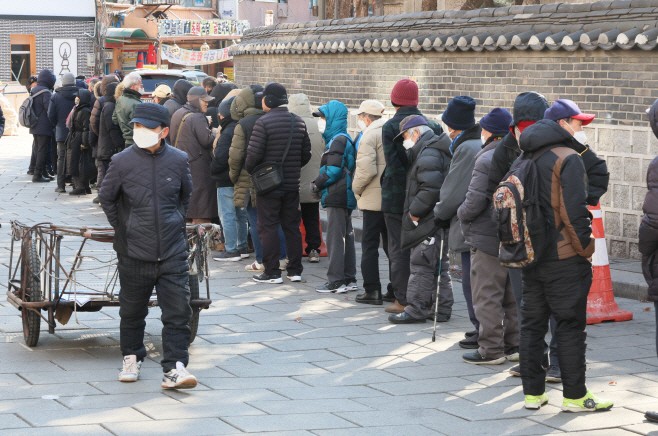 |
| Elderly queue for lunch at Tapgol Park Free Meal Center in Seoul. / Yonhap News |
Amid rapid demographic shifts driven by ultra-low birth rates and population aging, academics have proposed restructuring South Korea's basic pension system into a minimum-income guarantee program focused on low-income seniors. The proposal calls for replacing the current system, which covers the bottom 70% of income earners, with a more progressive model that provides greater benefits to poorer retirees.
According to a study titled "Directions and Future Tasks for Basic Pension Reform to Strengthen the Multi-Tier Retirement Income Security System" by Senior Research Fellow Choi Ok-geum, published in the Spring 2026 issue of the National Pension Research Institute's Pension Forum, transitioning to a universal basic pension would face significant fiscal and policy constraints amid low fertility and rapid population aging. The report also noted that a universal system would require reducing the income-redistributive component (A-benefit) of the National Pension Scheme and could disproportionately benefit higher-income groups.
Instead, Choi proposed gradually narrowing eligibility for the current basic pension while increasing benefit levels for low-income elderly people, ultimately transforming the program into a minimum-income guarantee system.
Such a reform, the report argues, would provide more efficient retirement income support for vulnerable seniors while clarifying the roles of the basic pension, the National Pension Scheme, and the National Basic Livelihood Security Program within South Korea's broader retirement income framework.
Assuming the basic pension evolves into a minimum-income guarantee program, Choi emphasized that the National Pension Scheme should remain the primary source of retirement income for the general population, while the basic pension should focus on supporting low-income seniors in the current generation.
He noted that although the income eligibility threshold for the basic pension stands at 2.47 million won per month this year, the standard pension benefit amounts to only 349,700 won. He therefore proposed a medium-term strategy of gradually reducing the number of beneficiaries while steadily increasing benefit levels for low-income seniors, eventually transitioning the program into a minimum-income guarantee system.
Choi also stressed that any such reform should be accompanied by improvements to the income-assessment method used to determine eligibility, with a stronger focus on low-income seniors. He argued that the current system has prioritized maintaining a 70% beneficiary rate by continually expanding deductions and exemptions. In addition, he suggested reviewing the integration of the basic pension and the National Basic Livelihood Security Program in the long run, given their potentially overlapping roles under a minimum-income guarantee framework.
Meanwhile, the Ministry of Health and Welfare held an expert forum on basic pension reform in Seoul on June 9, chaired by First Vice Minister Hyun Soo-yup. The ministry stated that it plans to pursue a reform package based on the principle of providing larger benefits to lower-income seniors, with the goal of strengthening retirement income security and reducing elderly poverty.
Seo Byung-joo
Most Read
-
1
Trump demands rates fall below 1% as Fed hikes for..

-
2
Celltrion seeks rheumatoid arthritis indication ex..

-
3
Chinese e-commerce giants AliExpress, Temu and She..

-
4
Trump warns countries not helping U.S. must pay re..

-
5
Turkish Airlines named main club partner of Liverp..

-
6
China expels No. 2 military official Zhang Youxia..

-
7
Houthi rebels release video claiming downing of Sa..

PEOPLE







-
Address : In-Young Bldg., 34, Uisadang-daero 1-gil, Yeongdeungpo-gu, Seoul
Copyright by ASIATODAY CO., LTD. All rights resereved