



Service sector leads job growth as manufacturing, construction, youth employment remain weak
Jun 09, 2026, 01:46 pm


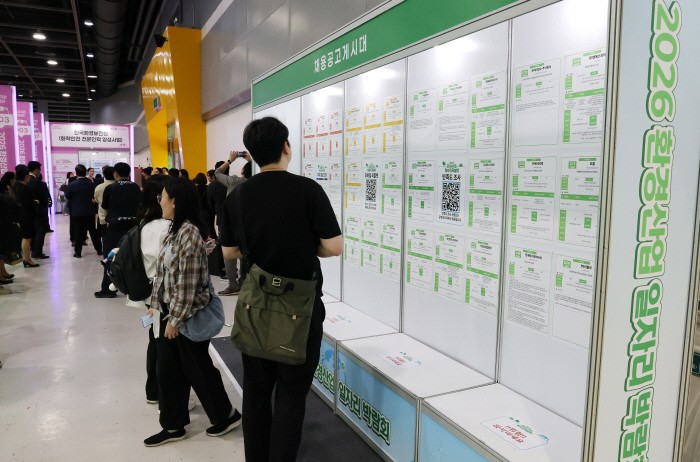 |
| Job seekers look through postings at the 2026 Environmental Industry Job Fair held on May 19 at aT Center in Seocho-gu, Seoul. /Yonhap News |
Employment insurance subscribers continued to rise in the high 200,000s for the fifth consecutive month. Growth was driven by the service sector, including health and welfare and accommodation and food services, while manufacturing and construction continued to decline. The number of insured workers aged 29 and under also fell by more than 60,000, highlighting persistent disparities by industry and age group.
According to the “May 2026 Labor Market Trends Based on Employment Administration Statistics” released by the Ministry of Employment and Labor on the 9th, the number of employment insurance subscribers stood at 15.848 million at the end of last month, up 268,000 (1.7%) from a year earlier. The pace of increase remained in the high-200,000 range for five consecutive months, following gains of 263,000 in January, 259,000 in February, 270,000 in March, and 271,000 in April.
By industry, service-sector subscribers totaled 11.113 million, an increase of 284,000 from a year earlier. Health and social welfare services recorded the largest gain at 114,000, followed by accommodation and food services (55,000), business services (24,000), education services (22,000), and professional, scientific and technical services (22,000).
In contrast, weakness in manufacturing and construction persisted. Manufacturing subscribers totaled 3.84 million, down 10,000 year-on-year, marking the 12th consecutive month of decline. Gains were seen in other transport equipment (5,000), electronics and communications (4,000), and medical substances and pharmaceuticals (2,000), while declines were recorded in fabricated metal products (-4,000), textiles (-3,000), rubber and plastics (-3,000), and automobiles (-2,000).
Within manufacturing, sectoral divergence was evident. Electronics and communications manufacturing continued to rise for nine consecutive months, driven by semiconductors. Other transport equipment, including shipbuilding, also extended its growth streak to 42 months. In contrast, automobile manufacturing turned negative in March and the pace of decline has since widened. A Ministry of Employment and Labor official attributed part of this to supply chain disruptions and export delays following industrial safety incidents affecting parts production.
Excluding the impact of foreign workers under the Employment Permit System, manufacturing weakness appears more pronounced. Of the total 268,000 increase in employment insurance subscribers last month, 15,000 were foreign workers under E-9 and H-2 visas, 89.9% of whom were concentrated in manufacturing. Excluding these workers, manufacturing subscribers fell by 23,000.
Construction subscribers fell to 745,000, down 8,500 from a year earlier, extending a 34-month decline, mainly in general construction. However, the pace of decline has gradually eased, from 12,000 in January to 11,000 in February, 9,000 in March and April, and 8,000 in May.
By age group, those in their 30s, 50s, and aged 60 or older increased, while those aged 29 and under and those in their 40s declined. Workers aged 60 and over rose by 207,000, leading overall gains. Those in their 30s increased by 84,000 and those in their 50s by 46,000. In contrast, those aged 29 and under fell by 65,000, and those in their 40s declined by 5,000.
The decline among younger workers was seen across both manufacturing and services. Manufacturing employment insurance subscribers aged 29 and under fell by 28,000, while the service sector recorded a decline of 32,000 in the same age group. The ministry noted that while difficulties for young workers persist, the pace of decline is showing signs of slowing.
Unemployment benefit indicators also declined. New applicants for job-seeking benefits totaled 79,000, down 6,000 (-7.2%) from a year earlier, led by decreases in construction (-4,200) and manufacturing (-1,300). The number of recipients stood at 630,000, down 40,000 (-6.0%), while total benefit payments fell by 78 billion won (-7.0%) to 1.0328 trillion won.
New job postings through the integrated employment service platform “Job Korea 24” totaled 153,000, up 12,000 (8.7%) year-on-year, while new job seekers declined to 364,000, down 12,000 (-3.3%). As a result, the job vacancy ratio stood at 0.42, up from 0.37 a year earlier. However, the decline in job seekers also contributed to this increase, suggesting the need to consider hiring trends outside the platform.
Kim Nam-hyung
Most Read
-
1
Trump demands rates fall below 1% as Fed hikes for..

-
2
Celltrion seeks rheumatoid arthritis indication ex..

-
3
Chinese e-commerce giants AliExpress, Temu and She..

-
4
Trump warns countries not helping U.S. must pay re..

-
5
Turkish Airlines named main club partner of Liverp..

-
6
China expels No. 2 military official Zhang Youxia..

-
7
Houthi rebels release video claiming downing of Sa..

PEOPLE







-
Address : In-Young Bldg., 34, Uisadang-daero 1-gil, Yeongdeungpo-gu, Seoul
Copyright by ASIATODAY CO., LTD. All rights resereved