



[Market Power] Hyundai Motors incurs massive losses despite its push future bets
May 29, 2026, 10:00 am


 |
The Hyundai Motor Group’s three core future business engines—robotics, autonomous driving, and Advanced Air Mobility (AAM)—have logged a cumulative net loss exceeding 2.2 trillion won over the past five years.
Market consensus attributes these shortfalls to massive upfront investments aimed at securing dominance in the future mobility sector. Despite the losses, expectations for long-term growth remain strong as tangible achievements emerge, including commercialization milestones in robotics and autonomous driving, alongside soaring corporate valuations.
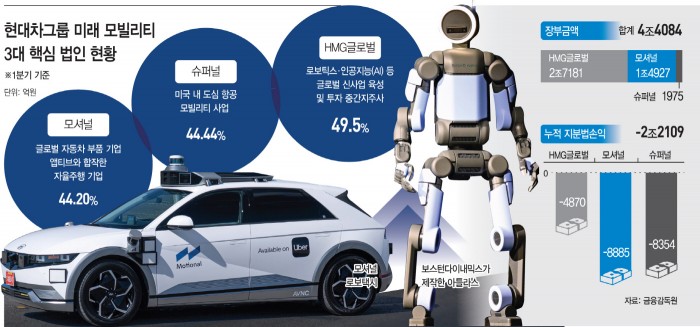
According to data from the Financial Supervisory Service’s electronic disclosure system on May 28, the combined book value of Hyundai’s core future business subsidiaries stands at 4.4084 trillion won as of the first quarter of this year. This total comprises 2.7181 trillion won for HMG Global, 1.4927 trillion won for Motional, and 197.5 billion won for Supernal.
In contrast, the cumulative equity-method losses generated by these entities have climbed to 2.2109 trillion won, effectively erasing more than half of their aggregate book value on paper. Individually, HMG Global recognized a loss of 487 billion won, Motional logged 888.5 billion won, and Supernal recorded 835.4 billion won.
HMG Global was established in the United States in 2022 as an investment holding company serving as the global command center for the group’s robotics and artificial intelligence initiatives. Owned jointly by Hyundai Motor (49.5%), Kia (30.5%), and Hyundai Mobis (20.0%), it holds a 56.25% stake in Boston Dynamics, the developer of the humanoid robot Atlas.
Boston Dynamics recently unveiled a strategic roadmap to build an annual production system of 30,000 Atlas units by 2028. Under this plan, 25,000 humanoids will be sequentially deployed directly onto Hyundai Motor's manufacturing lines.
The group is currently reviewing plans to pilot the deployment at Hyundai Motor Group Metaplant America (HMGMA) in Georgia before scaling the technology to Kia’s Georgia assembly plant.
Notably, Boston Dynamics’ corporate valuation has surged significantly following the public debut of Atlas at CES 2026 in Las Vegas this January.
Market analysts estimate the robotics firm's current valuation between 30 trillion and 60 trillion won, with some domestic brokerages and global investment banks projecting that its worth could eclipse 100 trillion won. Industry insiders forecast that if Boston Dynamics executes its initial public offering (IPO) next year, Hyundai will secure a massive influx of capital to fund subsequent future mobility investments.
Motional, the group's autonomous driving arm, also remains mired in deficit but is widely evaluated as having entered the initial stages of commercialization. Founded in 2020 as a joint venture between Hyundai Motor Group and global automotive supplier Aptiv, Motional specializes in developing and commercializing Level 4 and Level 5 autonomous driving solutions. Its ownership structure consists of Hyundai Motor (44.20%), Kia (24.25%), and Hyundai Mobis (17.32%).
In March of this year, Motional launched a commercial robotaxi service based on the Ioniq 5 platform in Las Vegas in partnership with Uber. While safety drivers currently remain in the front seat to monitor system diagnostics, the venture aims to transition to fully driverless operations by the end of the year. The core objective focuses on safely navigating dense urban corridors via AI-driven autonomous driving technology.
Conversely, Supernal, which oversees the group's AAM operations, is viewed as the business unit facing the highest degree of market uncertainty. Established by Hyundai Motor Group in 2020, Supernal is owned by Hyundai Motor (44.44%), Hyundai Mobis (33.33%), and Kia (22.22%). The subsidiary has already recognized losses that drastically outstrip its initial book value.
Following a executive shakeup last year, Supernal executed large-scale layoffs in March, intensifying market anxieties regarding the long-term viability of the project. Management, however, maintains that because AAM represents a critical pillar of the group's overarching future mobility vision, investment will remain aggressively focused on engineering commercially viable aircraft.
Experts analyze that Hyundai's sweeping financial losses should be interpreted as necessary expenditures to capture future market share rather than simple operational deficits.
"With global competitors like Toyota and the Volkswagen Group scaling back production volumes amid cooling market growth, Hyundai's aggressive expansion of future investments is an inevitable tactical move," observed Lee Hang-koo, a senior research fellow at the Korea Automobile Research Institute. "However, it is true that Supernal continues to operate under high structural uncertainty."
Lee Ho-geun, a professor of automotive engineering at Daeduk University, echoed this sentiment: "The reason Hyundai continues to funnel capital into robotics, autonomous driving, and AAM despite mounting losses is the looming battle for future industry hegemony. In the next-generation mobility ecosystem, securing data, internalizing core technologies, and establishing early network effects carry far greater weight than short-term quarterly profits."
Kang Tae-yun
Most Read
-
1
Kia Sportage outperforms Mazda CX-5 in German auto..

-
2
Houthis launch successive attacks on Saudi airport..

-
3
Saudi Arabia, Iran hold first diplomatic talks to..

-
4
U.S. deploys carrier, 10,000 more troops to Middle..

-
5
Saudi airport in Riyadh struck again, leaving at l..

-
6
Putin's ally visits China on the 8th ahead of APEC..

-
7
Chinese military support and training center opens..

PEOPLE






HEADLINE NEWS

-
Address : In-Young Bldg., 34, Uisadang-daero 1-gil, Yeongdeungpo-gu, Seoul
Copyright by ASIATODAY CO., LTD. All rights resereved