



Chey says 'generalists' will take the center stage in AI era
May 29, 2026, 09:45 am


 |
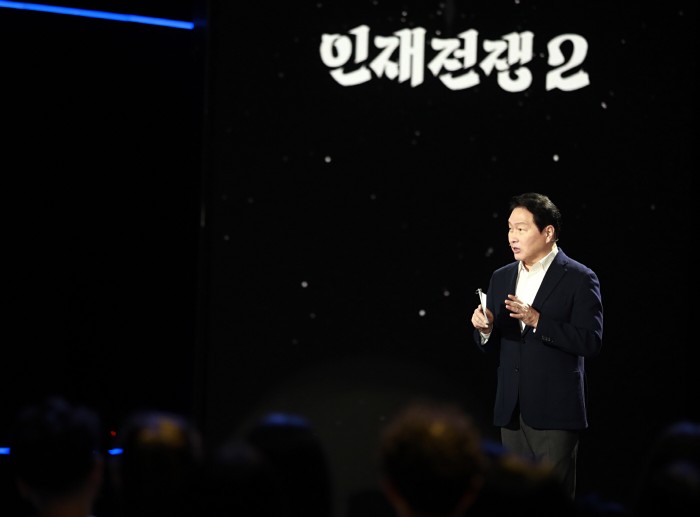
| SK Group Chairman Chey Tae-won delivers a lecture on the ideal talent profile for the artificial intelligence era during an appearance on the KBS1 documentary series The War for Talent 2: Chey Tae-won's Answer, which aired on May 28. / Photo courtesy of SK Group |
Chey Tae-won, chairman of SK Group and the Korea Chamber of Commerce and Industry (KCCI), emphasized that the dawn of the artificial intelligence (AI) era will prioritize "generalist talent"—individuals who have cultivated uniquely human capabilities. To support this shift, Chey suggested that the nation must accelerate the expansion of its AI infrastructure, anchored on the pillars of speed, scale, and safety.
According to SK Group on May 29, Chairman Chey appeared on the KBS1 documentary program Docu Insight - The War for Talent 2: Chey Tae-won's Answer, which aired on May 28. "In an era where AI is evolving faster than humanity, we must deeply reflect on what we need to learn and what capabilities we must foster," Chey remarked. "I wanted to share the insights I have gathered firsthand by engaging directly with global tech leaders and driving business initiatives on the front lines of the AI industry."
Chey diagnosed the current technological landscape as transitioning beyond the era of "Reasoning AI"—where systems primarily provide answers to human queries—and heading toward a full-fledged era of "Agentic AI," where systems possess the capacity to make autonomous judgments and execute actions.
"During this transitional phase, the capability gap between individuals who actively leverage AI and those who do not will widen far more drastically than what we see today," Chey explained. "This polarization will not be limited to individuals; it could intensify across corporations and nation-states depending on how swiftly and effectively they integrate AI capabilities."
However, looking further into the future toward the advent of Artificial General Intelligence (AGI)—AI that matches human-level cognition—Chey projected that the disparity in knowledge and productivity among humans would conversely contract. He illustrated this through a numerical analogy: if the current capability levels of two distinct individuals stand at 10 and 100 respectively, representing a tenfold gap, the integration of AGI will baseline both individuals with a foundational capability boost of, for instance, 1,000. Consequently, their respective capabilities would shift to 1,010 and 1,100, substantially diminishing the relative performance gap between them.
 |
Chey remarked, "Consequently, in the future, the specific occupation one holds becomes less critical than how effectively one can leverage and bridge the connection between humans and AI." He predicted that the significance of "generalist" talent—individuals capable of traversing diverse domains to design new systems and societies where humans and AI coexist—will far outshine that of traditional "specialists" whose expertise is confined to a singular field.
Furthermore, Chey added that as AI assumes a substantial portion of routine workloads, professionals will be empowered to maintain multiple roles simultaneously through a "multi-job" lifestyle. This structural shift is expected to gradually dismantle conventional 9-to-6 office routines and rigid, standardized career frameworks.
As for the core competencies individuals must cultivate to thrive in the AI era, Chey proposed a framework composed of "four critical muscles": the "thinking muscle" to interrogate the core of a problem, the "adaptive muscle" to respond to rapid transformation, the "empathy muscle" to leverage uniquely human emotional intelligence, and "body skills" to derive value through physical experiences like music, art, and sports. "The ability to rapidly memorize information and excel at standardized testing will be largely superseded by AI," Chey noted. "The imperative now lies in strengthening the domains exclusive to human consciousness."
Turning to macro-level strategy, Chey outlined a national blueprint for South Korea to transition into a competitive "AI Nation," introducing the "3S" framework: Speed, Scale, and Safety. This strategy dictates that the country must accelerate technological development, scale up massive AI infrastructure and investments, and concurrently establish institutional safeguards so that citizens can securely utilize AI technologies.
"AI talent is no longer a concept restricted to engineering and technical disciplines," Chey emphasized. "Our educational and societal frameworks must transform with urgency to ensure that future generations can naturally utilize and coexist with AI."
Kim Young-jin
Most Read
-
1
Kia Sportage outperforms Mazda CX-5 in German auto..

-
2
Houthis launch successive attacks on Saudi airport..

-
3
Saudi Arabia, Iran hold first diplomatic talks to..

-
4
U.S. deploys carrier, 10,000 more troops to Middle..

-
5
Saudi airport in Riyadh struck again, leaving at l..

-
6
Putin's ally visits China on the 8th ahead of APEC..

-
7
Chinese military support and training center opens..

PEOPLE






HEADLINE NEWS

-
Address : In-Young Bldg., 34, Uisadang-daero 1-gil, Yeongdeungpo-gu, Seoul
Copyright by ASIATODAY CO., LTD. All rights resereved