



SK chairman urges focus on human strengths in age of AI
May 29, 2026, 09:44 am


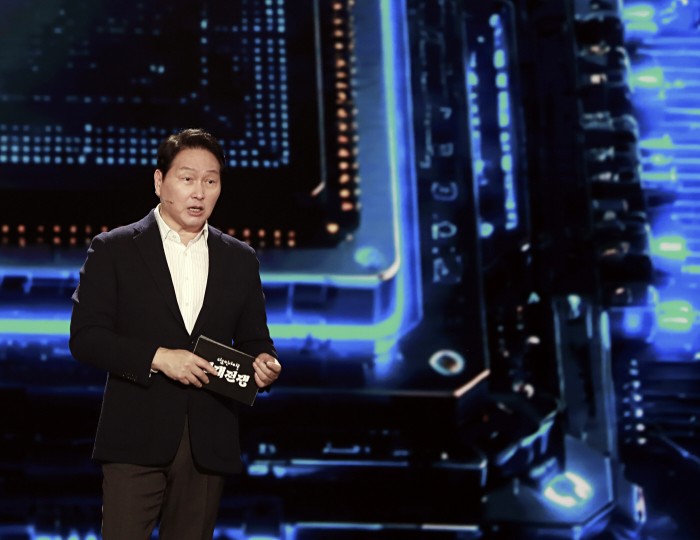 |
| Chey Tae-won, Chairman of SK Group and President of the Korea Chamber of Commerce and Industry, speaks about the future of AI talent during KBS1’s documentary program Insight – Talent War 2: Chey Tae-won’s Answer, aired on May 28. /SK Group |
Chey Tae-won, chairman of SK Group and the Korea Chamber of Commerce and Industry, emphasized that the AI era will place greater value on “generalist” talent capable of developing uniquely human capabilities. He also called for faster expansion of AI infrastructure at the national level based on speed, scale and safety.
According to SK Group on May 29, Chey appeared on KBS1’s documentary program Document Insight – Talent War 2: Chey Tae-won’s Answer, which aired on May 28.
“We need to think carefully about what we should learn and what abilities we should develop in an era when AI is evolving faster than humans,” Chey said. “I wanted to share the perspectives I have gained through direct conversations and business collaborations with many people across the AI industry.”
Chey said society is moving beyond the era of “reasoning AI,” which responds to human questions, and entering the age of “agentic AI,” capable of making decisions and taking actions on its own.
“At this stage, the gap between people who actively utilize AI and those who do not could become far wider than it is today,” he said. “The same applies to companies and nations. Polarization may deepen depending on how quickly and effectively they adopt AI.”
Looking further ahead, however, Chey predicted that the arrival of artificial general intelligence (AGI) could actually narrow the gap in knowledge and productivity among people. He explained that while one person may currently have a capability level of 10 and another 100, AGI could effectively add a baseline capability of 1,000 to everyone, raising them to 1,010 and 1,100, respectively, thereby reducing the relative difference.
“Therefore, in the future, it will be more important to understand how to combine and connect human capabilities with AI than to focus on a specific profession,” he said. “The importance of generalists who can move across diverse fields and design new systems and societies where humans and AI coexist will continue to grow.”
Chey also suggested that AI will enable people to take on multiple jobs simultaneously as technology assumes a significant portion of routine work. As a result, traditional nine-to-six work structures and fixed career concepts could gradually evolve.
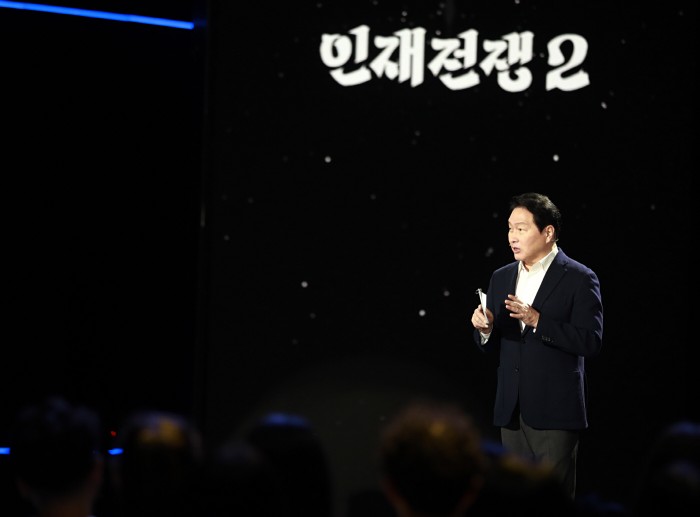 |
He outlined four essential capabilities individuals should develop to remain competitive in the AI era. The first is “thinking muscle,” the ability to question assumptions, identify the essence of problems and think critically. The second is “adaptation muscle,” which enables people to respond quickly and effectively to rapid change. The third is “empathy muscle,” a uniquely human capacity to understand and connect with others emotionally. The fourth is “body skills,” which create value through physical and creative activities such as sports, music and art.
“The ability to rapidly absorb knowledge and perform well on exams will be substantially replaced by AI,” he said. “What will matter most is strengthening capabilities that remain uniquely human.”
Chey also proposed a national strategy for transforming South Korea into a competitive “AI Nation.” He identified three key requirements — Speed, Scale and Safety, which he referred to as the “3S” framework. This means accelerating technological advancement, expanding large-scale AI infrastructure and investment, and establishing institutional safeguards that allow citizens to use AI safely.
“AI talent does not simply refer to engineers or technical specialists,” Chey said. “Education systems and social institutions must also evolve quickly so future generations can naturally work alongside and coexist with AI.”
#Chey Tae-won #SK Group #AI #artificial intelligence #generalist
Copyright by Asiatoday
Most Read
-
1
Kia Sportage outperforms Mazda CX-5 in German auto..

-
2
Houthis launch successive attacks on Saudi airport..

-
3
Saudi Arabia, Iran hold first diplomatic talks to..

-
4
U.S. deploys carrier, 10,000 more troops to Middle..

-
5
Saudi airport in Riyadh struck again, leaving at l..

-
6
Putin's ally visits China on the 8th ahead of APEC..

-
7
Chinese military support and training center opens..

PEOPLE





HEADLINE NEWS

-
Address : In-Young Bldg., 34, Uisadang-daero 1-gil, Yeongdeungpo-gu, Seoul
Copyright by ASIATODAY CO., LTD. All rights resereved