



OpenAI holds first Korea leadership summit on enterprise AI
May 29, 2026, 08:58 am


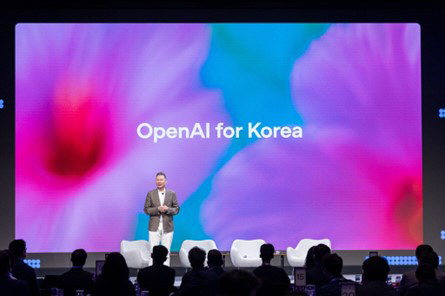 |
| Kyung-hoon Kim, Head of OpenAI Korea, speaks at OpenAI’s first Korean Exec Summit held in Seoul on May 27. /OpenAI |
OpenAI held its first executive leadership event in South Korea, bringing together more than 130 business and technology leaders to discuss the practical deployment and expansion of enterprise artificial intelligence.
According to OpenAI on May 29, the company hosted its inaugural “Exec Summit” in Seoul on May 27, where executives from major Korean corporations and technology firms explored how AI can be implemented across enterprise operations.
Held under the theme “Intelligence at Work,” the event focused on how AI is evolving beyond a personal productivity tool into a core component of corporate systems, data infrastructure and business processes.
OpenAI said AI adoption is accelerating rapidly in Korea. Weekly active users of ChatGPT Codex in the country have increased tenfold since the beginning of the year, while more than half of Codex requests now come from non-development tasks such as document creation, analysis, research and operations. The trend highlights AI’s expansion from a developer-focused tool into a broader workplace platform.
The summit drew senior executives from major conglomerates and leading IT companies, reflecting strong industry interest in OpenAI’s enterprise strategy and the practical application of advanced AI technologies.
Participants included Jason Kwon, OpenAI’s Chief Strategy Officer; Ashley Kramer, Vice President of Enterprise; and Kyung-hoon Kim, Head of OpenAI Korea, along with other global and regional leaders.
During technical sessions, OpenAI executives demonstrated how Codex, Workspace Agent and Forward Deployed Engineering solutions can support software development, workflow automation and complex business problem-solving.
In his keynote address, Jason Kwon emphasized that “the foundation of AI adoption is trust and security.” He noted that OpenAI is helping Korean government agencies and corporate security teams utilize Daybreak, the company’s cybersecurity initiative, through its Korea Cyber Action Plan.
Ashley Kramer said, “Corporate competitiveness in the AI era depends on how deeply AI is integrated into actual work and enterprise systems. When AI becomes embedded within teams and workflows, organizations can create meaningful economic value.”
Live demonstrations showed AI agents and Codex analyzing complex business challenges and generating actionable outcomes. One example illustrated an AI agent reviewing inventory and shipping data to address supply chain issues before conducting financial impact analysis. Another demonstration highlighted Codex supporting tasks ranging from market opportunity analysis and candidate research to spreadsheet creation, brand campaign planning, website development and executive reporting.
As a domestic case study, executives from Krafton shared the company’s experience with enterprise-wide AI transformation and Codex adoption. Following its AI-first strategy announced last year, Krafton has promoted AI literacy and process innovation across the organization. According to an internal survey conducted in February, 97.2% of employees use generative AI tools such as ChatGPT.
Codex is being utilized not only for rapid prototyping and integration with data and deployment environments, but also for onboarding new engineers to legacy codebases, software documentation, meeting summaries, action-item management and the development of internal automation tools.
During a discussion session, Kyung-young Lim said, “For leaders considering AI adoption, a culture that is not afraid of trial and error is essential. Because the AI ecosystem is evolving rapidly and there is no single correct answer, organizations should encourage experimentation and quickly test tools that fit their needs.”
Kyung-hoon Kim said OpenAI plans to continue expanding partnerships with Korean companies to help ensure AI is safely integrated into business operations and organizational management, while delivering repeatable results across industries.
#OpenAI #Exec Summit #South Korea #enterprise AI #ChatGPT
Copyright by Asiatoday
Most Read
-
1
Kia Sportage outperforms Mazda CX-5 in German auto..

-
2
Houthis launch successive attacks on Saudi airport..

-
3
Saudi Arabia, Iran hold first diplomatic talks to..

-
4
U.S. deploys carrier, 10,000 more troops to Middle..

-
5
Saudi airport in Riyadh struck again, leaving at l..

-
6
Putin's ally visits China on the 8th ahead of APEC..

-
7
Chinese military support and training center opens..

PEOPLE






HEADLINE NEWS

-
Address : In-Young Bldg., 34, Uisadang-daero 1-gil, Yeongdeungpo-gu, Seoul
Copyright by ASIATODAY CO., LTD. All rights resereved