



Samsung union scrambles to maintain majority amid membership exodus
May 29, 2026, 08:41 am


 |
Samsung Electronics’ labor union is moving to contain growing internal unrest following the conclusion of the company’s 2026 wage negotiations, as membership withdrawals and factional tensions raise concerns over the union’s ability to maintain its majority status.
The labor dispute’s aftermath has prompted both management and union leaders to take corrective measures. Samsung Electronics recently announced plans to invest 5 trillion won in coexistence initiatives and talent development, while the Samsung Electronics branch of the Samsung Group enterprise-level labor union has launched a restructuring effort aimed at restoring internal unity.
On May 28, the enterprise-level union issued a statement outlining its future bargaining and operational plans, apologizing for past mistakes and announcing a confidence vote for its chairman on June 17.
The move comes after strong opposition from members in Samsung Electronics’ Device eXperience (DX) division during the wage negotiation process. Union leadership also apologized for controversial remarks made during internal disputes, including comments expressing frustration with representing DX employees.
The enterprise-level union played the lead role in this year’s collective bargaining process. Although the National Samsung Electronics Union held official bargaining rights, it formed a joint negotiating body with the enterprise-level union and the Samsung Electronics Donghaeng Union, effectively delegating bargaining authority to the enterprise-level union.
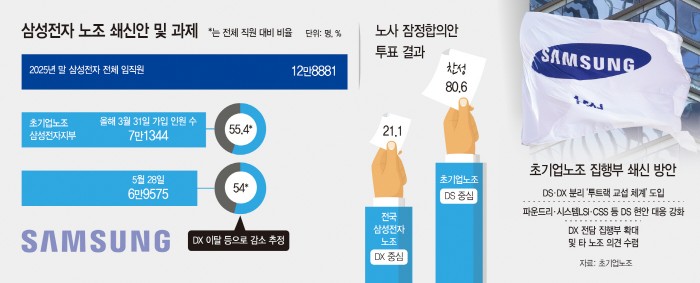
The union’s growing influence stems from a milestone reached in April, when it secured membership from more than half of Samsung Electronics employees. Under South Korea’s labor law, a union representing a majority of workers can obtain exclusive bargaining rights when multiple unions exist within a company.
To strengthen its position, the union has proposed one of its most significant organizational reforms to date: separating bargaining structures for the Device Solutions (DS) and DX divisions. Rather than maintaining a unified negotiating framework, the union plans to establish dedicated executive teams for each division and expand representation for business units such as foundry, System LSI and compound semiconductor operations.
However, questions remain about whether DX employees’ concerns will be adequately reflected, as the restructuring process is being led primarily by a union whose membership base remains concentrated in the semiconductor-focused DS division.
Membership erosion has already become visible. As of May 28, total membership stood at 69,575, falling below the 70,000-member threshold after surpassing that level in March.
Union officials have reported increasing withdrawal inquiries from DX employees following the wage agreement. Industry observers warn that continued departures from the DX division and non-memory semiconductor businesses could jeopardize the union’s majority status.
At the same time, membership in the Samsung Electronics Donghaeng Union has been rising rapidly. The union reported 16,290 members as of May 28, with much of the growth coming from DX employees.
Tensions between the divisions were also reflected in voting results on the tentative wage agreement. According to industry sources, the Samsung Electronics branch of the enterprise-level union, whose membership is heavily concentrated in the DS division, recorded an approval rate of 80.6%. By contrast, the National Samsung Electronics Union, which has stronger support among DX employees, reported approval of only 21.1%.
Some union members are also considering legal action related to the wage negotiations and performance-based compensation system, adding further pressure on union leadership to restore cohesion.
An industry official said the challenge facing Samsung’s labor organizations now extends beyond ratifying the wage agreement itself.
“The bigger issue has become repairing internal divisions and reorganizing labor representation,” the official said. “Competition over exclusive bargaining rights next year could trigger a broader realignment of Samsung Electronics’ labor landscape.”
#Samsung Electronics #labor union #Samsung labor dispute #wage negotiations #enterprise-level union
Copyright by Asiatoday
Most Read
-
1
Kia Sportage outperforms Mazda CX-5 in German auto..

-
2
Houthis launch successive attacks on Saudi airport..

-
3
Saudi Arabia, Iran hold first diplomatic talks to..

-
4
U.S. deploys carrier, 10,000 more troops to Middle..

-
5
Saudi airport in Riyadh struck again, leaving at l..

-
6
Putin's ally visits China on the 8th ahead of APEC..

-
7
Chinese military support and training center opens..

PEOPLE






HEADLINE NEWS

-
Address : In-Young Bldg., 34, Uisadang-daero 1-gil, Yeongdeungpo-gu, Seoul
Copyright by ASIATODAY CO., LTD. All rights resereved