



Carbon neutrality emerges as key to industrial competitiveness
May 29, 2026, 08:39 am


 |
As prolonged conflicts in the Middle East and ongoing global supply-chain disruptions heighten concerns over energy security, South Korea is increasingly treating renewable energy expansion as a strategic imperative for industrial competitiveness and national resilience rather than merely an environmental policy objective.
The shift comes as export-oriented industries, including steel, petrochemicals and semiconductors, face growing pressure from global carbon-reduction initiatives such as RE100 and the European Union’s Carbon Border Adjustment Mechanism (CBAM). Policymakers and businesses alike are increasingly recognizing that carbon neutrality is becoming a key determinant of export competitiveness.
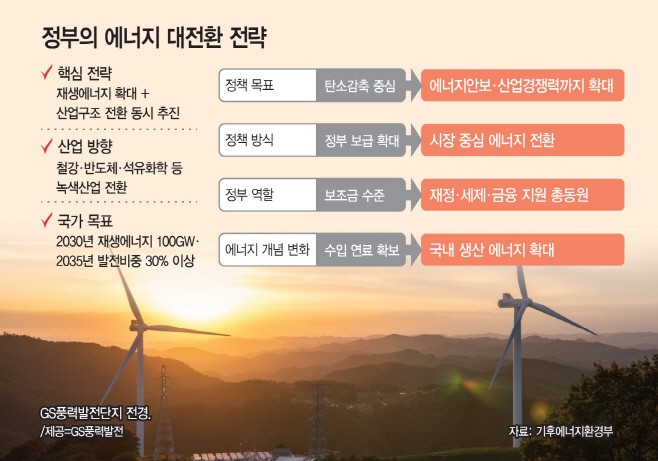
According to government and industry sources, the Ministry of Climate, Energy and Environment recently unveiled its first Basic Plan for Renewable Energy, targeting 100 gigawatts (GW) of renewable-energy capacity by 2030 and a renewable-energy share of more than 30% in electricity generation by 2035.
The government has redefined renewable energy not simply as a tool for reducing greenhouse-gas emissions but as a strategy to increase domestically produced energy and reduce dependence on imported fossil fuels. Rising concerns over oil and natural-gas supply disruptions following conflicts in the Middle East have reinforced the view that reducing energy imports is becoming a critical component of national competitiveness.
The policy approach is also evolving. While earlier initiatives focused primarily on expanding solar and wind installations, current plans emphasize broader industrial and market reforms. The government aims to simultaneously rebuild domestic solar and wind supply chains, expand energy storage systems (ESS), modernize power grids, introduce long-term fixed-price electricity contracts and lower renewable-energy generation costs.
Industry leaders increasingly view renewable-energy adoption as a business necessity rather than an option. Global corporations’ RE100 requirements and the implementation of the EU’s CBAM are creating direct challenges for South Korea’s export-driven manufacturing sector.
Despite the ambitious goals, significant obstacles remain.
South Korea’s renewable-energy generation share reached 9.1% in 2024, equivalent to 39.6 GW of capacity, falling short of the 11.4% target, or 42.6 GW, set under the fifth Basic Plan for Renewable Energy.
Cost competitiveness remains another challenge. Government estimates show that the levelized cost of electricity (LCOE) for solar power in South Korea is approximately 2.2 times higher than the global average, while onshore wind generation costs are roughly 3.2 times higher.
Structural issues, including soaring renewable energy certificate (REC) prices, grid congestion and permitting delays, have also contributed to a sharp decline in competitive solar-power auctions in recent years.
Experts argue that the success of the energy transition ultimately depends on market design rather than installation targets alone.
Son Jeong-rak, a professor at the Graduate School of Green Growth and Sustainability at KAIST, said policymakers must move beyond simply increasing solar and wind capacity.
“The key is creating a market structure in which businesses and citizens can naturally participate while realizing economic benefits,” he said.
Son added that South Korea’s energy-transition policies and its K-GX green industrial transformation initiative must work in tandem to achieve a successful transition.
“Because the burden on companies during the green industrial transformation process is substantial, the government must play a catalytic role through fiscal support and institutional reforms,” he said. “Building social consensus will also be essential.”
#renewable energy #carbon neutrality #energy transition #RE100 #CBAM
Copyright by Asiatoday
Most Read
-
1
Kia Sportage outperforms Mazda CX-5 in German auto..

-
2
Houthis launch successive attacks on Saudi airport..

-
3
Saudi Arabia, Iran hold first diplomatic talks to..

-
4
U.S. deploys carrier, 10,000 more troops to Middle..

-
5
Saudi airport in Riyadh struck again, leaving at l..

-
6
Putin's ally visits China on the 8th ahead of APEC..

-
7
Chinese military support and training center opens..

PEOPLE





HEADLINE NEWS

-
Address : In-Young Bldg., 34, Uisadang-daero 1-gil, Yeongdeungpo-gu, Seoul
Copyright by ASIATODAY CO., LTD. All rights resereved